Still have questions about our products?
Our scientists can help you choose the right assay format, substrate, and enzyme for your experiment.
Also known as: BLK proto-oncogene, Src family tyrosine kinase • MGC10442 • B lymphoid tyrosine kinase • B lymphocyte kinase • P55-BLK
.jpg?width=450&name=PhosphoSens%20Packaging%20C%20(3).jpg)
BLK (B lymphoid tyrosine kinase) is a non-receptor tyrosine kinase belonging to the Src family, which shares a conserved domain architecture comprising SH2, SH3, and catalytic SH1 domains. BLK is predominantly expressed in B lymphocytes and plays a critical role in B-cell receptor (BCR) signaling, proliferation, and differentiation. Upon BCR engagement, BLK is activated through Lyn-mediated transphosphorylation at its activation loop tyrosine (Y389) and dephosphorylation of its inhibitory C-terminal tyrosine by CD45 phosphatase. Key substrates include CD79a/b (Igα/Igβ), BLNK, and downstream effectors of the PI3K and MAPK cascades. BLK has emerging roles in pancreatic beta-cell function and insulin secretion regulation. Dysregulation of BLK is implicated in systemic lupus erythematosus (SLE), rheumatoid arthritis, type 1 diabetes, and B-cell malignancies including diffuse large B-cell lymphoma. Its restricted tissue expression makes BLK an attractive therapeutic target for autoimmune diseases and B-cell-driven cancers with a potentially favorable selectivity window.
Characterizing BLK inhibitors presents significant challenges: BLK shares high active-site homology with Src-family members LCK, LYN, and FYN, demanding sensitive selectivity profiling. Conventional endpoint assays such as ADP-Glo and HTRF require fixed ATP concentrations that obscure true kinetic constants, miss time-dependent inhibition, and cannot detect covalent or slow-binding mechanisms. Radiometric filters introduce quench artifacts and radioactive waste. AssayQuant's PhosphoSens CSox-based peptide substrates enable continuous, real-time fluorescence monitoring of BLK-mediated phosphorylation using physiological ATP concentrations, generating full progress curves that accurately capture Km(ATP), IC50, Ki, and covalent kinact/KI parameters. This approach eliminates endpoint variability, reduces assay steps, and enables rapid selectivity counter-screening across the Src family in a single-day workflow.
Have questions about BLK assay design, selectivity panels, or covalent inhibitor characterization?
Ask Our Scientists →Continuous, real-time fluorescent assays optimized for quantitative BLK activity measurements, IC50 determination, and mechanistic studies.
PhosphoSens-Kinetic assays directly quantify enzyme activity by continuously monitoring substrate phosphorylation or dephosphorylation in real time, generating a full progress curve in every well.
Learn more about PhosphoSens-Kinetic →Need pricing or availability? Select a kit or substrate to request a quote below.
Kits
Ready-to-use assay kits containing substrate and all essential reagents.
Automatically save 10% when bundling 10ug recombinant enzyme with your 1,000 assay kit. View enzymes
Substrate
Bulk PhosphoSens® substrate for assay development and high-throughput workflows.
Automatically save 10% when bundling Reagent Packs with your substrate. View Reagent Packs
Select a kit, substrate, or enzyme above. Our team will confirm pricing, availability, and any applicable bundle discounts.
Robust endpoint TRF assays optimized for high-throughput screening and quantitative BLK activity measurement in plate-based workflows.
PhosphoSens-Red assays use europium-based time-resolved fluorescence detection to enable robust, plate-based quantification of enzyme activity, making them well suited for high-throughput screening workflows.
Learn more about PhosphoSens-Red →Need pricing or availability? Select a kit or substrate to request a quote below.
Kits
Ready-to-use TRF assay kits containing substrate and essential reagents.
Automatically save 10% when bundling 10ug recombinant enzyme with your 1,000 assay kit. View enzymes
Substrate
Bulk substrate for PhosphoSens-Red TRF assays and high-throughput workflows.
Automatically save 10% when bundling Reagent Packs with your substrate. View Reagent Packs
Select a kit, substrate, or enzyme above. Our team will confirm pricing, availability, and any applicable bundle discounts.
Wild-type and mutant forms of BLK for assay development, kinase profiling, and mechanistic studies. Enzymes are supplied active and optimized for PhosphoSens® substrates.
Human • Baculovirus-Insect Cells
Price: $$348.00
AssayQuant offers PhosphoSens CSox-based peptide substrates optimized for Src-family tyrosine kinases, including substrates derived from CD79a ITAM sequences that are efficiently phosphorylated by BLK. These substrates incorporate a chelation-enhanced fluorophore that ratiometrically reports phosphorylation in real time, enabling continuous kinetic measurements without antibodies or secondary detection reagents.
Yes. Because PhosphoSens assays run continuously under identical physiological ATP conditions, you can directly compare kinetic parameters (kcat/Km, IC50, Ki) for BLK versus LCK, LYN, FYN, and SRC in parallel wells on the same plate. This eliminates normalization artifacts that arise when comparing endpoint assays run at different ATP concentrations, making selectivity profiling across the Src family quantitatively reliable.
Full real-time progress curves generated by PhosphoSens directly reveal time-dependent inhibition signaturesu2014such as curved progress lines or progressive enzyme inactivationu2014that are completely invisible to endpoint ADP-Glo or HTRF readouts. kinact and KI values for covalent inhibitors can be extracted directly from progress curve analysis using established kinetic models, enabling accurate characterization of irreversible or slowly reversible BLK inhibitor candidates.
Explore data and documents to support your kinase and phosphatase experiments. Download sample data, protocols and other resources to see how our assays perform and to help you get started in your own lab. All validation data generated using PhosphoSens® assays under recommended conditions.
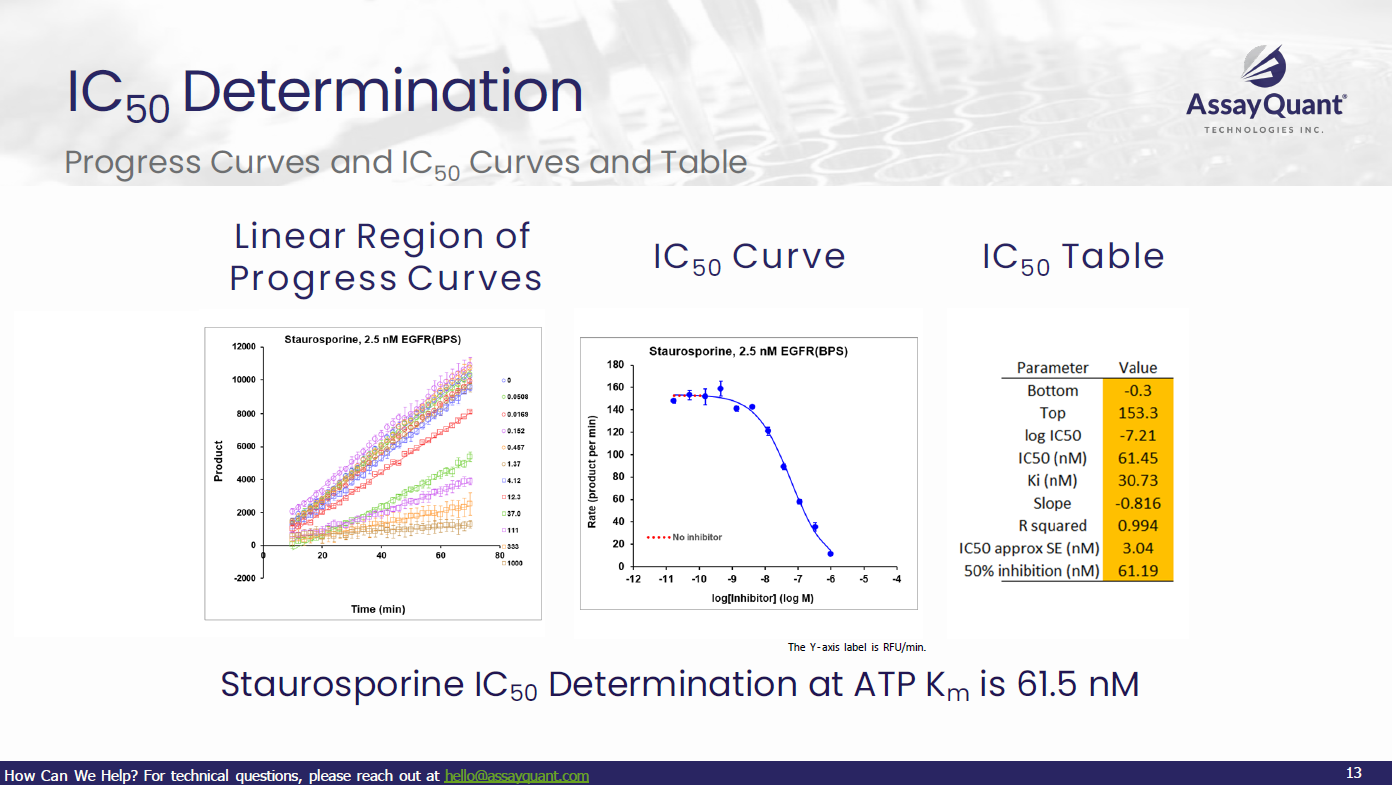
Each validation report provides experimental conditions and data showing:
Protocol
See how the PhosphoSens-Kinetic Assay can be used to find the IC50 of a kinase inhibitor.
Download Protocol →Webinar
Discover how continuous assay formats power deep understanding of kinase function. See how PhosphoSens® assays guide inhibitor profiling, selectivity assessment, and mechanistic characterization.
Watch the Webinar →Service
Need broader selectivity data? KinSight profiling runs your compounds across our full kinase panel under identical PhosphoSens conditions.
Learn about KinSight →Want to hear the latest about our technology? Be among the first to learn about our latest products and services.