Continuous, real-time assays that directly quantify ALK catalytic activity — generating a full progress curve in every well for IC₅₀, mechanism, and selectivity studies.
Real-time kinetic or TRF endpoint formats
Optimized substrates and assay-ready kits
Compatible with physiological ATP and cofactors
Designed for: drug discovery, lead optimization, and mechanistic kinase research teams
ALK (Anaplastic Lymphoma Kinase) is a receptor tyrosine kinase belonging to the insulin receptor superfamily and the ALK/LTK subfamily. Under physiological conditions, ALK is activated by its ligands ALKAL1 and ALKAL2, triggering autophosphorylation at key tyrosine residues (Y1278, Y1282, Y1283) within the activation loop and subsequent downstream signaling. Key substrates include IRS-1, SHC, and STAT3, driving activation of RAS/MAPK, PI3K/AKT, and JAK/STAT pathways that regulate cell proliferation, survival, and differentiation. In cancer, ALK is aberrantly activated through chromosomal translocations producing fusion oncoproteins — most notably EML4-ALK in non-small cell lung cancer (NSCLC) — as well as point mutations and gene amplification seen in anaplastic large cell lymphoma (ALCL), neuroblastoma, and inflammatory myofibroblastic tumors. These oncogenic alterations make ALK one of the most clinically validated and therapeutically actionable kinase targets in oncology, with multiple generations of ALK inhibitors approved and in active clinical development.
Why PhosphoSens for ALK?
Developing ALK inhibitors presents several assay challenges: ALK fusion proteins require careful construct selection to capture relevant oncogenic activity, while resistance mutations (e.g., L1196M, G1269A) demand sensitive assays that distinguish subtle potency shifts. Endpoint assays such as ADP-Glo and HTRF require quench steps that introduce timing artifacts and miss transient inhibition kinetics critical for covalent or slow-binding inhibitors. Radiometric formats add safety and throughput burdens. AssayQuant's PhosphoSens CSox-based continuous assay monitors ALK-mediated substrate phosphorylation in real time at physiological ATP concentrations, generating full kinetic progress curves. This enables precise Km(ATP) determinations for better cellular translation, accurate IC50 measurements unaffected by endpoint timing, and direct kinact/KI measurement for covalent inhibitors — all in a homogeneous, no-antibody, mix-and-read format compatible with high-throughput screening.
PhosphoSens-Kinetic assays directly quantify enzyme activity by continuously
monitoring substrate phosphorylation or dephosphorylation in real time,
generating a full progress curve in every well.
PhosphoSens-Red assays use europium-based time-resolved fluorescence detection
to enable robust, plate-based quantification of enzyme activity, making them
well suited for high-throughput screening workflows.
Need pricing or availability? Select a kit or substrate to request a quote below.
Kits
PhosphoSens-Red Kinase Activity Kit - AQT0653
Ready-to-use TRF assay kits containing substrate and essential reagents.
Kit Contents
Optimized PhosphoSens® substrate (AQT0653)
ATP, DTT, EGTA, Reaction Buffer & Dilution Buffer
Europium Detection Solution
Automatically save 10% when bundling 10ug recombinant enzyme with your 1,000 assay kit.
View enzymes
Price: $455
Substrate
PhosphoSens Kinase Substrate AQT0653
Bulk substrate for PhosphoSens-Red TRF assays and high-throughput workflows.
Specifications
Automatically save 10% when bundling Reagent Packs with your substrate.
View Reagent Packs
Price: $2795
Ready to request pricing for ALK?
Select a kit, substrate, or enzyme above. Our team will confirm pricing, availability, and any applicable bundle discounts.
Active Recombinant Enzymes for ALK
Wild-type and mutant forms of ALK for assay development, kinase profiling, and mechanistic studies.
Enzymes are supplied active and optimized for PhosphoSens® substrates.
Purity/Activity: For specific information on a given lot, see related technical data sheet.
Storage Conditions: Store product at -70°C. For optimal storage, aliquot target into smaller quantities after centrifugation and store at recommended temperature. For most favorable performance, avoid repeated handling and multiple freeze/thaw cycles.
Purity/Activity: For specific information on a given lot, see related technical data sheet.
Storage Conditions: Store product at -70°C. For optimal storage, aliquot target into smaller quantities after centrifugation and store at recommended temperature. For most favorable performance, avoid repeated handling and multiple freeze/thaw cycles.
Purity/Activity: For specific information on a given lot, see related technical data sheet.
Storage Conditions: Store product at -70°C. For optimal storage, aliquot target into smaller quantities after centrifugation and store at recommended temperature. For most favorable performance, avoid repeated handling and multiple freeze/thaw cycles.
Purity/Activity: For specific information on a given lot, see related technical data sheet.
Storage Conditions: Store product at -70°C. For optimal storage, aliquot target into smaller quantities after centrifugation and store at recommended temperature. For most favorable performance, avoid repeated handling and multiple freeze/thaw cycles.
Purity/Activity: For specific information on a given lot, see related technical data sheet.
Storage Conditions: Store product at -70°C. For optimal storage, aliquot target into smaller quantities after centrifugation and store at recommended temperature. For most favorable performance, avoid repeated handling and multiple freeze/thaw cycles.
Purity/Activity: For specific information on a given lot, see related technical data sheet.
Storage Conditions: Store product at -70°C. For optimal storage, aliquot target into smaller quantities after centrifugation and store at recommended temperature. For most favorable performance, avoid repeated handling and multiple freeze/thaw cycles.
Purity/Activity: For specific information on a given lot, see related technical data sheet.
Storage Conditions: Store product at -70°C. For optimal storage, aliquot target into smaller quantities after centrifugation and store at recommended temperature. For most favorable performance, avoid repeated handling and multiple freeze/thaw cycles.
Purity/Activity: For specific information on a given lot, see related technical data sheet.
Storage Conditions: Store product at -70°C. For optimal storage, aliquot target into smaller quantities after centrifugation and store at recommended temperature. For most favorable performance, avoid repeated handling and multiple freeze/thaw cycles.
Purity/Activity: For specific information on a given lot, see related technical data sheet.
Storage Conditions: Store product at -70°C. For optimal storage, aliquot target into smaller quantities after centrifugation and store at recommended temperature. For most favorable performance, avoid repeated handling and multiple freeze/thaw cycles.
Purity/Activity: For specific information on a given lot, see related technical data sheet.
Storage Conditions: Store product at -70°C. For optimal storage, aliquot target into smaller quantities after centrifugation and store at recommended temperature. For most favorable performance, avoid repeated handling and multiple freeze/thaw cycles.
Purity/Activity: For specific information on a given lot, see related technical data sheet.
Storage Conditions: Store product at -70°C. For optimal storage, aliquot target into smaller quantities after centrifugation and store at recommended temperature. For most favorable performance, avoid repeated handling and multiple freeze/thaw cycles.
Purity/Activity: For specific information on a given lot, see related technical data sheet.
Storage Conditions: Store product at -70°C. For optimal storage, aliquot target into smaller quantities after centrifugation and store at recommended temperature. For most favorable performance, avoid repeated handling and multiple freeze/thaw cycles.
Purity/Activity: For specific information on a given lot, see related technical data sheet.
Storage Conditions: Store product at -70°C. For optimal storage, aliquot target into smaller quantities after centrifugation and store at recommended temperature. For most favorable performance, avoid repeated handling and multiple freeze/thaw cycles.
Purity/Activity: For specific information on a given lot, see related technical data sheet.
Storage Conditions: Store product at -70°C. For optimal storage, aliquot target into smaller quantities after centrifugation and store at recommended temperature. For most favorable performance, avoid repeated handling and multiple freeze/thaw cycles.
Purity/Activity: For specific information on a given lot, see related technical data sheet.
Storage Conditions: Store product at -70°C. For optimal storage, aliquot target into smaller quantities after centrifugation and store at recommended temperature. For most favorable performance, avoid repeated handling and multiple freeze/thaw cycles.
Available Sizes:
Price: $$338.00
🔬 150+ peer-reviewed citations·🏛️ MIT spinout technology·⚗️ PhosphoSens® validated by independent labs worldwide·Browse technical articles →
Frequently Asked Questions: ALK Assays
What substrate does AssayQuant use for ALK kinase assays?
AssayQuant offers PhosphoSens peptide substrates optimized for ALK catalytic activity, derived from validated ALK phosphorylation sites. These Sox-based substrates produce a direct fluorescent signal upon phosphorylation, eliminating the need for antibodies or secondary detection reagents and enabling continuous real-time monitoring of kinase activity.
Can the PhosphoSens ALK assay measure inhibitor kinact/KI for covalent inhibitors?
Yes. Because PhosphoSens generates continuous fluorescent progress curves, time-dependent inhibition and covalent inactivation kinetics can be directly resolved from a single experiment. This allows straightforward determination of kinact and KI parameters that endpoint assays fundamentally cannot provide without laborious multi-timepoint designs.
How does physiological ATP concentration impact ALK inhibitor IC50 measurements?
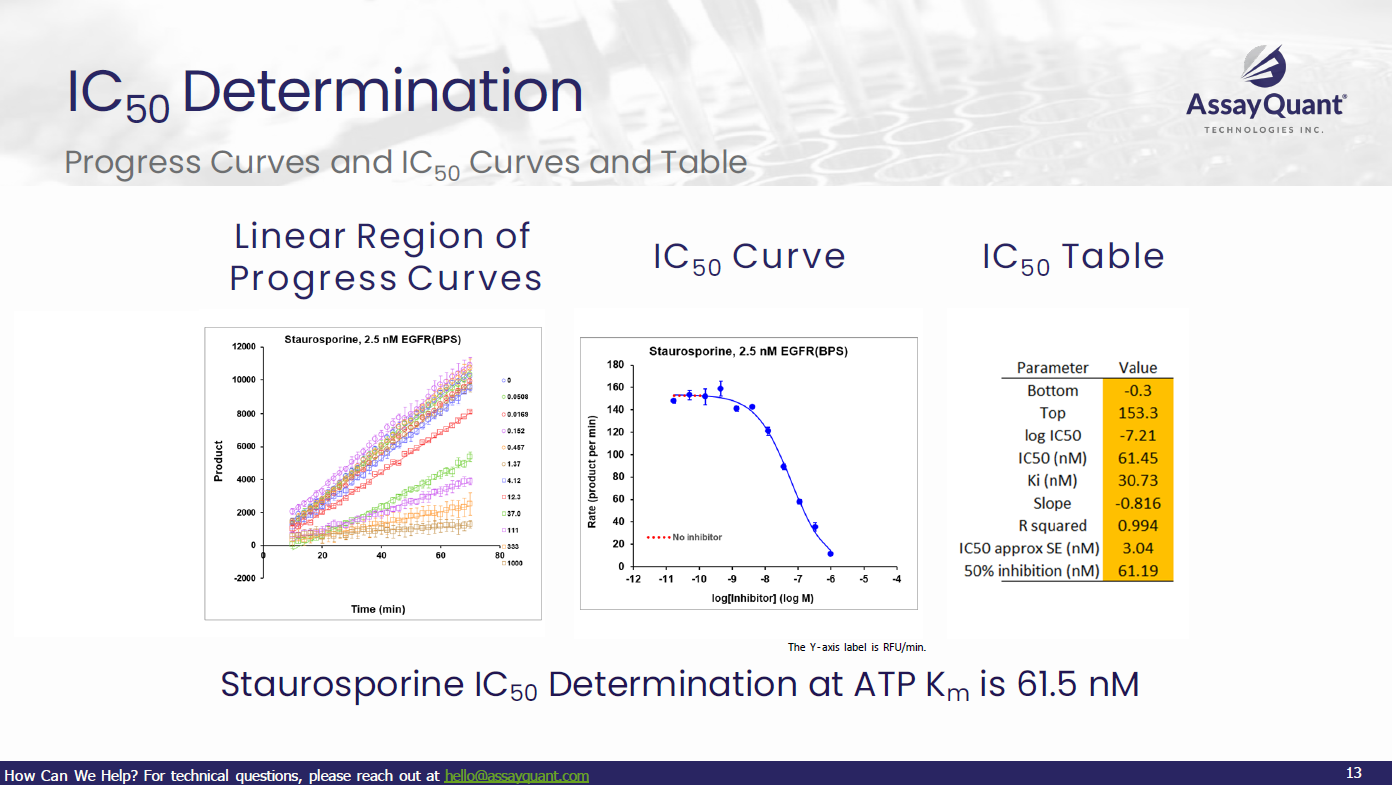
Most ATP-competitive ALK inhibitors show strong ATP-competitive behavior, meaning IC50 values shift significantly with ATP concentration. By running assays at or near the cellular ATP Km, PhosphoSens provides IC50 values with greater predictive power for cellular and in vivo potency, avoiding the systematic underestimation of potency common with artificially low ATP conditions used in some endpoint formats.
Data & Resources
Explore data and documents to support your kinase and phosphatase experiments. Download sample
data, protocols and other resources to see how our assays perform and to help you get started in your own lab.
All validation data generated using PhosphoSens® assays under recommended conditions.
Discover how continuous assay formats power deep understanding of kinase function. See how
PhosphoSens® assays guide inhibitor profiling, selectivity assessment, and
mechanistic characterization.
.jpg?width=450&name=PhosphoSens%20Packaging%20C%20(3).jpg)