SERVICES

Kinase and Phosphatase Compound Testing Services

Flexible and customizable compound testing services with quick turnaround time.

AssayQuant's compound testing services provide the flexibility to meet your needs, including a variety of compound potency measurements and the option for preincubations, comparison of ATP at the Km app or 1 mM, and analysis with recombinant enzyme or crude cell lysates.

560+

Protein kinases available

48+

Protein phosphatases available

n=2

All assays run in duplicate

2 formats

Recombinant enzyme or crude cell/tissue lysate

A single IC50 number can hide the mechanism behind it

Two compounds can post nearly identical IC50 values and still behave completely differently at the target — one reversible and fast-equilibrating, one slow-binding, one covalent. An endpoint read can't tell those apart. Because PhosphoSens® captures the full reaction progress curve in every well, a single-target run gives you potency and the kinetic behavior underneath it — reversibility, time-dependence, and mode of inhibition — from one experiment instead of several.

How KinSight Services Work

  1. 1

    Target & format selection

    Tell us the target — wild-type or a specific resistance mutant — and whether recombinant enzyme or a crude cell/tissue lysate best represents your biology. Choose ATP at the apparent Km or 1 mM physiological conditions.

  2. 2

    Continuous kinetic measurement, not a single frame

    An endpoint read captures one moment after the reaction has already stopped — like judging a movie from a single frame. PhosphoSens® instead monitors every well throughout the entire reaction, so what you get is the full sequence, not a still.

  3. 3

    Kinetics that separate compounds an endpoint can't

    Two compounds can show nearly identical inhibition at a single timepoint and still be doing very different things underneath — one fast and reversible, one slow and time-dependent, one covalent. KinSight's progress-curve analysis resolves that difference directly, flagging TDI, slow-binding behavior, and mechanism-of-action signals that a single % inhibition value collapses into one indistinguishable number.

  4. 4

    Reporting built for a decision, not just a data pull.

    Dose-response curves, fitted parameters, and raw progress-curve data for every well, reviewed by our scientists before delivery — standard turnaround of 7 business days.

What's in your data package?

  • Waterfall plots ranked by % inhibition across all targets
  • Annotated kinome tree visualization
  • Tabular % inhibition data export
  • Progress curves for every well (not just endpoint)
  • TDI, slow-binding, and unusual kinetics flagged by scientists
  • MOA insights and selectivity score summary

Standard turnaround: 2 weeks

Rush timelines available on request. No minimum compound quantity required for feasibility discussion.

Start Your Project

Choose the determination that matches your question

IC50 & Ki

12-point dose-response against a single target, wild-type or mutant, with BSA or DTT, at ATP Km or 1 mM, against recombinant enzyme or crude lysate. Ki is derived from the same kinetic dataset when a condition-independent inhibition constant is needed — for comparing potency across assays run at different ATP concentrations.

EC50

Potency of compounds that activate rather than inhibit a target, for programs working with target-activating chemical matter. Same 12-point dose-response format, fit to an activation curve.

Time-Dependent Inhibition (TDI) Characterization

Some inhibitors don't hit equilibrium and stay there — their potency keeps shifting the longer they sit on the target. KinSight™ TDI resolves that behavior directly: reversibility, residence time, and inactivation efficiency from one continuous PhosphoSens® run, not a guess from a shifting IC50.

Learn more

Don't See the Right Fit?

Work directly with our scientists to design an experiment around your program's specific targets and needs. 

PLATFORM COMPARISON

Activity vs. Binding vs. Endpoint: Know What You're Actually Measuring

Most biochemical kinase and phosphatase assays platforms compress an entire enzyme reaction into a single number at one timepoint. KinSight measures the full reaction in real time — revealing not just which kinases are inhibited, but how and how confidently.

Features KinSight Competition Binding Radiometric Assay
Measures kinase activityActual enzyme velocity, not an indirect signal
Real-time progress curve per wellFull reaction trajectory, not a single endpoint read
Detects TDI & slow-binding inhibitorsInvisible to endpoint assays
Built-in reaction QC per wellCurve shape reveals artifacts and interference
Versatile ATP concentrationsATP Km for potency, 1 mM for physiological relevance Partial
Native peptide sequencesDerived from authentic biological substrates Varies
Expert MOA annotation in reportScientists flag TDI, unusual kinetics, liabilities

* "Detects TDI & slow-binding inhibitors" requires a continuous readout by definition — time-dependent inhibition is a kinetic phenomenon that collapses to a single value at any endpoint read. "ATP Km conditions (Partial)" indicates some ATP concentration flexibility, but not true enzyme-specific Km as standard. "Optimized substrate (Varies)" reflects that substrate selection and quality varies across kinases on those platforms. KINOMEscan (Eurofins/DiscoverX) measures binding displacement, not catalytic activity — a fundamentally different biological question.

What This Looks Like In Practice

True initial rates, no artifacts

Calculated from the linear region of the curve, before drift or degradation distort the signal.

TDI and slow-binding detection

Time-dependent inhibition shows up as curvature — invisible at a single endpoint.

Physiologically relevant ATP

Profile at ATP Km, 1 mM, or both — not locked to one concentration.

Kinetic selectivity, not rank order

Distinguishes competitive, slow-binding, and irreversible inhibitors across the panel.

Continuous profiling does more than rank kinases by % inhibition.

It reveals whether the assay is linear, curvy, delayed, or time-dependent — that's the difference between data you can act on and data that looks right until it isn't.

See What Continuous Profiling Reveals That Endpoints Miss →

Examples of Enzyme Inhibitor Assessments Offered as Custom Service

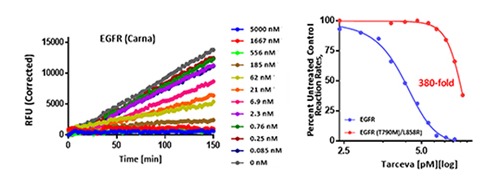
A. IC50 Determination for Tarceva (reversible) with EGFR and EGFR T790M/L858R
Enzyme_Inhibitor

Determination of reaction rates at each inhibitor concentration showing 380-fold decrease in potency with the EGFR T790M/L858R mutant resulting in drug resistance.

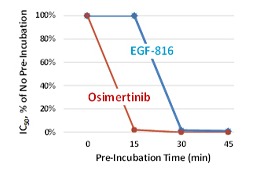
B. Pre-Incubation Time vs. Inhibitor Potency for Covalent Compounds with EGFR T790M/L858R
Enzyme_Inhibitor-1

Osimertinib (AZ) showing faster kinetics of inactivation than EGF-816 (Novartis).

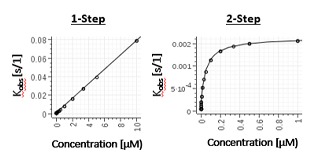
C. Kobs vs. [1], Kinact/KI for Covalent Inhibitors
Enzyme_Inhibitor-2

1-step vs. 2-step covalent inhibitor mechanism.

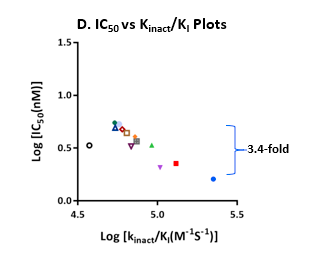
D. IC50 vs kinact/KI Plots
ic50-vs-kinact-ki-plots

13 inhibitors with IC50 values in a 3.4-fold range (1.6 - 5.5nM) are differentiated with kinact/KI.

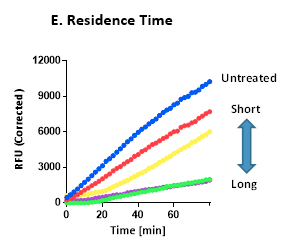
E. Residence Time
residence-time

Jump-dilution method for determination of Residence Time (Tau) for receptor or soluble tyrosine kinases with values ranging from 8.3 min (0/14h) to 1,149 (19.2 h). Due to the high precision of the platform, can detect values from 30 sec to 2 days.
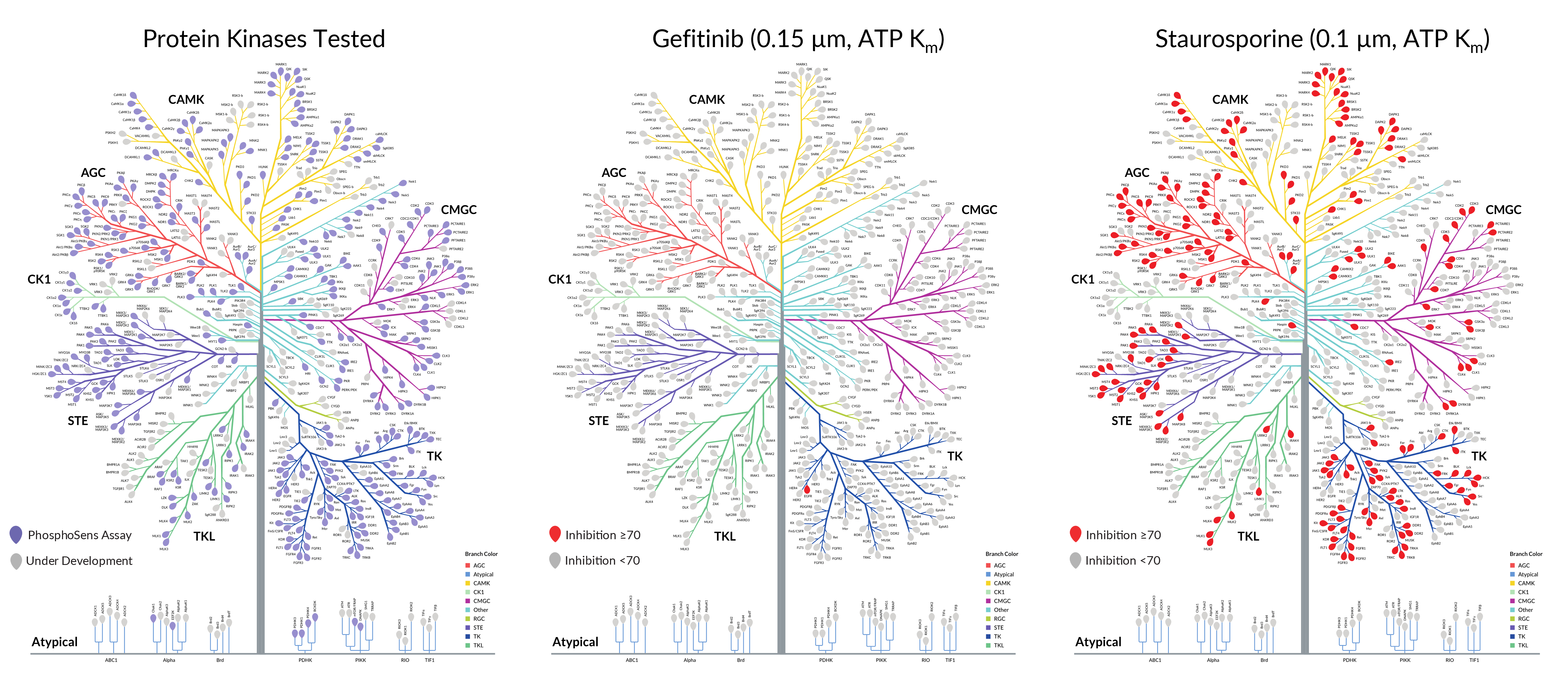

F. KinSight Kinome Profiling With a Panel of 400+ Wild-Type Kinases Providing Kinetic Insights into Selectivity and Mechanism of Action

kinsight kinome profiling 400 wild-type kinases

Stay Informed

Want to hear the latest about our technology? Be among the first to learn about our latest products and services.