Still have questions about our products?
Our scientists can help you choose the right assay format, substrate, and enzyme for your experiment.
Also known as: SRC proto-oncogene, non-receptor tyrosine kinase • ASV • SRC1 • c-SRC • p60-Src
.jpg?width=450&name=PhosphoSens%20Packaging%20C%20(3).jpg)
SRC is the founding member of the Src family kinases (SFKs), a group of non-receptor tyrosine kinases that includes YES1, FYN, LCK, HCK, BLK, LYN, FGR, and ZAP70. SRC is regulated by an intramolecular autoinhibitory mechanism in which phosphorylation of Y527 by CSK stabilizes a closed, inactive conformation, while dephosphorylation or displacement of the SH2 and SH3 domains promotes activation and autophosphorylation at Y416. Key substrates include FAK, paxillin, p130CAS, STAT3, and cortactin, linking SRC to integrin signaling, cytoskeletal remodeling, cell proliferation, survival, and migration. SRC sits at the convergence of RTK, GPCR, and integrin pathways, amplifying signals from EGFR, VEGFR, and HER2. Overexpression or hyperactivation of SRC occurs in breast, colorectal, lung, pancreatic, and gastric cancers, as well as in hematologic malignancies. Because SRC activity is frequently elevated without mutation, it represents a compelling drug target for combination oncology strategies and resistance mechanism studies.
SRC assays are challenged by its broad substrate promiscuity, sensitivity to DMSO, and the need to discriminate true kinase inhibition from substrate competition artifacts common in endpoint formats. ADP-Glo and HTRF measure single timepoints and miss biphasic kinetics that arise from SRC autophosphorylation or allosteric modulator effects. Radiometric assays require isotope handling and cannot distinguish covalent from reversible inhibitors in real time. PhosphoSens continuous fluorescent assays use the CSox-based peptide substrate to generate full progress curves at physiological ATP concentrations (Km ATP), enabling accurate Ki, IC50, and kinact/KI determination for covalent and irreversible-acting compounds. Real-time monitoring detects hook effects, substrate depletion, and inhibitor time-dependency that endpoint methods obscure, dramatically improving hit quality and SAR fidelity in SRC drug discovery campaigns.
Have questions about SRC assay design, selectivity panels, or covalent inhibitor characterization?
Ask Our Scientists →Continuous, real-time fluorescent assays optimized for quantitative SRC activity measurements, IC50 determination, and mechanistic studies.
PhosphoSens-Kinetic assays directly quantify enzyme activity by continuously monitoring substrate phosphorylation or dephosphorylation in real time, generating a full progress curve in every well.
Learn more about PhosphoSens-Kinetic →Need pricing or availability? Select a kit or substrate to request a quote below.
Kits
Ready-to-use assay kits containing substrate and all essential reagents.
Automatically save 10% when bundling 10ug recombinant enzyme with your 1,000 assay kit. View enzymes
Substrate
Bulk PhosphoSens® substrate for assay development and high-throughput workflows.
Automatically save 10% when bundling Reagent Packs with your substrate. View Reagent Packs
Select a kit, substrate, or enzyme above. Our team will confirm pricing, availability, and any applicable bundle discounts.
Robust endpoint TRF assays optimized for high-throughput screening and quantitative SRC activity measurement in plate-based workflows.
PhosphoSens-Red assays use europium-based time-resolved fluorescence detection to enable robust, plate-based quantification of enzyme activity, making them well suited for high-throughput screening workflows.
Learn more about PhosphoSens-Red →Need pricing or availability? Select a kit or substrate to request a quote below.
Kits
Ready-to-use TRF assay kits containing substrate and essential reagents.
Automatically save 10% when bundling 10ug recombinant enzyme with your 1,000 assay kit. View enzymes
Substrate
Bulk substrate for PhosphoSens-Red TRF assays and high-throughput workflows.
Automatically save 10% when bundling Reagent Packs with your substrate. View Reagent Packs
Select a kit, substrate, or enzyme above. Our team will confirm pricing, availability, and any applicable bundle discounts.
Wild-type and mutant forms of SRC for assay development, kinase profiling, and mechanistic studies. Enzymes are supplied active and optimized for PhosphoSens® substrates.
Rous Sarcoma Virus • Baculovirus-Insect Cells
Price: $$348.00
We recommend running SRC assays at the Km ATP for SRC (typically 50-150 uM) to generate physiologically relevant IC50 values that better predict cellular potency. Using PhosphoSens continuous kinetics, you can directly observe substrate phosphorylation progress curves and confirm linear velocity before calculating inhibition constants, avoiding the errors introduced by endpoint assays run outside the linear range.
Yes. PhosphoSens real-time progress curves directly reveal time-dependent inhibition characteristic of covalent or slowly reversible compounds by showing a progressive decrease in reaction rate over time. This allows straightforward kinact/KI determination by fitting progress curves at multiple inhibitor concentrations, a measurement impossible with single-timepoint ADP-Glo or HTRF formats.
Because PhosphoSens monitors fluorescence continuously, any assay artifacts introduced by DMSO concentrations above 1% or detergent carry-over are immediately visible as anomalous progress curve shapes rather than silent errors in a single endpoint read. We recommend validating compound solubility conditions using no-enzyme controls run in parallel, and the continuous format allows real-time identification and exclusion of aggregator or nuisance compound behavior.
Explore data and documents to support your kinase and phosphatase experiments. Download sample data, protocols and other resources to see how our assays perform and to help you get started in your own lab. All validation data generated using PhosphoSens® assays under recommended conditions.
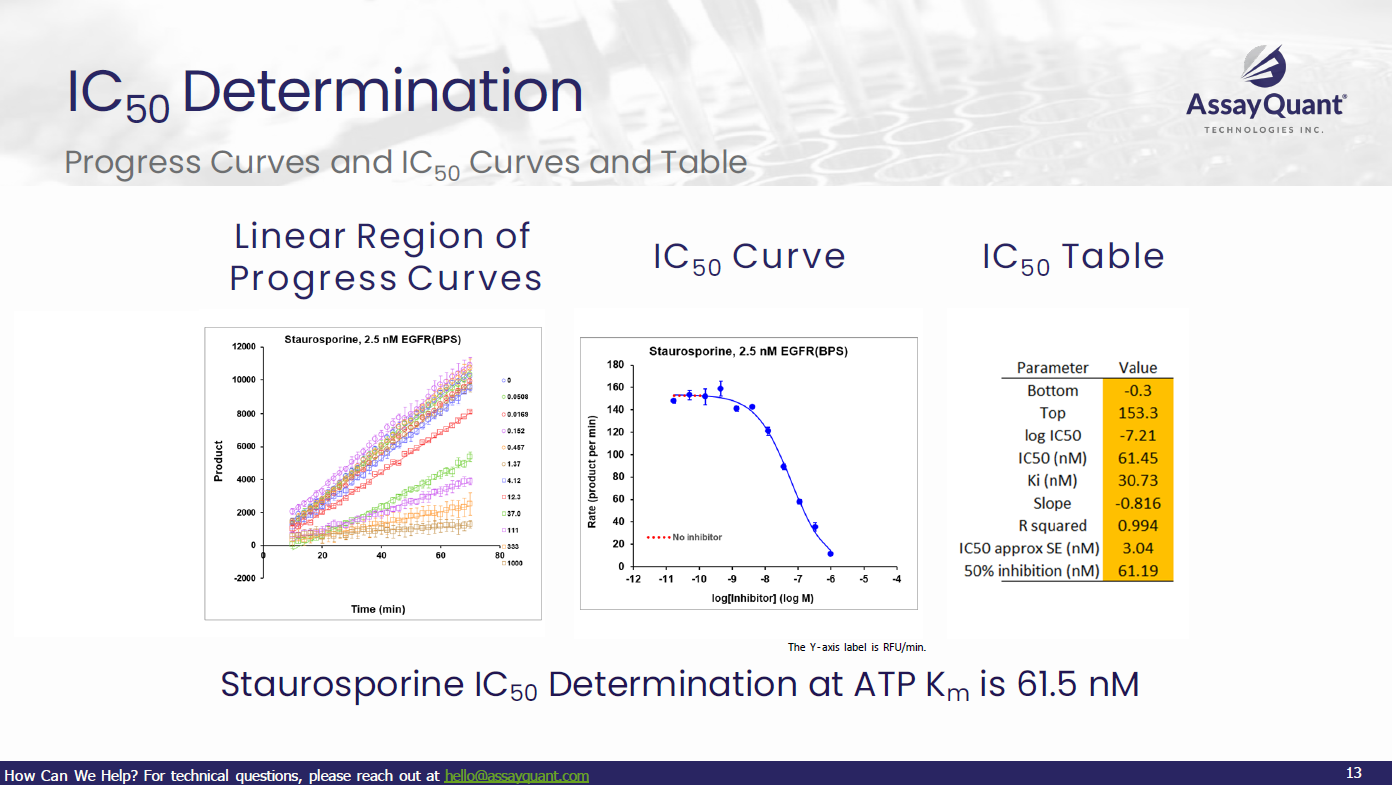
Each validation report provides experimental conditions and data showing:
Protocol
See how the PhosphoSens-Kinetic Assay can be used to find the IC50 of a kinase inhibitor.
Download Protocol →Webinar
Discover how continuous assay formats power deep understanding of kinase function. See how PhosphoSens® assays guide inhibitor profiling, selectivity assessment, and mechanistic characterization.
Watch the Webinar →Service
Need broader selectivity data? KinSight profiling runs your compounds across our full kinase panel under identical PhosphoSens conditions.
Learn about KinSight →Want to hear the latest about our technology? Be among the first to learn about our latest products and services.