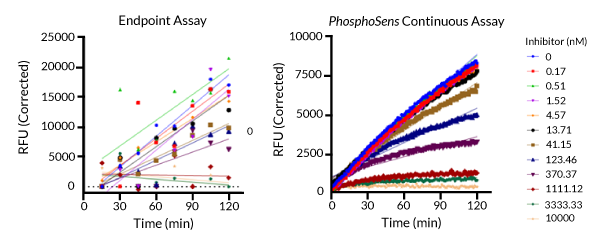

PhosphoSens-Kinetic Enzyme Activity Assays
PhosphoSens-Kinetic assays directly quantify catalytic activity of kinase or phosphatase targets using continuous real-time measurement of substrate phosphorylation or dephosphorylation.
Every well delivers a complete progress curve — simple, add-and-read workflow with high-fidelity kinetic data for more confident decision-making.
Assay Principle & Workflow
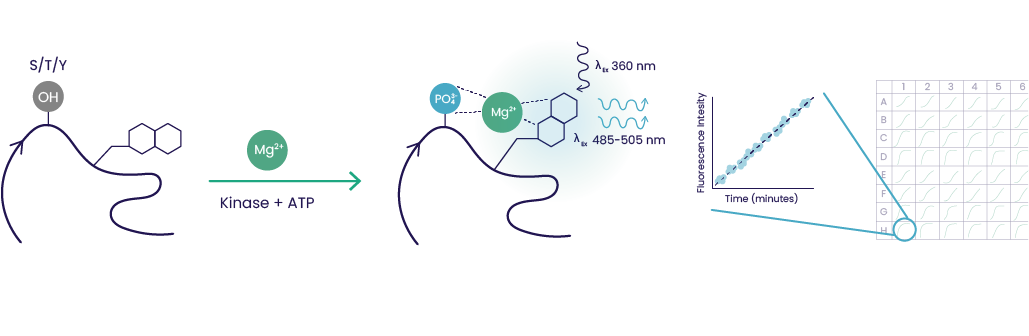
PhosphoSens assays leverages AssayQuant’s Proprietary Detection Technology to provide real-time, continuous measurements of kinase activity by directly detecting substrate phosphorylation throughout the kinase reaction.
Sensor Peptide Substrates are developed with the Sox readout molecule, covalently attached via a cysteine residue in close proximity to the phosphorylation site (± 2-5 residues).
As the kinase acts on the substrate, phosphorylation induces a chelation‑enhanced fluorescence (ChEF) signal proportional to phosphorylation level.

Add
Active enzyme is added to reaction mix containing a Sensor Peptide Substrate, catalyzing phosphotransfer from ATP to the substrate in real time.
Read
Add plate to reader and monitor kinase activity throughout the reaction. Signal is directly proportional to the phosphorylation level of the substrate.
Revolutionizing Kinase Research and Drug Development with Continuous Activity Assays
Continuous, Real-Time Monitoring
Directly observe catalytic activity throughout the reaction — no quench steps, no lag-phase ambiguity, and no reliance on artifacts from single-timepoint reads.
Streamlined, Homogeneous Workflow
Add reagents → Read continuously. No wash steps, coupling reactions, or specialized detection equipment needed.
Reproducible, High-Quality Data
Continuous curves reduce variability and improve statistical power for hit validation, SAR, and mechanistic characterization.
Physiologically Relevant Conditions
Peptide substrates derived from biologically relevant sequences. Compatible with low to physiological [mM] concentrations of ATP and native co-factors.
Direct Measurement of Enzyme Activity
Phosphorylation or dephosphorylation of the Sensor Peptide generates the fluorescent signal. No antibodies or secondary enzymes needed.
What Continuous Profiling Reveals That Endpoints Miss
AssayQuant’s Quartet: Same Endpoint, Different Story
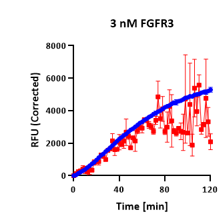
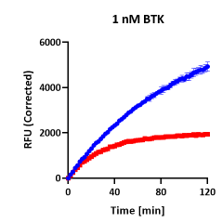
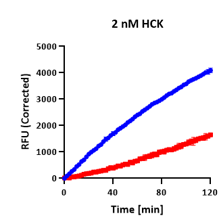
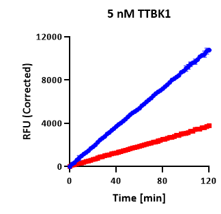
In a comparative example, four kinases — TTBK1, FGFR3, BTK, and HCK — each appeared to show ~60–65% inhibition in a standard endpoint assay.
Each mechanism produces similar endpoint values — yet radically different kinetics and implications for inhibitor optimization.
On paper, they look the same, but continuous progress curves tell a very different story:
| Target | % Inhibition |
| TTBK1 | 65% |
| FGFR3 | 61% |
| BTK | 61% |
| HCK | 60% |

Distinguishing Kinetic from Lysate Mode
PhosphoSens-Kinetic = Recombinant Enzyme Format
Designed for purified recombinant kinases and phosphatases, enabling precise enzymology and inhibitor characterization.
PhosphoSens-Lysate = Endogenous Activity Format
PhosphoSens-Lysate adapts the Kinetic detection principle to measure activity in complex biological samples.
Browse Recombinant Enzyme Assay Catalogs
Browse Our Catalog Of 500+ Protein Kinase Activity Assays To Find The Right PhosphoSens Products For Your Experiments
Explore Our Catalog Of 35+ Protein Phosphatase Activity Assays And Discover Your Next Phosphatase Assay Technology
Understand How Our Technology Can Support Your Next Discovery
Deep Kinetic Characterization: When IC50 Isn't Enough
A continuous assay, like our PhosphoSens assay, that measures the catalytic event of phosphorylation in real time enables determination of kinetic parameters that power your drug discovery research.
Continuous vs. Endpoint Kinase Assays: What You Need to Know
PhosphoSens-Kinetic Kinase Inhibitor IC50 Determination
Stay Informed
Want to hear the latest about our technology? Be among the first to learn about our latest products and services.