Still have questions about our products?
Our scientists can help you choose the right assay format, substrate, and enzyme for your experiment.
Also known as: calcium/calmodulin dependent protein kinase IV • brain Ca++-calmodulin-dependent protein kinase type IV • CAM kinase IV • CaMK-GR • MGC36771 • CAM kinase-GR • CaMK IV • KCC4 • Calspermin
.jpg?width=450&name=PhosphoSens%20Packaging%20C%20(3).jpg)
CAMK4 (Calcium/Calmodulin-Dependent Protein Kinase IV) belongs to the CAMK1 family of serine/threonine kinases and functions as a critical nuclear effector of calcium signaling. Upon intracellular calcium elevation, calmodulin binds and partially activates CAMK4, with full activation requiring phosphorylation by upstream kinases CaMKK1 or CaMKK2. Key substrates include CREB (Ser133), MEF2 transcription factors, HDAC4/5, and DARPP-32, linking CAMK4 to transcriptional regulation, synaptic plasticity, and chromatin remodeling. CAMK4 is predominantly expressed in neurons, T lymphocytes, and testes, placing it at the intersection of neurological function and immune regulation. Dysregulation of CAMK4 is implicated in systemic lupus erythematosus (SLE), multiple sclerosis, autoimmune nephritis, Alzheimer's disease, and various cancers including hepatocellular carcinoma. Its selective nuclear localization and distinct substrate profile from the cytoplasmic CAMK1/2 isoforms make CAMK4 an attractive therapeutic target for autoimmune diseases and neurodegeneration, with growing interest in isoform-selective inhibitor development.
CAMK4 presents several assay challenges: it requires co-activation by calmodulin and calcium, making endpoint assays that consume ATP problematic, and its low basal activity means signal-to-noise is critical. ADP-Glo and HTRF endpoint formats miss the kinetic complexity of calmodulin-dependent activation and can produce artifacts when calmodulin or calcium concentrations are varied across compound screens. Radiometric assays offer sensitivity but are incompatible with real-time mechanistic studies. AssayQuant's PhosphoSens technology uses a chelation-enhanced fluorescent (CHEF) peptide substrate to continuously monitor CAMK4 phosphorylation in real time under physiological ATP concentrations (Km ATP). This enables accurate Ki and kinact/KI determination for covalent inhibitors, captures full progress curves across calmodulin titrations, and eliminates endpoint selection bias — providing richer kinetic data at higher throughput without radioactivity.
Have questions about CAMK4 assay design, selectivity panels, or covalent inhibitor characterization?
Ask Our Scientists →Continuous, real-time fluorescent assays optimized for quantitative CAMK4 activity measurements, IC50 determination, and mechanistic studies.
PhosphoSens-Kinetic assays directly quantify enzyme activity by continuously monitoring substrate phosphorylation or dephosphorylation in real time, generating a full progress curve in every well.
Learn more about PhosphoSens-Kinetic →Need pricing or availability? Select a kit or substrate to request a quote below.
Kits
Ready-to-use assay kits containing substrate and all essential reagents.
Automatically save 10% when bundling 10ug recombinant enzyme with your 1,000 assay kit. View enzymes
Substrate
Bulk PhosphoSens® substrate for assay development and high-throughput workflows.
Automatically save 10% when bundling Reagent Packs with your substrate. View Reagent Packs
Select a kit, substrate, or enzyme above. Our team will confirm pricing, availability, and any applicable bundle discounts.
Robust endpoint TRF assays optimized for high-throughput screening and quantitative CAMK4 activity measurement in plate-based workflows.
PhosphoSens-Red assays use europium-based time-resolved fluorescence detection to enable robust, plate-based quantification of enzyme activity, making them well suited for high-throughput screening workflows.
Learn more about PhosphoSens-Red →Need pricing or availability? Select a kit or substrate to request a quote below.
Kits
Ready-to-use TRF assay kits containing substrate and essential reagents.
Automatically save 10% when bundling 10ug recombinant enzyme with your 1,000 assay kit. View enzymes
Substrate
Bulk substrate for PhosphoSens-Red TRF assays and high-throughput workflows.
Automatically save 10% when bundling Reagent Packs with your substrate. View Reagent Packs
Select a kit, substrate, or enzyme above. Our team will confirm pricing, availability, and any applicable bundle discounts.
Wild-type and mutant forms of CAMK4 for assay development, kinase profiling, and mechanistic studies. Enzymes are supplied active and optimized for PhosphoSens® substrates.
Human • Baculovirus-Insect Cells
Price: $$348.00
PhosphoSens CSox-based peptide substrates are compatible with calcium and calmodulin in the assay buffer, allowing researchers to pre-activate CAMK4 with CaM prior to or simultaneously with substrate addition. Because fluorescence is monitored continuously, the onset of kinase activity is captured in real time, enabling precise measurement of activation kinetics and calmodulin concentration-response relationships without the endpoint selection artifacts that confound ADP-Glo or HTRF formats.
Yes. The continuous progress-curve format is uniquely suited for determining kinact and KI for covalent inhibitors, as the time-dependent loss of CAMK4 activity is directly observable in the fluorescence trace. This avoids the significant underestimation of covalent potency that occurs with fixed-time endpoint assays, providing more accurate structure-activity relationships for irreversible inhibitor campaigns.
AssayQuant offers PhosphoSens substrates optimized for the CAMK family, designed around consensus sequences derived from validated CAMK4 substrates such as CREB Ser133. The CSox-based fluorescent reporter is incorporated adjacent to the phosphorylation site so that phosphorylation by CAMK4 produces an immediate, real-time fluorescence increase, enabling Z-factor values suitable for HTS applications at physiological ATP concentrations.
Explore data and documents to support your kinase and phosphatase experiments. Download sample data, protocols and other resources to see how our assays perform and to help you get started in your own lab. All validation data generated using PhosphoSens® assays under recommended conditions.
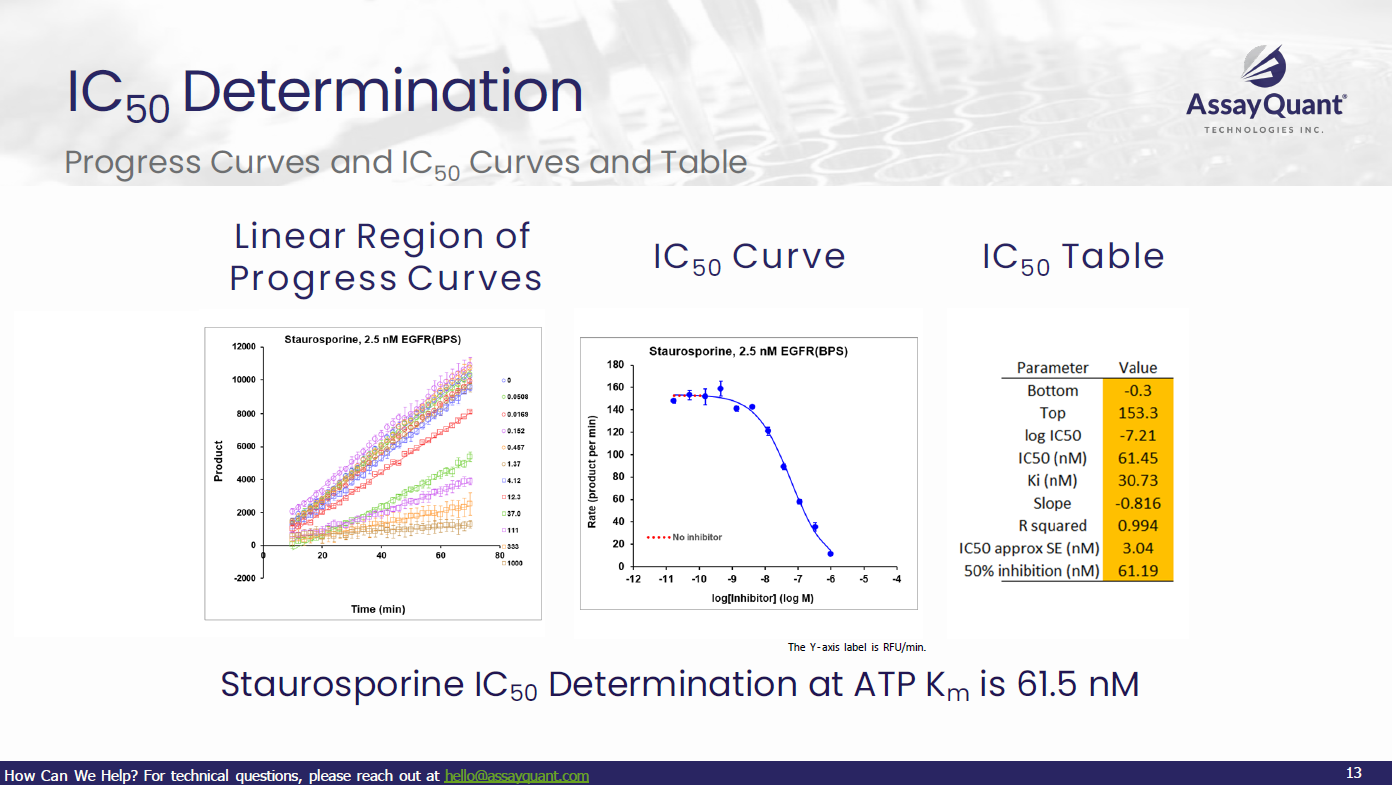
Each validation report provides experimental conditions and data showing:
Protocol
See how the PhosphoSens-Kinetic Assay can be used to find the IC50 of a kinase inhibitor.
Download Protocol →Webinar
Discover how continuous assay formats power deep understanding of kinase function. See how PhosphoSens® assays guide inhibitor profiling, selectivity assessment, and mechanistic characterization.
Watch the Webinar →Service
Need broader selectivity data? KinSight profiling runs your compounds across our full kinase panel under identical PhosphoSens conditions.
Learn about KinSight →Want to hear the latest about our technology? Be among the first to learn about our latest products and services.