Still have questions about our products?
Our scientists can help you choose the right assay format, substrate, and enzyme for your experiment.
Also known as: CaMK1a • calcium/calmodulin dependent protein kinase I • CAMK1-PEN • CAMKIa • KCC1 • KCC1A • CAM kinase I • CaMK1-alpha • CaMKI
.jpg?width=450&name=PhosphoSens%20Packaging%20C%20(3).jpg)
CAMK1 (calcium/calmodulin-dependent protein kinase I) belongs to the CAMK family of serine/threonine kinases and serves as a central mediator of calcium signaling downstream of calmodulin. Upon calcium influx, calmodulin binds the regulatory domain of CAMK1, relieving autoinhibition and enabling activation by upstream CAMK kinases (CAMKKs), particularly CAMKK1 and CAMKK2, through phosphorylation of Thr177 in the activation loop. Key substrates include CREB, synapsin I, and class II histone deacetylases (HDACs), linking CAMK1 activity to transcriptional regulation, neuronal plasticity, and cytoskeletal remodeling. CAMK1 participates in the CAMKK-CAMK1 signaling cascade that governs axonal outgrowth, dendritic arborization, and immune cell differentiation. Dysregulation of CAMK1 has been implicated in neurological disorders, inflammatory diseases, and select cancers. Its restricted substrate specificity and dependence on calcium/calmodulin activation make CAMK1 an attractive target for developing selective inhibitors in neurodegeneration and oncology.
Characterizing CAMK1 inhibitors presents several assay challenges: the kinase requires calcium/calmodulin co-activation, making endpoint assays sensitive to buffer composition artifacts, and its relatively low intrinsic activity demands sensitive detection methods. ADP-Glo and HTRF endpoint formats cannot resolve kinetic differences in calmodulin-dependent activation curves or detect slow-binding covalent inhibitors without labor-intensive time-point sampling. Radiometric assays introduce safety and throughput limitations. PhosphoSens continuous fluorescent peptide substrates overcome these challenges by monitoring substrate phosphorylation in real time under physiological ATP concentrations, enabling full progress curve analysis. This allows direct measurement of calmodulin-dependent activation kinetics, accurate Ki and kinact/KI determination for covalent probes, and early detection of assay artifacts — dramatically improving data quality and throughput for CAMK1 drug discovery campaigns.
Have questions about CAMK1 assay design, selectivity panels, or covalent inhibitor characterization?
Ask Our Scientists →Continuous, real-time fluorescent assays optimized for quantitative CAMK1 activity measurements, IC50 determination, and mechanistic studies.
PhosphoSens-Kinetic assays directly quantify enzyme activity by continuously monitoring substrate phosphorylation or dephosphorylation in real time, generating a full progress curve in every well.
Learn more about PhosphoSens-Kinetic →Need pricing or availability? Select a kit or substrate to request a quote below.
Kits
Ready-to-use assay kits containing substrate and all essential reagents.
Automatically save 10% when bundling 10ug recombinant enzyme with your 1,000 assay kit. View enzymes
Substrate
Bulk PhosphoSens® substrate for assay development and high-throughput workflows.
Automatically save 10% when bundling Reagent Packs with your substrate. View Reagent Packs
Select a kit, substrate, or enzyme above. Our team will confirm pricing, availability, and any applicable bundle discounts.
No PhosphoSens-Red format is currently available for CAMK1.
Select a kit, substrate, or enzyme above. Our team will confirm pricing, availability, and any applicable bundle discounts.
Wild-type and mutant forms of CAMK1 for assay development, kinase profiling, and mechanistic studies. Enzymes are supplied active and optimized for PhosphoSens® substrates.
Mouse • E. coli
Price: $$348.00
PhosphoSens peptide substrate assays are fully compatible with calcium/calmodulin supplemented buffers, allowing researchers to titrate calmodulin concentrations while monitoring real-time phosphorylation progress curves. This enables direct kinetic characterization of calmodulin-dependent activation without the endpoint artifacts that complicate ADP-Glo or HTRF formats. Continuous readout makes it straightforward to optimize co-activator concentrations in a single experiment.
Yes u2014 because PhosphoSens generates continuous fluorescent progress curves in real time at physiological ATP concentrations, it captures the time-dependent inhibition signatures characteristic of covalent and slow-binding compounds. The full progress curve data allow direct fitting of kinact and KI parameters, which endpoint assays systematically miss. This makes PhosphoSens particularly valuable for covalent CAMK1 probe development.
AssayQuant recommends using ATP concentrations near the physiological Km for CAMK1 (typically 10u2013100 u00b5M) to ensure competitive inhibitor IC50 values are physiologically relevant and not artificially elevated by supraphysiological ATP. PhosphoSens continuous kinetics allow Km(ATP) determination in a single experiment, enabling researchers to set the most appropriate ATP concentration for their screening or mechanistic studies.
Explore data and documents to support your kinase and phosphatase experiments. Download sample data, protocols and other resources to see how our assays perform and to help you get started in your own lab. All validation data generated using PhosphoSens® assays under recommended conditions.
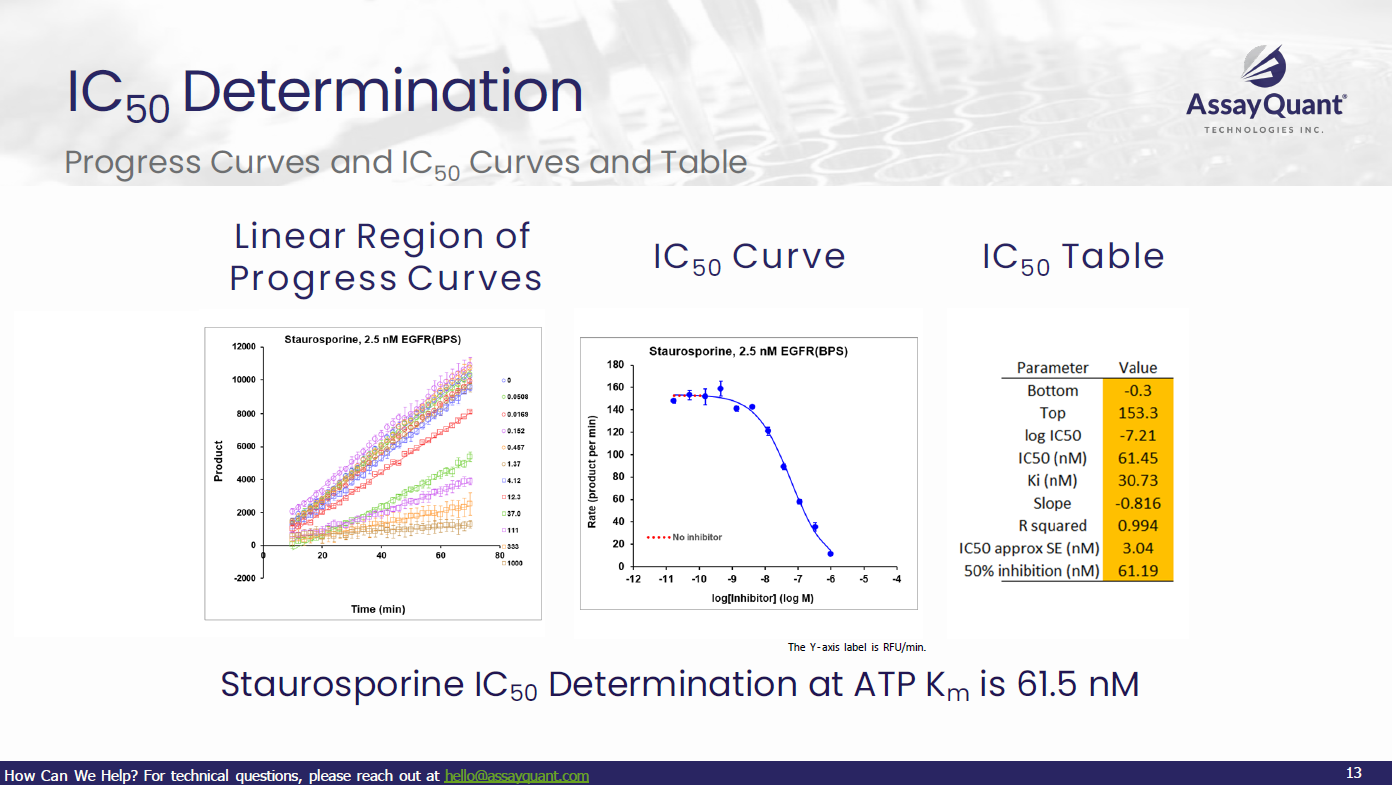
Each validation report provides experimental conditions and data showing:
Protocol
See how the PhosphoSens-Kinetic Assay can be used to find the IC50 of a kinase inhibitor.
Download Protocol →Webinar
Discover how continuous assay formats power deep understanding of kinase function. See how PhosphoSens® assays guide inhibitor profiling, selectivity assessment, and mechanistic characterization.
Watch the Webinar →Service
Need broader selectivity data? KinSight profiling runs your compounds across our full kinase panel under identical PhosphoSens conditions.
Learn about KinSight →Want to hear the latest about our technology? Be among the first to learn about our latest products and services.