Still have questions about our products?
Our scientists can help you choose the right assay format, substrate, and enzyme for your experiment.
Also known as: calcium/calmodulin dependent protein kinase ID • CKLiK • CaM-K1 • CaMK1-delta • CaM-KI delta • KCC1D
.jpg?width=450&name=PhosphoSens%20Packaging%20C%20(3).jpg)
CAMK1D (Calcium/Calmodulin-Dependent Protein Kinase ID) belongs to the CAMK1 subfamily of serine/threonine kinases, which are central mediators of calcium signaling cascades. Like other CAMK1 family members, CAMK1D is activated by calcium-bound calmodulin binding to its regulatory domain, relieving autoinhibition and enabling substrate phosphorylation. Upstream activation by CaM kinase kinases (CaMKK1/2) further amplifies signaling through phosphorylation of the activation loop threonine. Key substrates include CREB, synapsin I, and various transcription factors regulating gene expression. CAMK1D participates in neuronal differentiation, immune cell activation, insulin secretion, and cell cycle progression. Dysregulation has been linked to type 2 diabetes, where CAMK1D variants identified in genome-wide association studies affect pancreatic beta-cell function. Emerging evidence also implicates CAMK1D in breast cancer proliferation and survival signaling downstream of HER2. These connections position CAMK1D as an attractive therapeutic target in metabolic disease and oncology, motivating the development of selective small-molecule inhibitors with well-characterized kinetic profiles.
CAMK1D assay development presents notable challenges: the kinase requires co-activation by calcium-calmodulin, making endpoint assays prone to variability if activation states are inconsistent between wells. ADP-Glo and HTRF detect signal only at a fixed timepoint, missing kinetic information needed to characterize calcium-dependent activation dynamics or covalent inhibitor mechanisms. Radiometric assays handle physiological ATP poorly and generate radioactive waste. AssayQuant's PhosphoSens CSox-based peptide substrates enable continuous, real-time fluorescence readout of CAMK1D phosphorylation under physiological ATP concentrations, capturing full progress curves. This allows precise Km(ATP) determination critical for translational inhibitor potency corrections, detection of slow-on/slow-off inhibitor binding, and accurate kinact/KI measurement for any covalent candidates targeting the ATP-binding site. Real-time kinetics also confirm proper calmodulin-dependent activation within each experiment, improving data quality and reproducibility across screening campaigns.
Have questions about CAMK1D assay design, selectivity panels, or covalent inhibitor characterization?
Ask Our Scientists →Continuous, real-time fluorescent assays optimized for quantitative CAMK1D activity measurements, IC50 determination, and mechanistic studies.
PhosphoSens-Kinetic assays directly quantify enzyme activity by continuously monitoring substrate phosphorylation or dephosphorylation in real time, generating a full progress curve in every well.
Learn more about PhosphoSens-Kinetic →Need pricing or availability? Select a kit or substrate to request a quote below.
Kits
Ready-to-use assay kits containing substrate and all essential reagents.
Automatically save 10% when bundling 10ug recombinant enzyme with your 1,000 assay kit. View enzymes
Substrate
Bulk PhosphoSens® substrate for assay development and high-throughput workflows.
Automatically save 10% when bundling Reagent Packs with your substrate. View Reagent Packs
Select a kit, substrate, or enzyme above. Our team will confirm pricing, availability, and any applicable bundle discounts.
Robust endpoint TRF assays optimized for high-throughput screening and quantitative CAMK1D activity measurement in plate-based workflows.
PhosphoSens-Red assays use europium-based time-resolved fluorescence detection to enable robust, plate-based quantification of enzyme activity, making them well suited for high-throughput screening workflows.
Learn more about PhosphoSens-Red →Need pricing or availability? Select a kit or substrate to request a quote below.
Kits
Ready-to-use TRF assay kits containing substrate and essential reagents.
Automatically save 10% when bundling 10ug recombinant enzyme with your 1,000 assay kit. View enzymes
Substrate
Bulk substrate for PhosphoSens-Red TRF assays and high-throughput workflows.
Automatically save 10% when bundling Reagent Packs with your substrate. View Reagent Packs
Select a kit, substrate, or enzyme above. Our team will confirm pricing, availability, and any applicable bundle discounts.
No recombinant enzymes are currently available for CAMK1D.
PhosphoSens uses CSox-based fluorescent peptide substrates that produce an immediate change in fluorescence emission upon phosphorylation by CAMK1D, enabling continuous monitoring of kinase activity without stopping the reaction. This generates full progress curves that reveal activation kinetics, substrate consumption, and inhibitor effects simultaneously. No secondary detection reagents or antibodies are required.
Yes, AssayQuant's CAMK1D assay format is fully compatible with inclusion of calcium and calmodulin in the reaction buffer to support physiological kinase activation. Real-time readout allows direct visualization of calmodulin-dependent activation onset within each well, providing an internal quality control metric for activation efficiency. This is a significant advantage over endpoint methods that cannot distinguish inactive from active kinase preparations.
Most ATP-competitive inhibitors show reduced potency at the physiological ATP concentrations found in cells (1-5 mM) compared to the artificially low ATP levels used in many endpoint assays. PhosphoSens assays support CAMK1D activity measurements at physiological ATP, enabling accurate Km(ATP) determination and Cheng-Prusoff corrections that yield inhibitor IC50 and Ki values predictive of cellular potency. This improves the translatability of SAR data during lead optimization.
Explore data and documents to support your kinase and phosphatase experiments. Download sample data, protocols and other resources to see how our assays perform and to help you get started in your own lab. All validation data generated using PhosphoSens® assays under recommended conditions.
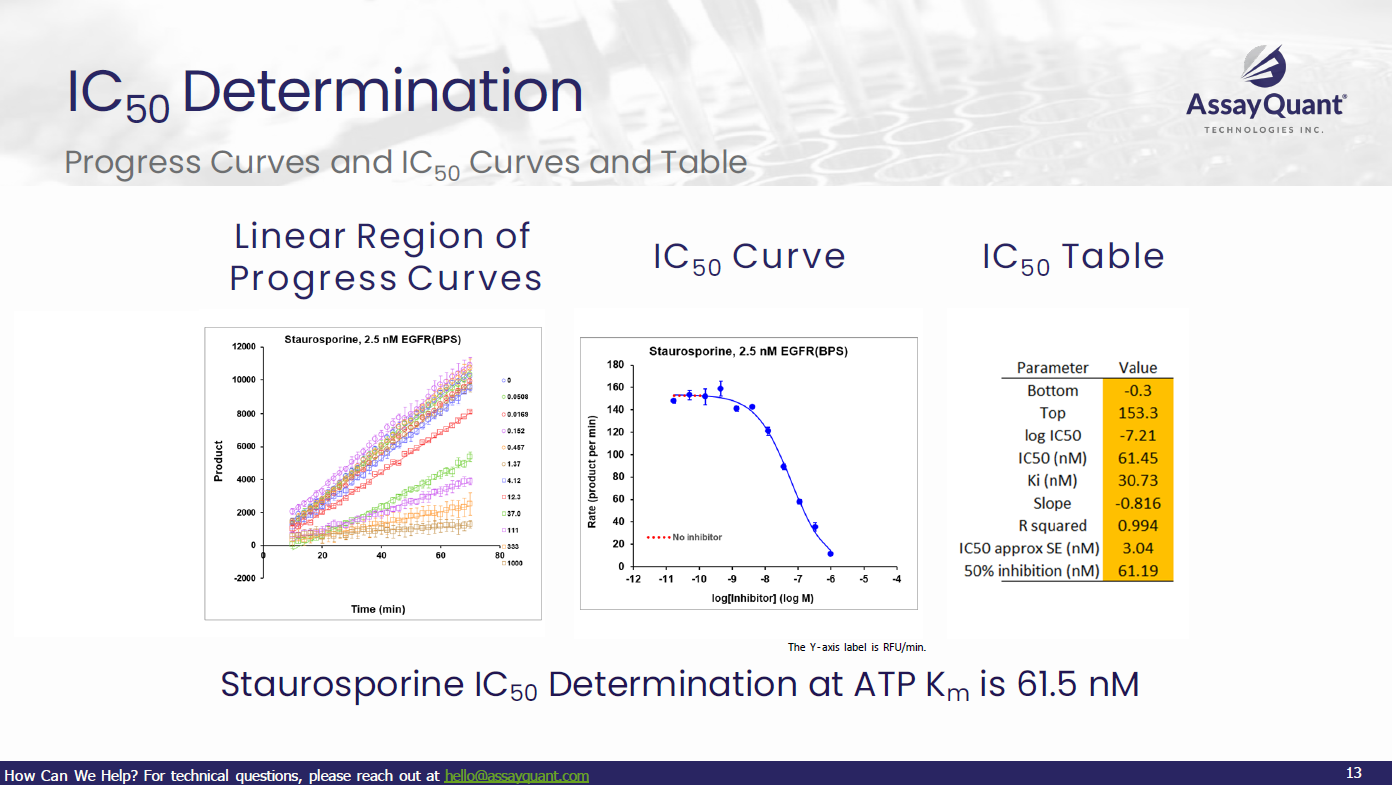
Each validation report provides experimental conditions and data showing:
Protocol
See how the PhosphoSens-Kinetic Assay can be used to find the IC50 of a kinase inhibitor.
Download Protocol →Webinar
Discover how continuous assay formats power deep understanding of kinase function. See how PhosphoSens® assays guide inhibitor profiling, selectivity assessment, and mechanistic characterization.
Watch the Webinar →Service
Need broader selectivity data? KinSight profiling runs your compounds across our full kinase panel under identical PhosphoSens conditions.
Learn about KinSight →Want to hear the latest about our technology? Be among the first to learn about our latest products and services.