Still have questions about our products?
Our scientists can help you choose the right assay format, substrate, and enzyme for your experiment.
Also known as: calcium/calmodulin dependent protein kinase IG • CLICKIII • VWS1 • dJ272L16.1 • Calcium/calmodulin-dependent protein kinase I gamma • KCC1G • CaMK1-gamma • CaMK-like CREB kinase III
.jpg?width=450&name=PhosphoSens%20Packaging%20C%20(3).jpg)
CAMK1G (Calcium/Calmodulin-Dependent Protein Kinase IG) is a member of the CAMK1 subfamily of serine/threonine kinases, which are activated by the calcium-sensing protein calmodulin upon intracellular calcium elevation. Like other CAMK1 family members, CAMK1G requires binding of Ca2+/calmodulin to relieve autoinhibitory domain suppression and achieve full activation, with upstream CaMKK1/CaMKK2 providing additional activating phosphorylation on the activation loop. CAMK1G is expressed predominantly in neuronal tissues and has been implicated in neurite outgrowth, synaptic plasticity, and neuronal differentiation. Key substrates include CREB and synapsin family proteins involved in transcriptional regulation and vesicle trafficking. Pathway involvement spans CREB-mediated gene expression, MAPK/ERK signaling crosstalk, and mTORC1 regulation. Disease relevance includes neurological disorders, epilepsy, and emerging roles in certain cancers where calcium signaling is dysregulated. As a druggable kinase with a well-defined catalytic domain and disease-associated expression, CAMK1G represents a compelling target for CNS-focused drug discovery programs seeking selective CAMK1 subfamily inhibitors.
CAMK1G presents significant assay challenges: it requires Ca2+/calmodulin supplementation for activation, making traditional endpoint assays prone to variability from incomplete activation states and signal artifacts. ADP-Glo and HTRF endpoint formats cannot distinguish partial from full activation kinetics, miss burst phases, and are incompatible with covalent inhibitor characterization. Radiometric assays introduce safety burdens and cannot track real-time progress curves. PhosphoSens continuous fluorescent kinase assays overcome these limitations by monitoring substrate phosphorylation in real time under physiological ATP concentrations, generating full progress curves that capture enzyme activation dynamics, calmodulin concentration dependence, and inhibitor kinetics including covalent kinact/KI determination. This enables accurate IC50 measurements uncontaminated by endpoint timing artifacts, faithful Km/Vmax determination, and robust selectivity profiling essential for developing CNS-targeted CAMK1G inhibitors.
Have questions about CAMK1G assay design, selectivity panels, or covalent inhibitor characterization?
Ask Our Scientists →Continuous, real-time fluorescent assays optimized for quantitative CAMK1G activity measurements, IC50 determination, and mechanistic studies.
PhosphoSens-Kinetic assays directly quantify enzyme activity by continuously monitoring substrate phosphorylation or dephosphorylation in real time, generating a full progress curve in every well.
Learn more about PhosphoSens-Kinetic →Need pricing or availability? Select a kit or substrate to request a quote below.
Kits
Ready-to-use assay kits containing substrate and all essential reagents.
Automatically save 10% when bundling 10ug recombinant enzyme with your 1,000 assay kit. View enzymes
Substrate
Bulk PhosphoSens® substrate for assay development and high-throughput workflows.
Automatically save 10% when bundling Reagent Packs with your substrate. View Reagent Packs
Select a kit, substrate, or enzyme above. Our team will confirm pricing, availability, and any applicable bundle discounts.
Robust endpoint TRF assays optimized for high-throughput screening and quantitative CAMK1G activity measurement in plate-based workflows.
PhosphoSens-Red assays use europium-based time-resolved fluorescence detection to enable robust, plate-based quantification of enzyme activity, making them well suited for high-throughput screening workflows.
Learn more about PhosphoSens-Red →Need pricing or availability? Select a kit or substrate to request a quote below.
Kits
Ready-to-use TRF assay kits containing substrate and essential reagents.
Automatically save 10% when bundling 10ug recombinant enzyme with your 1,000 assay kit. View enzymes
Substrate
Bulk substrate for PhosphoSens-Red TRF assays and high-throughput workflows.
Automatically save 10% when bundling Reagent Packs with your substrate. View Reagent Packs
Select a kit, substrate, or enzyme above. Our team will confirm pricing, availability, and any applicable bundle discounts.
No recombinant enzymes are currently available for CAMK1G.
Yes, CAMK1G requires supplementation with exogenous calmodulin and calcium chloride to achieve activation in biochemical assays. PhosphoSens assays are fully compatible with these cofactors, and the continuous real-time format allows direct visualization of how calmodulin concentration influences enzyme activation kinetics and substrate turnover rates.
Yes, the continuous progress curve format of PhosphoSens technology is uniquely suited to characterize covalent inhibitors by enabling direct measurement of kinact and KI parameters from real-time fluorescence data. This is not possible with endpoint ADP-Glo or HTRF formats, which provide only a single time-point snapshot and can significantly misreport potency for time-dependent inhibitors.
AssayQuant's CSox-based peptide substrates optimized for CAMK1 family kinases are recommended for CAMK1G assays, providing high signal-to-background and sensitivity at physiological ATP concentrations. Running assays at physiological ATP avoids the artificial competitive advantage seen with ATP-depleting detection reagents, ensuring inhibitor IC50 values are translationally relevant.
Explore data and documents to support your kinase and phosphatase experiments. Download sample data, protocols and other resources to see how our assays perform and to help you get started in your own lab. All validation data generated using PhosphoSens® assays under recommended conditions.
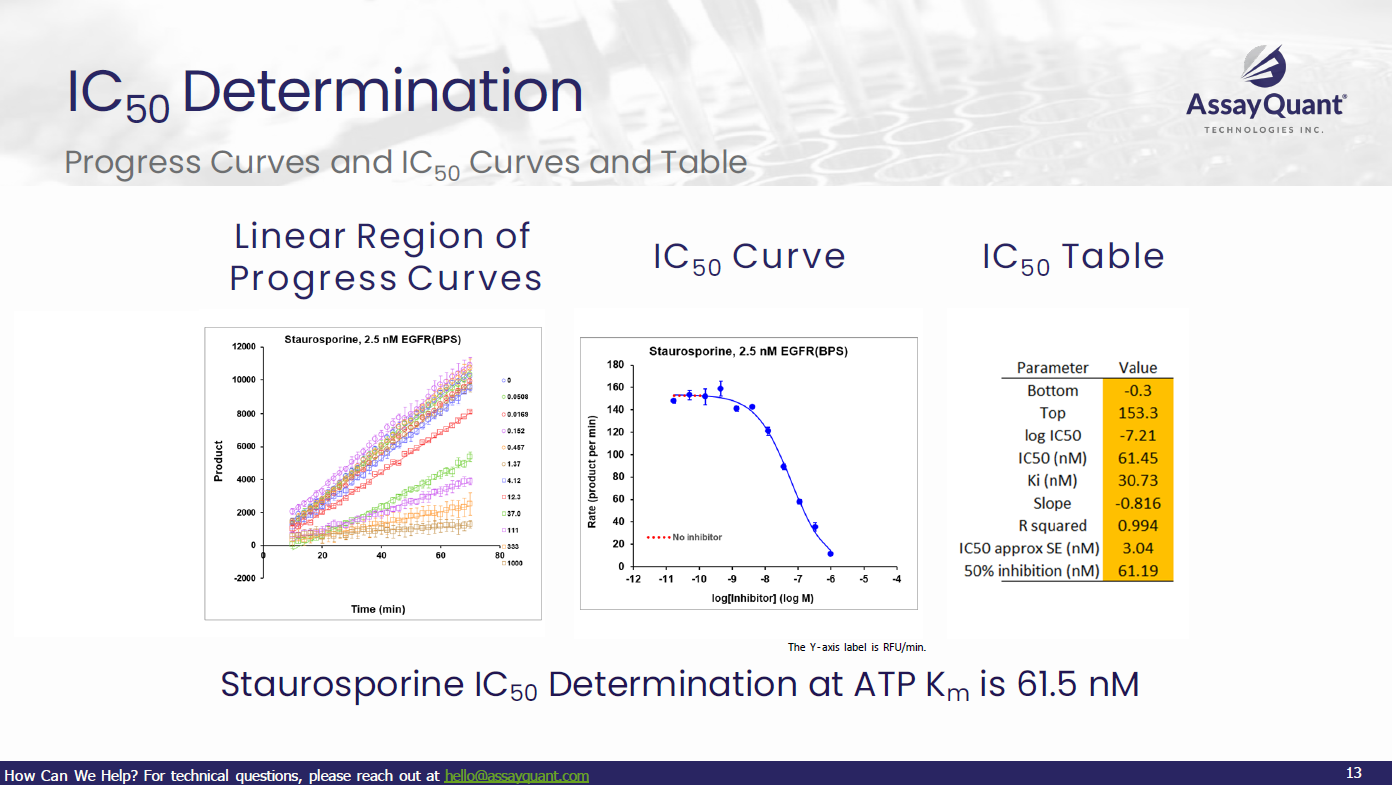
Each validation report provides experimental conditions and data showing:
Protocol
See how the PhosphoSens-Kinetic Assay can be used to find the IC50 of a kinase inhibitor.
Download Protocol →Webinar
Discover how continuous assay formats power deep understanding of kinase function. See how PhosphoSens® assays guide inhibitor profiling, selectivity assessment, and mechanistic characterization.
Watch the Webinar →Service
Need broader selectivity data? KinSight profiling runs your compounds across our full kinase panel under identical PhosphoSens conditions.
Learn about KinSight →Want to hear the latest about our technology? Be among the first to learn about our latest products and services.