Still have questions about our products?
Our scientists can help you choose the right assay format, substrate, and enzyme for your experiment.
Also known as: calcium/calmodulin dependent protein kinase II alpha • CaM kinase II alpha subunit • CaMKIINalpha • CAMKA • KIAA0968 • CaMKII-alpha • KCC2A • CaMK2-alpha
.jpg?width=450&name=PhosphoSens%20Packaging%20C%20(3).jpg)
CAMK2A (calcium/calmodulin-dependent protein kinase II alpha) belongs to the CAMK2 family, a group of multifunctional serine/threonine kinases that serve as central decoders of intracellular calcium signals. Upon binding of the Ca2+/calmodulin complex, CAMK2A undergoes autophosphorylation at Thr286, converting the enzyme to a calcium-independent, constitutively active state — a molecular memory mechanism critical for synaptic plasticity. Key substrates include AMPA receptor subunit GluA1 (Ser831), synapsin I, and multiple transcription factors including CREB. CAMK2A is a master regulator of long-term potentiation (LTP) and long-term depression (LTD), positioning it as a pivotal node in learning and memory circuits. Dysregulation of CAMK2A activity has been implicated in neurological disorders including intellectual disability, autism spectrum disorder, epilepsy, schizophrenia, and ischemic brain injury. In cardiac tissue, aberrant CAMK2A signaling drives arrhythmias and heart failure. Its broad disease relevance and druggable kinase domain make CAMK2A an attractive therapeutic target for both CNS and cardiovascular indications.
CAMK2A presents distinct assay challenges: its requirement for Ca2+/calmodulin activation demands precisely buffered assay conditions, and its autophosphorylation-driven autonomous activation complicates interpretation of endpoint data. Traditional ADP-Glo and HTRF assays capture only single time-point snapshots, masking the biphasic kinetics of CAMK2A activation and autophosphorylation. Radiometric assays carry handling burdens and fail to resolve mechanistic complexity. PhosphoSens continuous fluorescent kinase assays monitor substrate phosphorylation in real time, generating full progress curves that distinguish Ca2+/calmodulin-dependent versus autonomous CAMK2A activity. Physiological ATP concentrations are used, ensuring inhibitor IC50 values reflect true cellular relevance. Covalent and allosteric inhibitors are accurately characterized via kinact/KI determination — impossible with endpoint formats. This mechanistic richness accelerates hit triage and enables confident rank-ordering of CAMK2A inhibitor series.
Have questions about CAMK2A assay design, selectivity panels, or covalent inhibitor characterization?
Ask Our Scientists →Continuous, real-time fluorescent assays optimized for quantitative CAMK2A activity measurements, IC50 determination, and mechanistic studies.
PhosphoSens-Kinetic assays directly quantify enzyme activity by continuously monitoring substrate phosphorylation or dephosphorylation in real time, generating a full progress curve in every well.
Learn more about PhosphoSens-Kinetic →Need pricing or availability? Select a kit or substrate to request a quote below.
Kits
Ready-to-use assay kits containing substrate and all essential reagents.
Automatically save 10% when bundling 10ug recombinant enzyme with your 1,000 assay kit. View enzymes
Substrate
Bulk PhosphoSens® substrate for assay development and high-throughput workflows.
Automatically save 10% when bundling Reagent Packs with your substrate. View Reagent Packs
Select a kit, substrate, or enzyme above. Our team will confirm pricing, availability, and any applicable bundle discounts.
Robust endpoint TRF assays optimized for high-throughput screening and quantitative CAMK2A activity measurement in plate-based workflows.
PhosphoSens-Red assays use europium-based time-resolved fluorescence detection to enable robust, plate-based quantification of enzyme activity, making them well suited for high-throughput screening workflows.
Learn more about PhosphoSens-Red →Need pricing or availability? Select a kit or substrate to request a quote below.
Kits
Ready-to-use TRF assay kits containing substrate and essential reagents.
Automatically save 10% when bundling 10ug recombinant enzyme with your 1,000 assay kit. View enzymes
Substrate
Bulk substrate for PhosphoSens-Red TRF assays and high-throughput workflows.
Automatically save 10% when bundling Reagent Packs with your substrate. View Reagent Packs
Select a kit, substrate, or enzyme above. Our team will confirm pricing, availability, and any applicable bundle discounts.
No recombinant enzymes are currently available for CAMK2A.
PhosphoSens CAMK2A assays are formulated with optimized Ca2+/calmodulin concentrations that reproducibly activate the kinase to defined levels, enabling consistent and comparable inhibitor profiling across experiments. Buffer conditions are validated to maintain stable Ca2+ chelation throughout the continuous read, eliminating variability introduced by calcium fluctuation during long endpoint incubations. This allows researchers to study both Ca2+/calmodulin-dependent and autonomous (Thr286-autophosphorylated) CAMK2A activity in a single real-time experiment.
Yes u2014 because PhosphoSens generates continuous fluorescent progress curves, the temporal separation between CAMK2A autophosphorylation-driven activation and downstream substrate phosphorylation can be resolved mechanistically. Endpoint assays like ADP-Glo collapse this information into a single time-point, obscuring the biphasic kinetics that are diagnostic of CAMK2A autonomous activation. Real-time progress curves enable researchers to design experiments that specifically interrogate either the activation phase or the steady-state substrate turnover phase.
PhosphoSens CAMK2A assays utilize physiological ATP concentrations (typically 1 mM), which is critical because most competitive inhibitors show dramatically shifted IC50 values at the artificially low ATP concentrations used in many commercial kinase assays. Profiling inhibitors at physiological ATP ensures that potency rankings and selectivity data translate accurately to cellular and in vivo settings, reducing costly late-stage attrition. This is especially important for CAMK2A, where ATP-competitive and allosteric inhibitor scaffolds are both actively pursued.
Explore data and documents to support your kinase and phosphatase experiments. Download sample data, protocols and other resources to see how our assays perform and to help you get started in your own lab. All validation data generated using PhosphoSens® assays under recommended conditions.
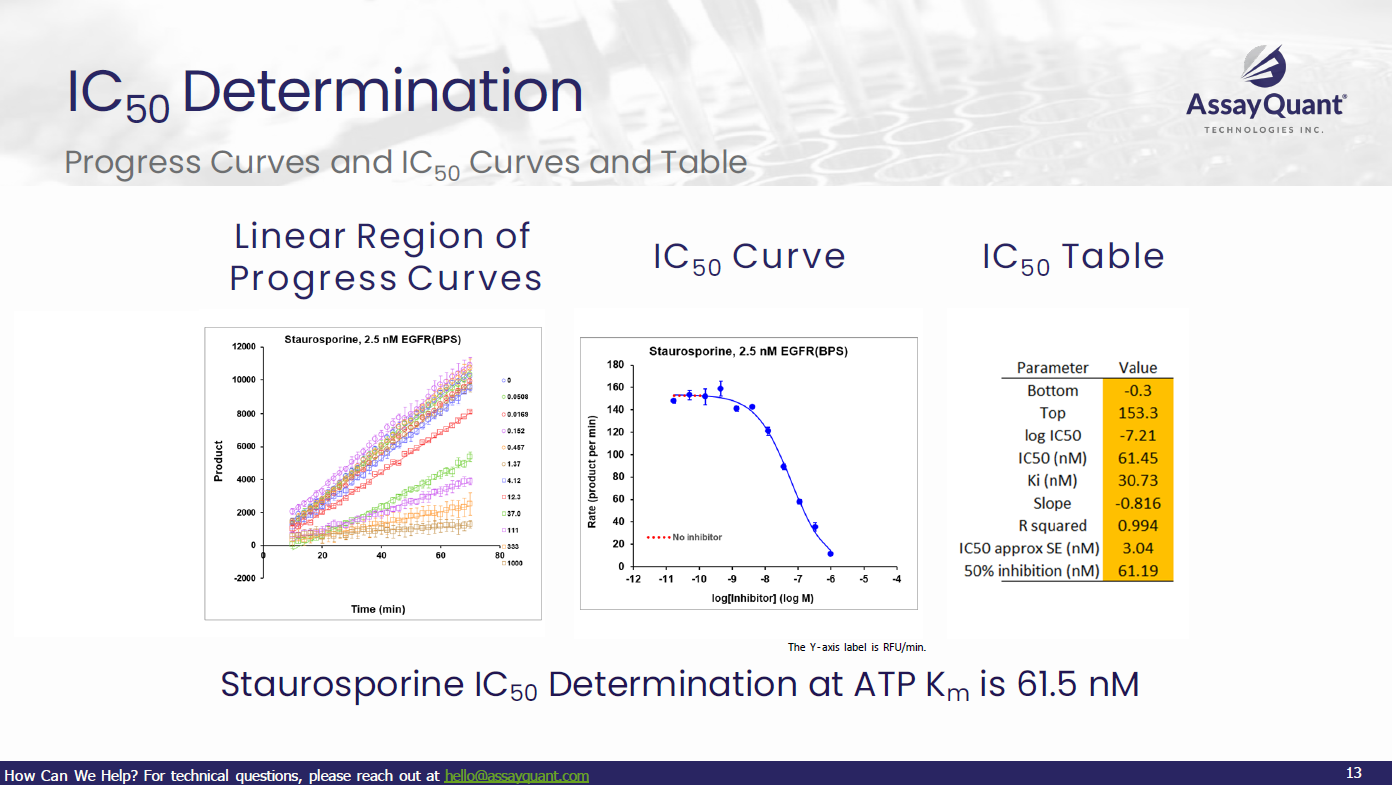
Each validation report provides experimental conditions and data showing:
Protocol
See how the PhosphoSens-Kinetic Assay can be used to find the IC50 of a kinase inhibitor.
Download Protocol →Webinar
Discover how continuous assay formats power deep understanding of kinase function. See how PhosphoSens® assays guide inhibitor profiling, selectivity assessment, and mechanistic characterization.
Watch the Webinar →Service
Need broader selectivity data? KinSight profiling runs your compounds across our full kinase panel under identical PhosphoSens conditions.
Learn about KinSight →Want to hear the latest about our technology? Be among the first to learn about our latest products and services.