Continuous Phosphatase Activity Assays for 50 Validated Targets
A PhosphoSens® phosphatase activity assay is a continuous, real-time fluorescence assay that measures phosphatase catalytic activity directly at the substrate level, using the same continuous detection chemistry validated across AssayQuant's kinase assay platform. Each well generates a full kinetic progress curve, supporting IC₅₀, selectivity, and mechanism-of-action studies.
Phosphatases are studied far less often than kinases despite being equally central to signaling regulation — most available assays are indirect, antibody-based, or endpoint-only. AssayQuant's catalog covers 50 validated phosphatase targets across major phosphatase families (PPP, PPM, PTPN, PTPR, DUSP, and others).
50
Validated Phosphatase Targets
2
Assay Formats & Sample Types
1536
Well Plate Compatible
NCI Funded
MIT-licensed technology
How PhosphoSens® Phosphatase Assays Work
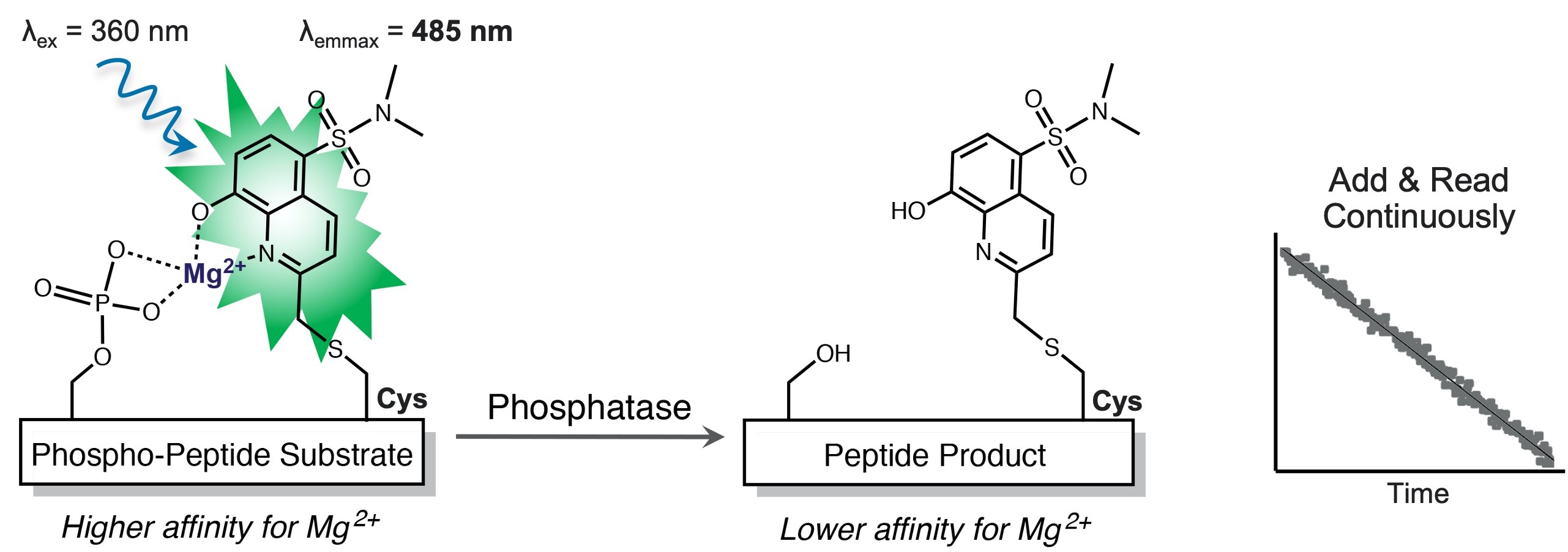
Most phosphatase activity assays measure activity indirectly, in one of two ways. Generic fluorogenic substrates like DiFMUP, or colorimetric methods like malachite green, detect free phosphate release from a small-molecule probe — they confirm that some phosphatase activity occurred, but not whether it happened on your target's actual physiological substrate sequence, since any phosphatase can cleave a generic phosphate ester. Antibody-based phospho-detection methods have the opposite problem: they confirm a residue's phosphorylation state at one moment, not the catalytic dephosphorylation event itself. Both approaches add reagents, add assumptions, and collapse the reaction into a single generic or indirect readout.
PhosphoSens® skips that chain entirely. Each sensor peptide substrate is synthesized to match the target phosphatase's actual physiological substrate sequence, with a small fluorescent tag — Sox — built directly into the peptide, positioned right next to the phospho-residue being removed. The moment dephosphorylation happens, the signal changes. No generic phosphate-release probe. No antibody has to find anything.
Choose the Format That Fits Your Research
Not all phosphatase assays are built the same. Select the format that matches how you work — in-house kits or a fully managed CRO service.
PhosphoSens-Kinetic
Generates a full activity progress curve in every well. Ideal for IC₅₀, Kᵢ, kobs, TDI, and mechanistic characterization. No endpoint assumptions.
Need a CRO to run it?
KinSight™ profiling services run your compounds against our 400+ kinase panel. You receive annotated kinetic reports with TDI flags and MOA insights — in two weeks.
Why Researchers Choose PhosphoSens® Over Endpoint Methods
Most phosphatase assays give you a single data point at a single moment in time. PhosphoSens generates a continuous activity trace — so you see the full kinetics, not just a snapshot.
True initial rates, no artifacts
Calculate rates from the true linear region of the progress curve — free from lag phase, substrate depletion, or enzyme instability artifacts.
Detect TDI and slow-binding inhibitors
Capture time-dependent mechanisms — TDI, slow-on/slow-off, irreversible binding — that endpoint assays miss entirely.
Physiologically relevant conditions
Compatible with physiological ATP, Mg²⁺, Mn²⁺, and Ca²⁺. Validated substrates with defined phospho-acceptor sites — no antibody cross-reactivity.
| Platform | Measures activity directly | Detects time dependent inhibition | Real-time kinetic readout | Uses your target's physiological substrate | Detects all inhibitor types |
|---|---|---|---|---|---|
| AssayQuant PhosphoSens® | |||||
| Generic fluorogenic substratese.g. DiFMUP, pNPP | |||||
| Colorimetric phosphate detectione.g. Malachite Green | Assay-Dependent | ||||
| Radiometric assayse.g. ³²P filter/charcoal separation | |||||
| Phospho-specific antibody detectione.g. phospho-ELISA, western blot |
✓ Supported | Assay-Dependent = varies by specific kit/substrate configuration | ✗ Not supported
Read: Continuous vs. Endpoint Kinase Assays →Kinase Activity Directly From Cell Lysates
Skip the purified enzyme. PhosphoSens-Lysate assays measure kinase activity in native cellular context — capturing the biology your recombinant assays can't.
Continuous Phosphatase Activity Assays
The same real-time, direct measurement you rely on for kinases — now for phosphatases. 50+ validated targets, same PhosphoSens® platform.
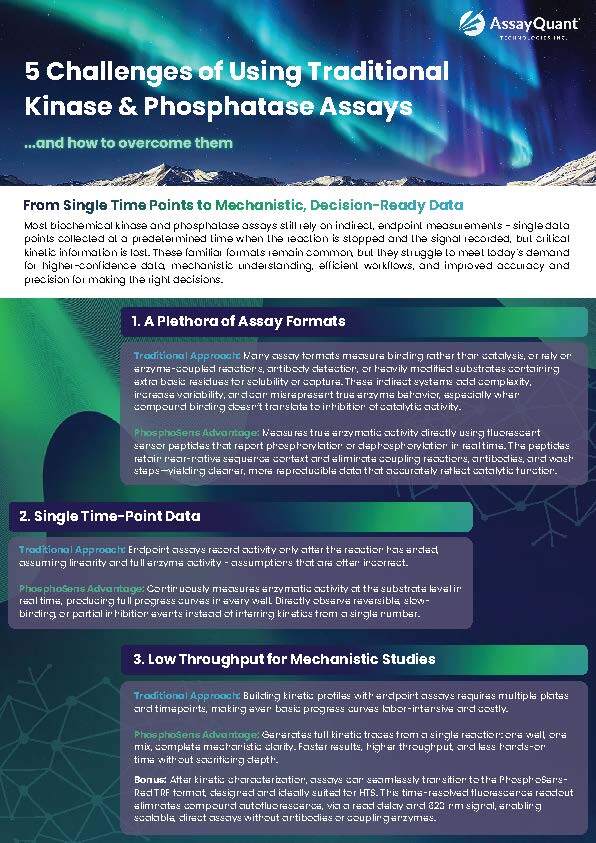
From Single Time Points to Mechanistic, Decision-Ready Data
AssayQuant’s PhosphoSens® real-time kinetic assays overcome the fundamental limitations of traditional kinase and phosphatase technologies. DOWNLOAD TO LEARN MORE.
Explore 50 Validated Phosphatase Assay Targets
Search by gene symbol, target family, or indication. Each target page includes available formats, substrates, enzymes, pricing, and application notes.
PhosphoSens-Kinetic Product Catalog
For your convenience, you can also download a PDF version to review later or share with your colleagues.
DownloadPhosphoSens® Phosphatase Activity Assay Catalog
Search 50+ protein phosphatase targets. Every assay is a continuous, no-antibody, real-time readout on a physiological peptide substrate — not a small-molecule surrogate.
| Target name | Type | Family | WT / Mutant | Full name | Substrate & Enzyme | Format & Status | Product Page |
|---|---|---|---|---|---|---|---|
| ACP1 | ACP (acid phosphatase) | Wild-Type | — | In Development | Request a Quote → | ||
| ACP3 | ACP (acid phosphatase) | Wild-Type | — | In Development | Request a Quote → | ||
| ACP5 | ACP (acid phosphatase) | Wild-Type | — | In Development | Request a Quote → | ||
| ACP6 | ACP (acid phosphatase) | Wild-Type | — | In Development | Request a Quote → | ||
| ALPI | ALPI (alkaline phosphatase) | Wild-Type | — | In Development | Request a Quote → | ||
| CDC25A | Dual (Y) | CDC25 | Wild-Type | cell division cycle 25A |
AQT0523
AQT-C04-20G
|
Kinetic
|
View Product Page → |
| CDC25B | Dual (Y) | CDC25 | Wild-Type | cell division cycle 25B |
AQT0523
AQT-C04-20BG
|
Kinetic
|
View Product Page → |
| CDC25C | Dual (Y) | CDC25 | Wild-Type | cell division cycle 25C |
AQT0523
AQT-C04-20CG
|
Kinetic
|
View Product Page → |
| DUSP1 | DUSP (dual-specificity phosphatase) | Wild-Type | — | In Development | Request a Quote → | ||
| DUSP10 | DUSP (dual-specificity phosphatase) | Wild-Type | — | In Development | Request a Quote → | ||
| DUSP14 | DUSP (dual-specificity phosphatase) | Wild-Type | — | In Development | Request a Quote → | ||
| DUSP22 | Dual | DUSP (dual-specificity phosphatase) | Wild-Type | dual specificity phosphatase 22 |
AQT0737
AQT-D22-20G
|
Kinetic
|
View Product Page → |
| DUSP23 | DUSP (dual-specificity phosphatase) | Wild-Type | — | In Development | Request a Quote → | ||
| DUSP3 | Dual (Y) | DUSP (dual-specificity phosphatase) | Wild-Type | dual specificity phosphatase 3 | AQT0264 |
Kinetic
|
View Product Page → |
| DUSP6 | DUSP (dual-specificity phosphatase) | Wild-Type | — | In Development | Request a Quote → | ||
| EYA4 | EYA (Eyes Absent family) | Wild-Type | — | In Development | Request a Quote → | ||
| PHLPP1 | Ser/Thr | PHLPP | Wild-Type | PH domain and leucine rich repeat protein phosphatase 1 | AQT0481 |
Kinetic
|
View Product Page → |
| PHLPP2 | Ser/Thr | PHLPP | Wild-Type | PH domain and leucine rich repeat protein phosphatase 2 | AQT0481 |
Kinetic
|
View Product Page → |
| PPM1A | Ser/Thr | PPM (Mg2+/Mn2+-dependent Ser/Thr phosphatase) | Wild-Type | protein phosphatase, Mg2+/Mn2+ dependent 1A |
AQT0267
AQT-P02-20BG
|
Kinetic
|
View Product Page → |
| PPM1D | Ser/Thr | PPM (Mg2+/Mn2+-dependent Ser/Thr phosphatase) | Wild-Type | protein phosphatase, Mg2+/Mn2+ dependent 1D |
AQT0525
AQT-P04-20G
|
Kinetic
|
View Product Page → |
| PPM1F | Ser/Thr | PPM (Mg2+/Mn2+-dependent Ser/Thr phosphatase) | Wild-Type | protein phosphatase, Mg2+/Mn2+ dependent 1F | AQT0523 |
Kinetic
|
View Product Page → |
| PPM1G | Ser/Thr | PPM (Mg2+/Mn2+-dependent Ser/Thr phosphatase) | Wild-Type | protein phosphatase, Mg2+/Mn2+ dependent 1G |
AQT0267
AQT-P07-20G
|
Kinetic
|
View Product Page → |
| PPP1CA | Ser/Thr | PPP (Ser/Thr phosphatase) | Wild-Type | protein phosphatase 1 catalytic subunit alpha |
AQT0480
AQT-P13-20G
|
Kinetic
|
View Product Page → |
| PPP1CB | Ser/Thr | PPP (Ser/Thr phosphatase) | Wild-Type | protein phosphatase 1 catalytic subunit beta |
AQT0523
AQT-P14-20G
|
Kinetic
|
View Product Page → |
| PPP2CA | Ser/Thr | PPP (Ser/Thr phosphatase) | Wild-Type | protein phosphatase 2 catalytic subunit alpha | AQT0523 |
Kinetic
|
View Product Page → |
| PPP2CB | Ser/Thr | PPP (Ser/Thr phosphatase) | Wild-Type | protein phosphatase 2 catalytic subunit beta | AQT0523 |
Kinetic
|
View Product Page → |
| PPP3CA/B | Ser/Thr | PPP (Ser/Thr phosphatase) | Wild-Type | protein phosphatase 3 catalytic subunit alpha/beta | AQT0670 |
Kinetic
|
View Product Page → |
| PTPN1 | Tyr | PTPN (non-receptor PTP) | Wild-Type | protein tyrosine phosphatase non-receptor type 1 |
AQT0266
AQT-P28-20G
|
Kinetic
|
View Product Page → |
| PTPN11 | Tyr | PTPN (non-receptor PTP) | Wild-Type | protein tyrosine phosphatase non-receptor type 11 |
AQT0737
AQT-P38-20G
|
Kinetic
|
View Product Page → |
| PTPN12 | Tyr | PTPN (non-receptor PTP) | Wild-Type | protein tyrosine phosphatase non-receptor type 12 |
AQT0737
AQT-P39-21G
|
Kinetic
|
View Product Page → |
| PTPN13 | Tyr | PTPN (non-receptor PTP) | Wild-Type | protein tyrosine phosphatase non-receptor type 13 |
AQT0737
AQT-P40-21G
|
Kinetic
|
View Product Page → |
| PTPN2 | Tyr | PTPN (non-receptor PTP) | Wild-Type | protein tyrosine phosphatase non-receptor type 2 |
AQT0266
AQT-P29-20G
|
Kinetic
|
View Product Page → |
| PTPN22 | Tyr | PTPN (non-receptor PTP) | Wild-Type | protein tyrosine phosphatase non-receptor type 22 | AQT0737 |
Kinetic
|
View Product Page → |
| PTPN4 | Tyr | PTPN (non-receptor PTP) | Wild-Type | protein tyrosine phosphatase non-receptor type 4 | AQT0737 |
Kinetic
|
View Product Page → |
| PTPN5 | Tyr | PTPN (non-receptor PTP) | Wild-Type | protein tyrosine phosphatase non-receptor type 5 | AQT0664 |
Kinetic
|
View Product Page → |
| PTPN6 | Tyr | PTPN (non-receptor PTP) | Wild-Type | protein tyrosine phosphatase non-receptor type 6 |
AQT0737
AQT-P33-20G
|
Kinetic
|
View Product Page → |
| PTPN7 | Tyr | PTPN (non-receptor PTP) | Wild-Type | protein tyrosine phosphatase non-receptor type 7 |
AQT0772
AQT-P34-20G
|
Kinetic
|
View Product Page → |
| PTPN9 | Tyr | PTPN (non-receptor PTP) | Wild-Type | protein tyrosine phosphatase non-receptor type 9 | AQT0737 |
Kinetic
|
View Product Page → |
| PTPRA | Tyr | PTPR (receptor-type PTP) | Wild-Type | protein tyrosine phosphatase receptor type A |
AQT0667
AQT-P48-21G
|
Kinetic
|
View Product Page → |
| PTPRB | Tyr | PTPR (receptor-type PTP) | Wild-Type | protein tyrosine phosphatase receptor type B |
AQT0667
AQT-P49-21G
|
Kinetic
|
View Product Page → |
| PTPRC | Tyr | PTPR (receptor-type PTP) | Wild-Type | protein tyrosine phosphatase receptor type C |
AQT0630
AQT-P50-21BG
|
Kinetic
|
View Product Page → |
| PTPRE | Tyr | PTPR (receptor-type PTP) | Wild-Type | protein tyrosine phosphatase receptor type E |
AQT0667
AQT-P52-21G
|
Kinetic
|
View Product Page → |
| PTPRF | Tyr | PTPR (receptor-type PTP) | Wild-Type | protein tyrosine phosphatase receptor type F |
AQT0737
AQT-P53-21G
|
Kinetic
|
View Product Page → |
| PTPRG | Tyr | PTPR (receptor-type PTP) | Wild-Type | protein tyrosine phosphatase receptor type G | AQT0667 |
Kinetic
|
View Product Page → |
| PTPRJ | Tyr | PTPR (receptor-type PTP) | Wild-Type | protein tyrosine phosphatase receptor type J |
AQT0737
AQT-P56-21G
|
Kinetic
|
View Product Page → |
| PTPRM | Tyr | PTPR (receptor-type PTP) | Wild-Type | protein tyrosine phosphatase receptor type M | AQT0737 |
Kinetic
|
View Product Page → |
| PTPRQ | PTPR (receptor-type PTP) | Wild-Type | — | In Development | Request a Quote → | ||
| PTPRS | Tyr | PTPR (receptor-type PTP) | Wild-Type | protein tyrosine phosphatase receptor type S |
AQT0737
AQT-P64-21G
|
Kinetic
|
View Product Page → |
| PPM1H | Ser/Thr | PPM (Mg2+/Mn2+-dependent Ser/Thr phosphatase) | Wild-Type | protein phosphatase, Mg2+/Mn2+ dependent 1H | — | In Development | Request a Quote → |
| PTPN11 [T253M/Q257L] | Tyr | PTPN (non-receptor PTP) | Mutant | protein tyrosine phosphatase non-receptor type 11 | — | In Development | Request a Quote → |
Not Sure Which Assay Fits Your Target?
Tell us your target and research application and we'll point you to the right assay format, substrate, and enzyme. No obligation — just a faster path to the right kit.
Resources for Kinase Assay Scientists
Deep Kinetic Characterization: When IC50 Isn't Enough
A continuous assay, like our PhosphoSens assay, that measures the catalytic event of phosphorylation in real time enables determination of kinetic parameters that power your drug discovery research.
Continuous vs. Endpoint Kinase Assays: What You Need to Know
PhosphoSens-Kinetic Phosphatase Inhibitor IC50 Determination
Frequently Asked Questions
What is a PhosphoSens® phosphatase assay?
PhosphoSens is a continuous, real-time fluorescence assay that tracks phosphatase-catalyzed dephosphorylation as it happens, well by well, rather than reading a single timepoint. It uses substrates built around native phosphosite sequences instead of a generic fluorogenic reporter like DiFMUP, so the signal reflects true catalytic turnover on a physiologically relevant substrate.
Why measure phosphatase activity directly instead of using a phospho-antibody readout?
Phospho-antibody methods infer phosphatase activity indirectly, from the disappearance of a phospho-signal at a fixed endpoint. PhosphoSens measures the phosphatase acting on its substrate continuously and directly, without relying on antibody specificity or wash-step consistency.
How does a continuous kinase assay detect time-dependent inhibition (TDI)?
TDI compounds produce a characteristic change in the progress curve shape — the inhibition deepens over time as the compound slowly occupies or covalently modifies the enzyme. Because PhosphoSens monitors activity continuously, this curve deviation is directly visible. Endpoint assays that measure at a single time point will either miss TDI entirely or mischaracterize its potency, depending on when they sample the reaction.
Do PhosphoSens phosphatase assays use a physiological substrate?
Yes — a sequence-specific peptide substrate rather than a small-molecule surrogate like pNPP or DiFMUP, which don't reflect how a phosphatase engages its native protein substrates.
Can't find my target in the catalog?
We offer custom assay development for kinase targets not currently in our catalog. Our team can design and validate a PhosphoSens substrate for your target, typically within 8–12 weeks. Contact us to discuss your target, timeline, and project requirements.
Can I get phosphatase activity data without running the assay myself?
Yes — KinSight Profiling now includes a phosphatase panel as a full CRO service. Send in your compounds and receive an annotated kinetic report.
What is phosphatase selectivity profiling?
Phosphatase selectivity profiling measures how a compound affects the catalytic activity of protein phosphatases across a panel of related enzymes — not just one target in isolation. Because phosphatase active sites can share structural features across families, a compound optimized against one target can retain unwanted activity against others. Profiling maps that activity directly, rather than inferring it from binding alone.
Which phosphatase families are covered in the catalog?
The catalog includes targets across the PPP (Ser/Thr), PPM (Mg²⁺/Mn²⁺-dependent), PTPN (non-receptor tyrosine), PTPR (receptor-type tyrosine), and DUSP (dual-specificity) phosphatase families, among others, covering 50 validated targets in total.
Ready to Characterize Your Compound?
Talk to one of our scientists about your target, your workflow, and which assay format will get you the data you need.
Stay Informed
Want to hear the latest about our technology? Be among the first to learn about our latest products and services.