Still have questions about our products?
Our scientists can help you choose the right assay format, substrate, and enzyme for your experiment.
Also known as: calcium/calmodulin dependent protein kinase II beta • CaM kinase II beta • CaM-kinase II beta chain • CAM • CAMK2 • CAM2 • CAMKB • MGC29528 • CaMK-II beta • KCC2B • CaMK2-beta
.jpg?width=450&name=PhosphoSens%20Packaging%20C%20(3).jpg)
CAMK2B (Calcium/Calmodulin-Dependent Protein Kinase II Beta) belongs to the CAMK2 family, a group of multifunctional serine/threonine kinases that serve as critical decoders of intracellular calcium signals. The CAMK2 holoenzyme assembles into dodecameric complexes, and CAMK2B subunits confer distinct actin-binding and structural properties compared to the alpha isoform. Activation requires calcium-bound calmodulin, which relieves autoinhibition; subsequent autophosphorylation at Thr287 generates calcium-independent autonomous activity. Key substrates include synapsin I, GluA1 (AMPA receptor subunit), RYR2, and HDAC4. CAMK2B is central to long-term potentiation, synaptic plasticity, and dendritic spine morphogenesis. Dysregulation has been linked to intellectual disability, epilepsy, cardiac arrhythmia, and neuropsychiatric disorders. Gain- and loss-of-function mutations in CAMK2B cause autosomal-dominant and recessive intellectual disability syndromes, making it a compelling drug target for neurodevelopmental and cardiac diseases where precise modulation of calcium-dependent signaling is therapeutically critical.
CAMK2B presents significant assay challenges: it requires calcium/calmodulin for activation, is prone to autonomous autophosphorylation that can confound endpoint reads, and its dodecameric architecture complicates stoichiometric inhibitor evaluation. Traditional endpoint methods like ADP-Glo and HTRF miss transient activation kinetics and can produce artifacts when calmodulin or ATP concentrations shift during long incubations. Radiometric assays lack real-time resolution and pose safety concerns. PhosphoSens continuous fluorescent kinase assays resolve these issues by tracking substrate phosphorylation in real time across full progress curves under physiological ATP concentrations. This enables accurate Km, Vmax, and IC50 determination, faithful capture of covalent inhibitor kinact/KI parameters, and reliable discrimination between autonomous and calmodulin-stimulated CAMK2B activity — all without antibodies or secondary reagents that complicate calcium-containing assay buffers.
Have questions about CAMK2B assay design, selectivity panels, or covalent inhibitor characterization?
Ask Our Scientists →Continuous, real-time fluorescent assays optimized for quantitative CAMK2B activity measurements, IC50 determination, and mechanistic studies.
PhosphoSens-Kinetic assays directly quantify enzyme activity by continuously monitoring substrate phosphorylation or dephosphorylation in real time, generating a full progress curve in every well.
Learn more about PhosphoSens-Kinetic →Need pricing or availability? Select a kit or substrate to request a quote below.
Kits
Ready-to-use assay kits containing substrate and all essential reagents.
Automatically save 10% when bundling 10ug recombinant enzyme with your 1,000 assay kit. View enzymes
Substrate
Bulk PhosphoSens® substrate for assay development and high-throughput workflows.
Automatically save 10% when bundling Reagent Packs with your substrate. View Reagent Packs
Select a kit, substrate, or enzyme above. Our team will confirm pricing, availability, and any applicable bundle discounts.
Robust endpoint TRF assays optimized for high-throughput screening and quantitative CAMK2B activity measurement in plate-based workflows.
PhosphoSens-Red assays use europium-based time-resolved fluorescence detection to enable robust, plate-based quantification of enzyme activity, making them well suited for high-throughput screening workflows.
Learn more about PhosphoSens-Red →Need pricing or availability? Select a kit or substrate to request a quote below.
Kits
Ready-to-use TRF assay kits containing substrate and essential reagents.
Automatically save 10% when bundling 10ug recombinant enzyme with your 1,000 assay kit. View enzymes
Substrate
Bulk substrate for PhosphoSens-Red TRF assays and high-throughput workflows.
Automatically save 10% when bundling Reagent Packs with your substrate. View Reagent Packs
Select a kit, substrate, or enzyme above. Our team will confirm pricing, availability, and any applicable bundle discounts.
No recombinant enzymes are currently available for CAMK2B.
PhosphoSens CSox-based peptide substrates are fully compatible with calcium/calmodulin-containing assay buffers because the fluorescent signal depends on chelation-enhanced fluorescence upon phosphorylation, not antibody binding or secondary enzyme reactions. This allows direct measurement of CAMK2B activity under physiologically relevant activation conditions. Calmodulin-stimulated versus autonomous activity states can be compared in the same assay format.
Yes. Because PhosphoSens generates continuous real-time progress curves, time-dependent inhibition indicative of covalent or slow-binding mechanisms is immediately visible as a characteristic curve shape change. Full kinact/KI parameters for irreversible inhibitors can be extracted from a single experiment, which is impossible with endpoint ADP-Glo or HTRF formats. This is especially valuable for allosteric and covalent CAMK2 tool compounds like AIP or emerging covalent scaffolds.
AssayQuant offers validated PhosphoSens peptide substrates optimized for the CAMK2 family, including CAMK2B. While CAMK2 isoforms share substrate consensus sequences, assay conditions including calmodulin concentration, calcium levels, and autophosphorylation pre-treatment can be tuned to reflect specific isoform activity states. Contact AssayQuant for guidance on configuring CAMK2B-specific assay conditions for your research application.
Explore data and documents to support your kinase and phosphatase experiments. Download sample data, protocols and other resources to see how our assays perform and to help you get started in your own lab. All validation data generated using PhosphoSens® assays under recommended conditions.
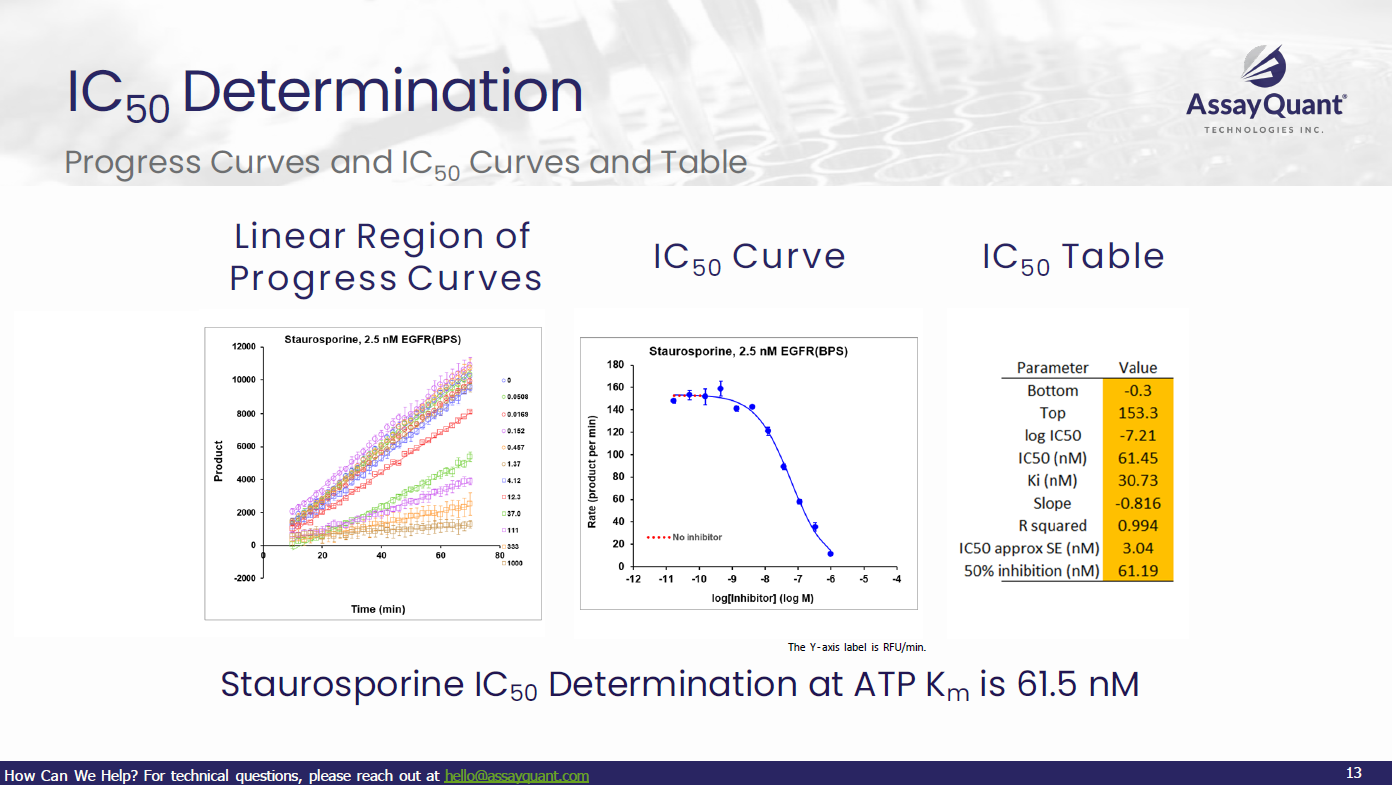
Each validation report provides experimental conditions and data showing:
Protocol
See how the PhosphoSens-Kinetic Assay can be used to find the IC50 of a kinase inhibitor.
Download Protocol →Webinar
Discover how continuous assay formats power deep understanding of kinase function. See how PhosphoSens® assays guide inhibitor profiling, selectivity assessment, and mechanistic characterization.
Watch the Webinar →Service
Need broader selectivity data? KinSight profiling runs your compounds across our full kinase panel under identical PhosphoSens conditions.
Learn about KinSight →Want to hear the latest about our technology? Be among the first to learn about our latest products and services.