Still have questions about our products?
Our scientists can help you choose the right assay format, substrate, and enzyme for your experiment.
Also known as: calcium/calmodulin dependent protein kinase II gamma • CAMK • CAMK-II • CAMKG • MGC26678 • CaM-kinase II gamma • CaMK2-gamma • CaMK-II gamma
.jpg?width=450&name=PhosphoSens%20Packaging%20C%20(3).jpg)
CAMK2G (calcium/calmodulin-dependent protein kinase II gamma) is one of four mammalian CAMK2 isoforms (alpha, beta, gamma, delta) that assemble into dodecameric holoenzymes capable of autonomous activity following autophosphorylation at Thr287. Activation is initiated by Ca2+/calmodulin binding to the regulatory domain, relieving autoinhibition and enabling trans-autophosphorylation. CAMK2G is broadly expressed outside the central nervous system, with prominent roles in cardiac myocytes, hematopoietic cells, and smooth muscle. Key substrates include phospholamban, ryanodine receptor RyR2, histone deacetylase HDAC4, and synapsin. CAMK2G integrates calcium signaling into downstream MAPK, CREB, and NFAT pathways governing gene expression, contractility, and cell survival. Dysregulation is implicated in heart failure, arrhythmia, hematological malignancies, and metabolic disorders. Its restricted tissue expression relative to CAMK2A makes CAMK2G an attractive therapeutic target for cardiac and oncologic indications where isoform selectivity is critical.
CAMK2G poses several assay challenges: its requirement for Ca2+/calmodulin co-activation complicates endpoint formats that cannot monitor activation kinetics in real time, and physiological ATP concentrations are essential to avoid artifactual potency shifts for ATP-competitive inhibitors. ADP-Glo and HTRF require endpoint quenching that misses transient autophosphorylation states and autonomous activation transitions, while radiometric assays carry handling burdens incompatible with rapid SAR campaigns. AssayQuant's PhosphoSens peptide biosensors provide continuous, real-time fluorescence readout of substrate phosphorylation under physiological ATP, enabling direct capture of Ca2+/calmodulin-dependent activation curves and covalent inhibitor kinact/KI determination in a single experiment. This eliminates endpoint artifacts and supports mechanistic mode-of-inhibition studies, profiling of allosteric versus ATP-competitive scaffolds, and high-throughput screening with minimal assay interference.
Have questions about CAMK2G assay design, selectivity panels, or covalent inhibitor characterization?
Ask Our Scientists →Continuous, real-time fluorescent assays optimized for quantitative CAMK2G activity measurements, IC50 determination, and mechanistic studies.
PhosphoSens-Kinetic assays directly quantify enzyme activity by continuously monitoring substrate phosphorylation or dephosphorylation in real time, generating a full progress curve in every well.
Learn more about PhosphoSens-Kinetic →Need pricing or availability? Select a kit or substrate to request a quote below.
Kits
Ready-to-use assay kits containing substrate and all essential reagents.
Automatically save 10% when bundling 10ug recombinant enzyme with your 1,000 assay kit. View enzymes
Substrate
Bulk PhosphoSens® substrate for assay development and high-throughput workflows.
Automatically save 10% when bundling Reagent Packs with your substrate. View Reagent Packs
Select a kit, substrate, or enzyme above. Our team will confirm pricing, availability, and any applicable bundle discounts.
Robust endpoint TRF assays optimized for high-throughput screening and quantitative CAMK2G activity measurement in plate-based workflows.
PhosphoSens-Red assays use europium-based time-resolved fluorescence detection to enable robust, plate-based quantification of enzyme activity, making them well suited for high-throughput screening workflows.
Learn more about PhosphoSens-Red →Need pricing or availability? Select a kit or substrate to request a quote below.
Kits
Ready-to-use TRF assay kits containing substrate and essential reagents.
Automatically save 10% when bundling 10ug recombinant enzyme with your 1,000 assay kit. View enzymes
Substrate
Bulk substrate for PhosphoSens-Red TRF assays and high-throughput workflows.
Automatically save 10% when bundling Reagent Packs with your substrate. View Reagent Packs
Select a kit, substrate, or enzyme above. Our team will confirm pricing, availability, and any applicable bundle discounts.
No recombinant enzymes are currently available for CAMK2G.
PhosphoSens assays are run in solution-based formats that fully accommodate supplementation of Ca2+ and calmodulin at defined concentrations, allowing real-time monitoring of kinase activation and substrate phosphorylation simultaneously. Because fluorescence is recorded continuously, researchers can observe the lag phase associated with Ca2+/CaM-dependent activation and autonomous autophosphorylation transitions that endpoint assays miss entirely.
Yes. By running parallel PhosphoSens assays with purified CAMK2G, CAMK2A, CAMK2B, and CAMK2D under identical physiological ATP conditions, selectivity profiles across isoforms are generated from full progress curves rather than single endpoint measurements. This provides Km-corrected IC50 values that reliably rank isoform selectivity for compound prioritization.
PhosphoSens assays operate in standard 384-well plate formats with fluorescence plate readers, eliminating the wash steps, antibody incubations, and quenching protocols required by HTRF or ADP-Glo. Continuous kinetic readout reduces well-to-well variability and allows early termination of assay reads for confirmed hits, substantially increasing throughput and data quality during primary screening campaigns.
Explore data and documents to support your kinase and phosphatase experiments. Download sample data, protocols and other resources to see how our assays perform and to help you get started in your own lab. All validation data generated using PhosphoSens® assays under recommended conditions.
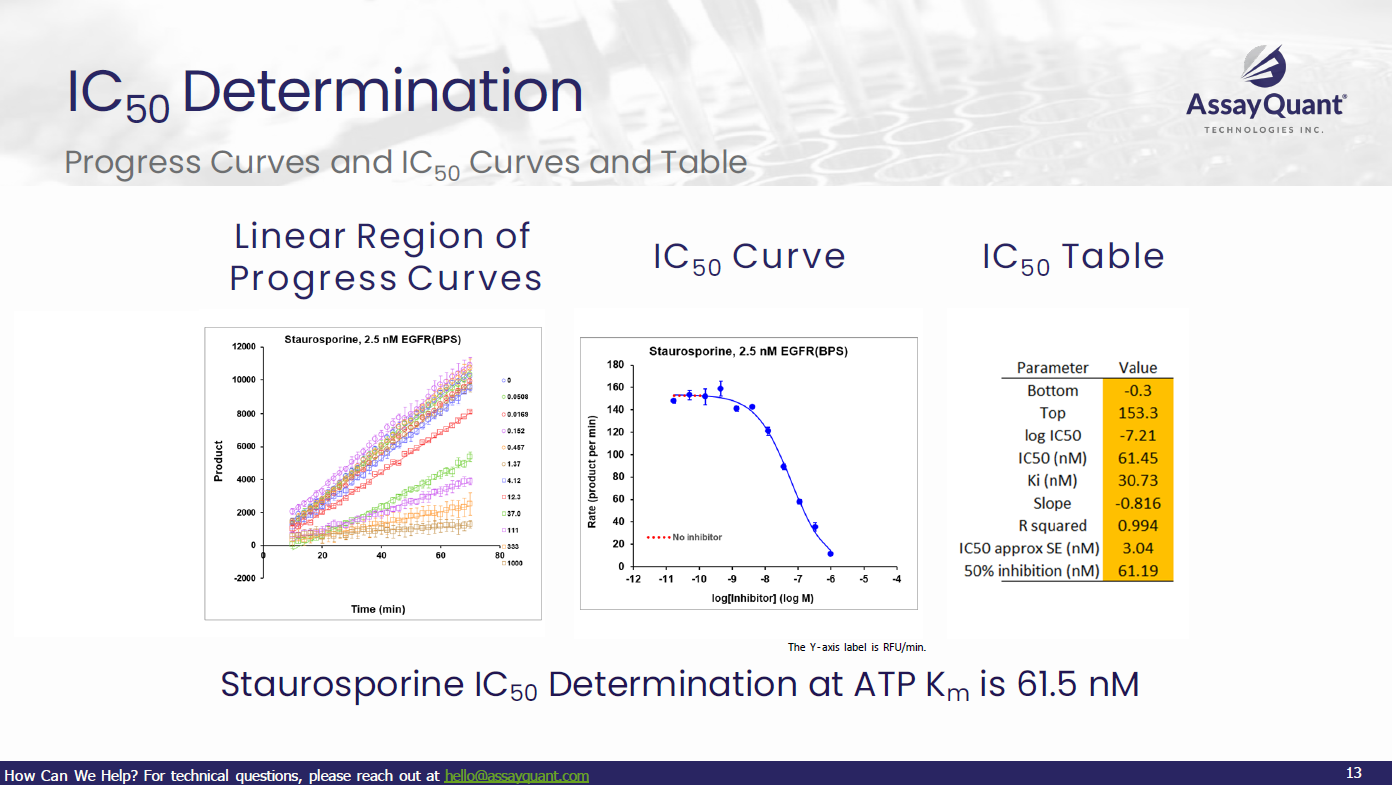
Each validation report provides experimental conditions and data showing:
Protocol
See how the PhosphoSens-Kinetic Assay can be used to find the IC50 of a kinase inhibitor.
Download Protocol →Webinar
Discover how continuous assay formats power deep understanding of kinase function. See how PhosphoSens® assays guide inhibitor profiling, selectivity assessment, and mechanistic characterization.
Watch the Webinar →Service
Need broader selectivity data? KinSight profiling runs your compounds across our full kinase panel under identical PhosphoSens conditions.
Learn about KinSight →Want to hear the latest about our technology? Be among the first to learn about our latest products and services.