Still have questions about our products?
Our scientists can help you choose the right assay format, substrate, and enzyme for your experiment.
Also known as: ARG • ABLL • Abelson-related gene
.jpg?width=450&name=PhosphoSens%20Packaging%20C%20(3).jpg)
ABL2 (also known as ARG, Abelson-related gene) is a non-receptor tyrosine kinase belonging to the Abl family, which also includes the closely related ABL1. ABL2 contains SH2 and SH3 domains that regulate its kinase activity through intramolecular autoinhibitory interactions, and its activation is governed by relief of this autoinhibition via phosphorylation, protein-protein interactions, or oncogenic fusion events. Key substrates include cortactin, p190RhoGAP, and various actin-regulatory proteins, linking ABL2 to cytoskeletal remodeling, cell migration, and invasion. ABL2 signals through the RAS/MAPK, PI3K/AKT, and Rho GTPase pathways to control proliferation and survival. Aberrant ABL2 activity has been implicated in solid tumors including breast, colorectal, and brain cancers, as well as leukemia via chromosomal translocations generating oncogenic fusion kinases. The kinase domain of ABL2 shares high homology with ABL1, making it a co-target of clinically proven ABL inhibitors and an important drug discovery target in its own right for both hematologic malignancies and metastatic solid tumors.
Profiling ABL2 kinase activity presents several assay challenges: its autoinhibitory regulation demands careful attention to enzyme activation state, and high substrate selectivity requires well-validated peptide substrates. Traditional endpoint methods such as ADP-Glo and HTRF can miss transient kinetic phenomena, are susceptible to compound interference, and require fixed ATP concentrations far above physiological levels, distorting IC50 values for ATP-competitive inhibitors. Radiometric assays add radioactive handling burdens and poor throughput. PhosphoSens continuous fluorescent assays monitor ABL2-mediated substrate phosphorylation in real time using physiological ATP concentrations, generating complete progress curves that reveal mechanism of action, detect covalent inhibitors through kinact/KI determination, and eliminate endpoint artifacts. This approach enables robust selectivity profiling against ABL1 and enables higher-quality SAR decisions during lead optimization campaigns targeting ABL2.
Have questions about ABL2 assay design, selectivity panels, or covalent inhibitor characterization?
Ask Our Scientists →Continuous, real-time fluorescent assays optimized for quantitative ABL2 activity measurements, IC50 determination, and mechanistic studies.
PhosphoSens-Kinetic assays directly quantify enzyme activity by continuously monitoring substrate phosphorylation or dephosphorylation in real time, generating a full progress curve in every well.
Learn more about PhosphoSens-Kinetic →Need pricing or availability? Select a kit or substrate to request a quote below.
Kits
Ready-to-use assay kits containing substrate and all essential reagents.
Automatically save 10% when bundling 10ug recombinant enzyme with your 1,000 assay kit. View enzymes
Substrate
Bulk PhosphoSens® substrate for assay development and high-throughput workflows.
Automatically save 10% when bundling Reagent Packs with your substrate. View Reagent Packs
Select a kit, substrate, or enzyme above. Our team will confirm pricing, availability, and any applicable bundle discounts.
Robust endpoint TRF assays optimized for high-throughput screening and quantitative ABL2 activity measurement in plate-based workflows.
PhosphoSens-Red assays use europium-based time-resolved fluorescence detection to enable robust, plate-based quantification of enzyme activity, making them well suited for high-throughput screening workflows.
Learn more about PhosphoSens-Red →Need pricing or availability? Select a kit or substrate to request a quote below.
Kits
Ready-to-use TRF assay kits containing substrate and essential reagents.
Automatically save 10% when bundling 10ug recombinant enzyme with your 1,000 assay kit. View enzymes
Substrate
Bulk substrate for PhosphoSens-Red TRF assays and high-throughput workflows.
Automatically save 10% when bundling Reagent Packs with your substrate. View Reagent Packs
Select a kit, substrate, or enzyme above. Our team will confirm pricing, availability, and any applicable bundle discounts.
Wild-type and mutant forms of ABL2 for assay development, kinase profiling, and mechanistic studies. Enzymes are supplied active and optimized for PhosphoSens® substrates.
Human • Baculovirus-Insect Cells
Price: $$348.00
PhosphoSens uses proprietary chelation-enhanced fluorescent (CHEF) peptide substrates that produce a real-time fluorescent signal change upon phosphorylation by ABL2, eliminating the need for antibodies or secondary detection reagents. This generates complete kinetic progress curves from a single reaction well, enabling precise rate measurements and mechanistic characterization. The approach is compatible with physiological ATP concentrations, providing more biologically relevant inhibitor potency data.
Yes, AssayQuant offers optimized substrate and assay conditions for both ABL1 and ABL2, enabling direct head-to-head selectivity profiling within the same fluorescent assay platform. Because both assays run under matched physiological ATP conditions, IC50 values are directly comparable across the two kinases. This is critical for developing isoform-selective inhibitors or understanding the dual-targeting profile of clinical Abl inhibitors.
Absolutely. The continuous, real-time nature of PhosphoSens progress curves makes it uniquely suited for determining kinact/KI parameters that define covalent inhibitor efficiency, something endpoint assays like ADP-Glo or HTRF cannot reliably capture. By monitoring the time-dependent loss of ABL2 activity in a single kinetic experiment, researchers can rapidly distinguish covalent from reversible mechanisms and rank covalent warhead efficiency during lead optimization.
Explore data and documents to support your kinase and phosphatase experiments. Download sample data, protocols and other resources to see how our assays perform and to help you get started in your own lab. All validation data generated using PhosphoSens® assays under recommended conditions.
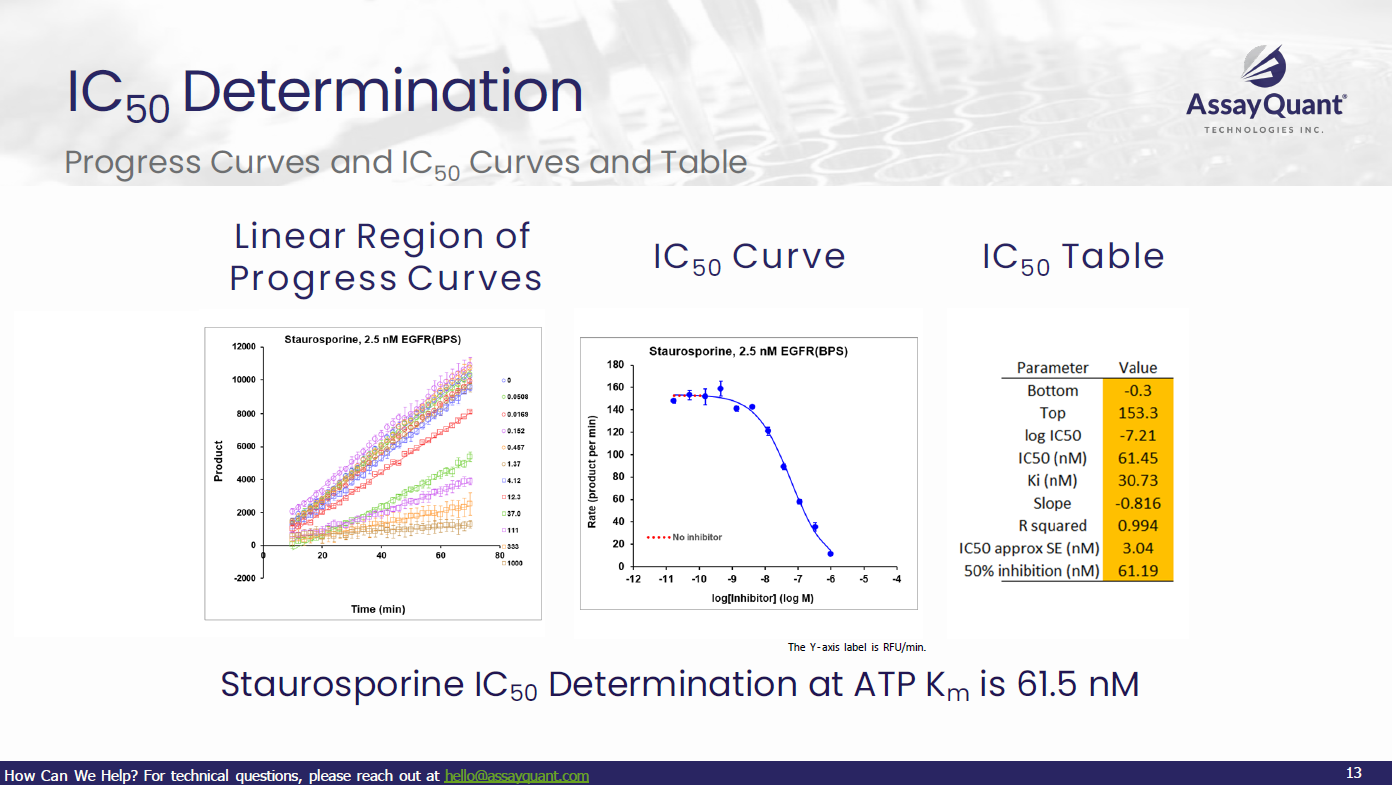
Each validation report provides experimental conditions and data showing:
Protocol
See how the PhosphoSens-Kinetic Assay can be used to find the IC50 of a kinase inhibitor.
Download Protocol →Webinar
Discover how continuous assay formats power deep understanding of kinase function. See how PhosphoSens® assays guide inhibitor profiling, selectivity assessment, and mechanistic characterization.
Watch the Webinar →Service
Need broader selectivity data? KinSight profiling runs your compounds across our full kinase panel under identical PhosphoSens conditions.
Learn about KinSight →Want to hear the latest about our technology? Be among the first to learn about our latest products and services.