Still have questions about our products?
Our scientists can help you choose the right assay format, substrate, and enzyme for your experiment.
Also known as: Bruton tyrosine kinase • IMD1 • AGMX1 • AT • BPK • PSCTK1 • ATK • Bruton's tyrosine kinase • XLA • Agammaglobulinaemia tyrosine kinase • B cell progenitor kinase
.jpg?width=450&name=PhosphoSens%20Packaging%20C%20(3).jpg)
Bruton tyrosine kinase (BTK) is a non-receptor tyrosine kinase and founding member of the Tec family, which also includes ITK, TEC, BMX, and TXK. BTK is activated downstream of the B-cell receptor (BCR) through a two-step mechanism: first, LYN-mediated phosphorylation of the PH domain recruits BTK to the plasma membrane, where PI3K-generated PIP3 promotes autophosphorylation at Y551 in the activation loop by SYK, followed by autophosphorylation at Y223 in the SH3 domain. Key substrates include PLCγ2, which drives calcium mobilization, PKCβ, and NF-κB pathway effectors. BTK is indispensable for BCR signaling, B-cell development, differentiation, and survival. Dysregulation drives B-cell malignancies including CLL, MCL, DLBCL, and Waldenström macroglobulinemia, as well as autoimmune diseases such as rheumatoid arthritis and lupus. Loss-of-function mutations cause X-linked agammaglobulinemia (XLA). BTK's central role in oncogenic BCR signaling, its druggable ATP-binding pocket featuring a unique cysteine (C481), and its restricted hematopoietic expression make it a premier oncology and immunology drug target.
BTK assay development is complicated by its dual-substrate kinetics (PLCγ2-derived peptides vs. full-length substrates), the prevalence of covalent irreversible and reversible-covalent inhibitors targeting C481, and artifacts introduced by endpoint assays when measuring covalent inactivation. ADP-Glo and HTRF methods cannot distinguish time-dependent inhibition from equilibrium binding and require quenching steps that obscure kinact/KI parameters critical for covalent drug characterization. Radiometric assays offer sensitivity but lack real-time resolution. PhosphoSens continuous fluorescent kinase assays use chelation-enhanced fluorescent (CSox) peptide substrates to generate full progress curves at physiological ATP concentrations, enabling direct extraction of kinact/KI for covalent BTK inhibitors like ibrutinib, acalabrutinib, and zanubrutinib. Real-time monitoring eliminates endpoint artifacts, supports compound selectivity profiling, and dramatically accelerates SAR campaigns.
Have questions about BTK assay design, selectivity panels, or covalent inhibitor characterization?
Ask Our Scientists →Continuous, real-time fluorescent assays optimized for quantitative BTK activity measurements, IC50 determination, and mechanistic studies.
PhosphoSens-Kinetic assays directly quantify enzyme activity by continuously monitoring substrate phosphorylation or dephosphorylation in real time, generating a full progress curve in every well.
Learn more about PhosphoSens-Kinetic →Need pricing or availability? Select a kit or substrate to request a quote below.
Kits
Ready-to-use assay kits containing substrate and all essential reagents.
Automatically save 10% when bundling 10ug recombinant enzyme with your 1,000 assay kit. View enzymes
Substrate
Bulk PhosphoSens® substrate for assay development and high-throughput workflows.
Automatically save 10% when bundling Reagent Packs with your substrate. View Reagent Packs
Select a kit, substrate, or enzyme above. Our team will confirm pricing, availability, and any applicable bundle discounts.
Robust endpoint TRF assays optimized for high-throughput screening and quantitative BTK activity measurement in plate-based workflows.
PhosphoSens-Red assays use europium-based time-resolved fluorescence detection to enable robust, plate-based quantification of enzyme activity, making them well suited for high-throughput screening workflows.
Learn more about PhosphoSens-Red →Need pricing or availability? Select a kit or substrate to request a quote below.
Kits
Ready-to-use TRF assay kits containing substrate and essential reagents.
Automatically save 10% when bundling 10ug recombinant enzyme with your 1,000 assay kit. View enzymes
Substrate
Bulk substrate for PhosphoSens-Red TRF assays and high-throughput workflows.
Automatically save 10% when bundling Reagent Packs with your substrate. View Reagent Packs
Select a kit, substrate, or enzyme above. Our team will confirm pricing, availability, and any applicable bundle discounts.
Wild-type and mutant forms of BTK for assay development, kinase profiling, and mechanistic studies. Enzymes are supplied active and optimized for PhosphoSens® substrates.
Rat • Baculovirus-Insect Cells
Price: $$348.00
PhosphoSens continuous assays monitor substrate phosphorylation in real time, generating full progress curves that directly capture the time-dependent loss of BTK activity caused by covalent inactivators. By fitting progress curves at multiple inhibitor concentrations, kinact and KI can be extracted in a single experiment without the endpoint artifacts that confound ADP-Glo or HTRF approaches. This is essential for characterizing irreversible inhibitors like ibrutinib and acalabrutinib and for distinguishing covalent from non-covalent binding modes.
AssayQuant offers optimized CSox-based peptide substrates derived from BTK's physiological substrate PLCu03b32, engineered to balance Km, fluorescence dynamic range, and aqueous solubility. These substrates are validated at physiological ATP concentrations (matching cellular Km,ATP ~1 mM) to provide pharmacologically relevant IC50 values that correlate with cellular potency. Custom substrate development is also available for specific research needs.
Yes, AssayQuant provides continuous kinase assays for multiple Tec family members including ITK and TEC, enabling direct head-to-head selectivity profiling under identical assay conditions. Because all assays use the same PhosphoSens platform with physiological ATP, IC50 values are directly comparable across kinases without normalization artifacts introduced by different detection chemistries. This is particularly valuable for distinguishing BTK-selective inhibitors from pan-Tec inhibitors in the context of autoimmune drug discovery.
Explore data and documents to support your kinase and phosphatase experiments. Download sample data, protocols and other resources to see how our assays perform and to help you get started in your own lab. All validation data generated using PhosphoSens® assays under recommended conditions.
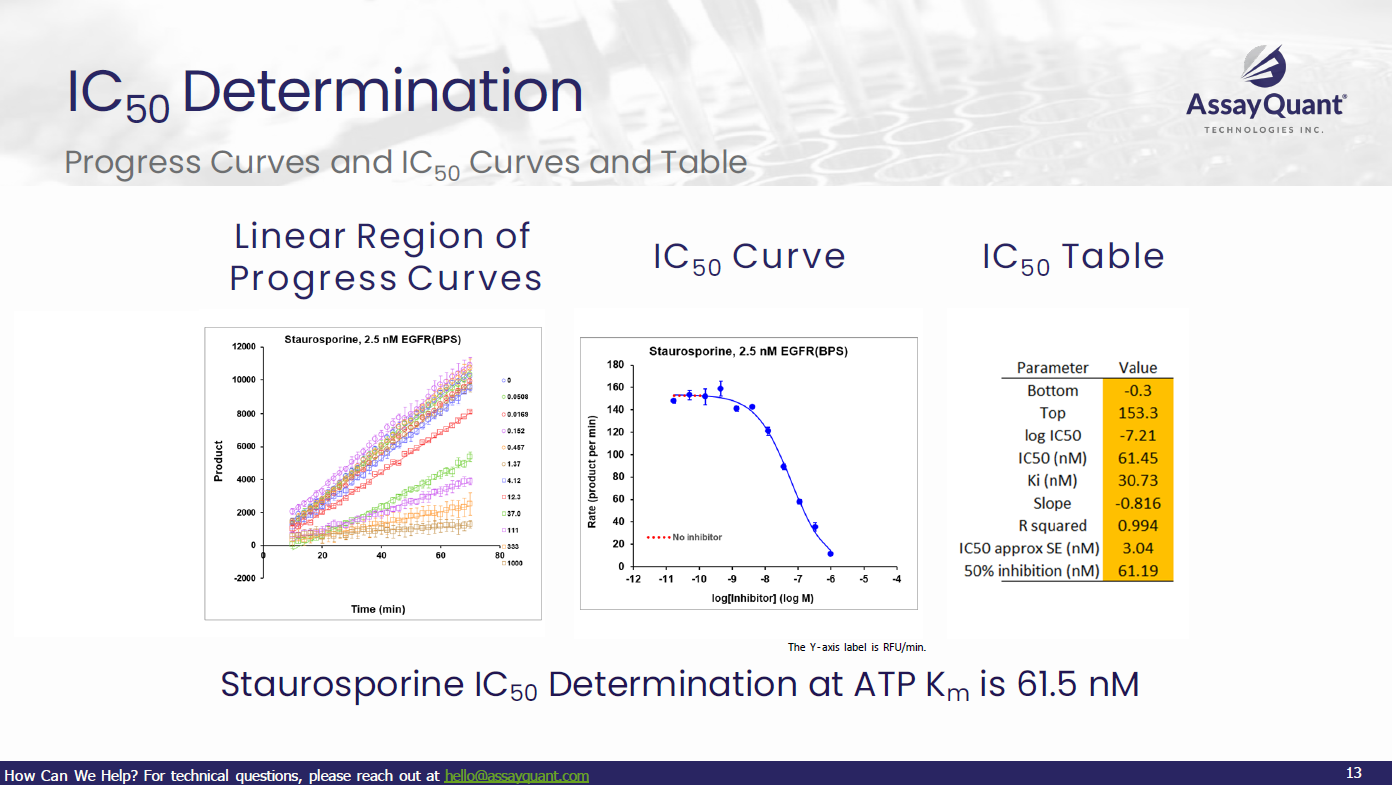
Each validation report provides experimental conditions and data showing:
Protocol
See how the PhosphoSens-Kinetic Assay can be used to find the IC50 of a kinase inhibitor.
Download Protocol →Webinar
Discover how continuous assay formats power deep understanding of kinase function. See how PhosphoSens® assays guide inhibitor profiling, selectivity assessment, and mechanistic characterization.
Watch the Webinar →Service
Need broader selectivity data? KinSight profiling runs your compounds across our full kinase panel under identical PhosphoSens conditions.
Learn about KinSight →Want to hear the latest about our technology? Be among the first to learn about our latest products and services.