Still have questions about our products?
Our scientists can help you choose the right assay format, substrate, and enzyme for your experiment.
Also known as: AurC • aurora kinase C • ARK3, AurC • AIE2 • AIK3 • STK13 • AIE1 • Ipl1-related kinase 3 • Aurora-C • STKD
.jpg?width=450&name=PhosphoSens%20Packaging%20C%20(3).jpg)
Aurora kinase C (AURKC) belongs to the Aurora serine/threonine kinase family, which includes AURKA and AURKB. AURKC is predominantly expressed in the testes and is essential for male meiosis, regulating chromosome segregation and spindle assembly during spermatogenesis. It shares structural and functional homology with AURKB and can substitute for AURKB in the chromosomal passenger complex (CPC), interacting with INCENP, Survivin, and Borealin. Key substrates include histone H3 (Ser10/Ser28), INCENP, and MKlp2. AURKC participates in pathways governing mitotic fidelity, cytokinesis, and spindle checkpoint activation. While less studied than AURKA or AURKB, AURKC overexpression has been detected in multiple human cancers including breast, liver, and colorectal tumors, where it may compensate for AURKB and drive chromosomal instability. Loss-of-function mutations in AURKC cause male infertility due to macrozoospermia. Its tissue-restricted normal expression and oncogenic overexpression profile make it an attractive cancer drug target with a potentially favorable therapeutic window.
AURKC drug discovery presents unique assay challenges due to its low endogenous expression outside testes, difficulty obtaining recombinant active enzyme, and the need to distinguish AURKC activity from the closely related AURKB. Traditional endpoint assays such as ADP-Glo and HTRF require quenched timepoints that miss early kinetic events, obscure compound interference with the substrate-enzyme interaction, and cannot capture covalent or slow-binding inhibitor mechanisms. Radiometric assays provide sensitivity but are low-throughput and hazardous. PhosphoSens continuous fluorescent kinase assays monitor substrate phosphorylation in real time using physiological ATP concentrations, generating full progress curves that reveal mechanistic nuance, accurately measure kinact/KI for covalent inhibitors, and eliminate endpoint artifacts. This enables robust IC50, Km, and selectivity profiling against AURKB under identical conditions, accelerating identification of AURKC-selective chemical matter relevant to cancer and male fertility research.
Have questions about AURKC assay design, selectivity panels, or covalent inhibitor characterization?
Ask Our Scientists →Continuous, real-time fluorescent assays optimized for quantitative AURKC activity measurements, IC50 determination, and mechanistic studies.
PhosphoSens-Kinetic assays directly quantify enzyme activity by continuously monitoring substrate phosphorylation or dephosphorylation in real time, generating a full progress curve in every well.
Learn more about PhosphoSens-Kinetic →Need pricing or availability? Select a kit or substrate to request a quote below.
Kits
Ready-to-use assay kits containing substrate and all essential reagents.
Automatically save 10% when bundling 10ug recombinant enzyme with your 1,000 assay kit. View enzymes
Substrate
Bulk PhosphoSens® substrate for assay development and high-throughput workflows.
Automatically save 10% when bundling Reagent Packs with your substrate. View Reagent Packs
Select a kit, substrate, or enzyme above. Our team will confirm pricing, availability, and any applicable bundle discounts.
Robust endpoint TRF assays optimized for high-throughput screening and quantitative AURKC activity measurement in plate-based workflows.
PhosphoSens-Red assays use europium-based time-resolved fluorescence detection to enable robust, plate-based quantification of enzyme activity, making them well suited for high-throughput screening workflows.
Learn more about PhosphoSens-Red →Need pricing or availability? Select a kit or substrate to request a quote below.
Kits
Ready-to-use TRF assay kits containing substrate and essential reagents.
Automatically save 10% when bundling 10ug recombinant enzyme with your 1,000 assay kit. View enzymes
Substrate
Bulk substrate for PhosphoSens-Red TRF assays and high-throughput workflows.
Automatically save 10% when bundling Reagent Packs with your substrate. View Reagent Packs
Select a kit, substrate, or enzyme above. Our team will confirm pricing, availability, and any applicable bundle discounts.
Wild-type and mutant forms of AURKC for assay development, kinase profiling, and mechanistic studies. Enzymes are supplied active and optimized for PhosphoSens® substrates.
Human • Baculovirus-Insect Cells
Price: $$348.00
PhosphoSens continuous assays use the same peptide substrate under identical physiological ATP conditions for both AURKB and AURKC, allowing direct kinetic comparison in parallel reactions. Real-time progress curves reveal differences in compound potency and binding kinetics without endpoint-to-endpoint variability. This is critical for identifying inhibitors that discriminate between these highly homologous kinases.
Yes. Because PhosphoSens monitors phosphorylation continuously, deviations from linear kinetics caused by covalent or slow-binding inhibitors are immediately visible in the progress curves. Full kinact/KI parameters for covalent inhibitors and kon/koff for slow binders can be extracted from a single experiment, capabilities not accessible with endpoint ADP-Glo or HTRF formats.
AssayQuant PhosphoSens assays are run at physiological ATP concentrations (approximating cellular ATP levels near 1 mM), which directly affects IC50 values for ATP-competitive inhibitors. Using physiological ATP yields IC50 data that more accurately predicts cellular potency compared to assays run at low ATP concentrations that artificially inflate apparent compound potency.
Explore data and documents to support your kinase and phosphatase experiments. Download sample data, protocols and other resources to see how our assays perform and to help you get started in your own lab. All validation data generated using PhosphoSens® assays under recommended conditions.
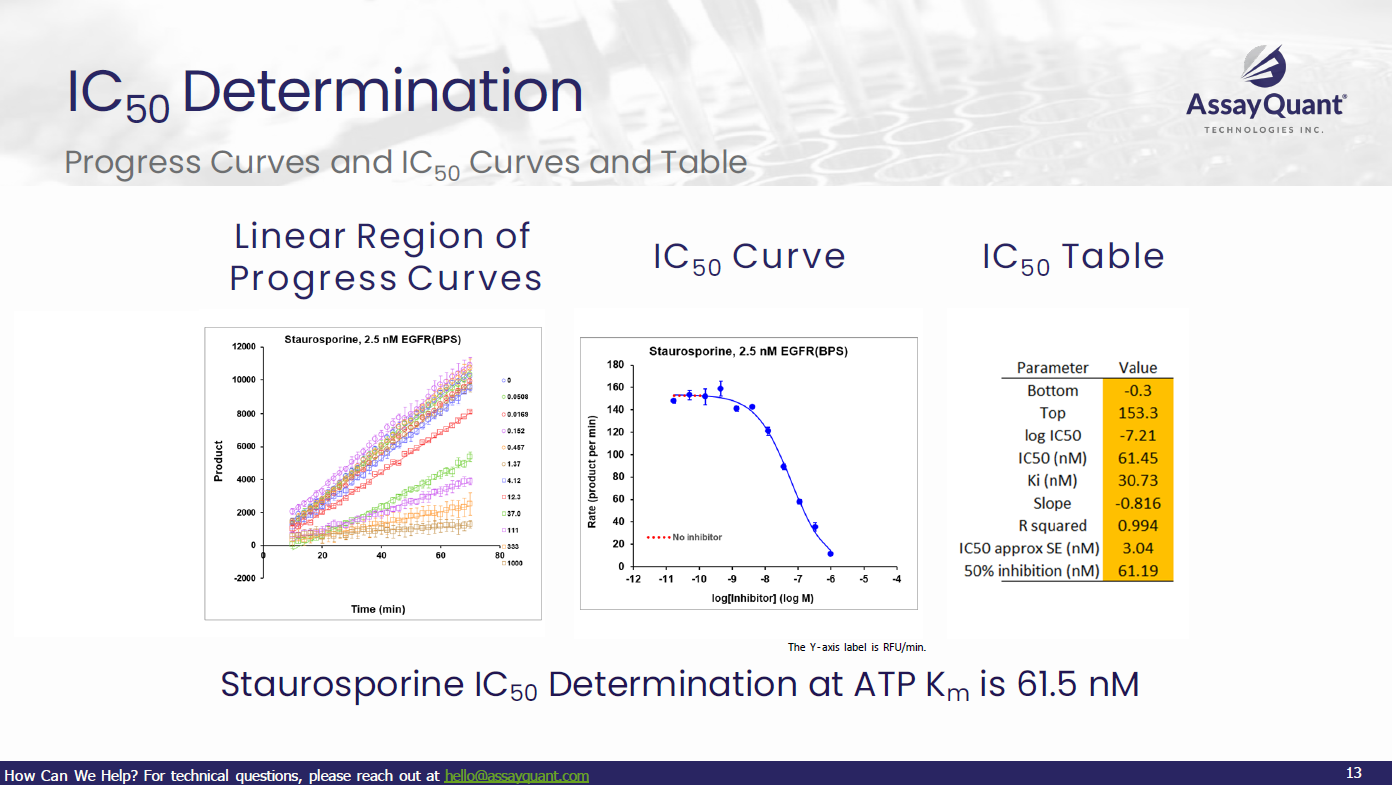
Each validation report provides experimental conditions and data showing:
Protocol
See how the PhosphoSens-Kinetic Assay can be used to find the IC50 of a kinase inhibitor.
Download Protocol →Webinar
Discover how continuous assay formats power deep understanding of kinase function. See how PhosphoSens® assays guide inhibitor profiling, selectivity assessment, and mechanistic characterization.
Watch the Webinar →Service
Need broader selectivity data? KinSight profiling runs your compounds across our full kinase panel under identical PhosphoSens conditions.
Learn about KinSight →Want to hear the latest about our technology? Be among the first to learn about our latest products and services.