Still have questions about our products?
Our scientists can help you choose the right assay format, substrate, and enzyme for your experiment.
Also known as: AurB • aurora kinase B • aurora-1 • aurora-B • IPL1 • PPP1R48 • protein phosphatase 1, regulatory subunit 48 • AIK2 • AIM1 • ARK2 • STK5 • AIM-1 • STK12 • IPL1-related kinase 2 • Aurora-2
.jpg?width=450&name=PhosphoSens%20Packaging%20C%20(3).jpg)
Aurora Kinase B (AURKB) is a serine/threonine kinase and founding member of the chromosomal passenger complex (CPC), which also includes INCENP, Survivin, and Borealin. AURKB is activated through autophosphorylation at Thr232 and allosteric stimulation by INCENP, reaching peak activity during mitosis. Key substrates include histone H3 (Ser10 and Ser28), MCAK, MIS12, and KIF2C, coordinating chromosome condensation, kinetochore-microtubule attachments, and cytokinesis. AURKB governs the spindle assembly checkpoint by correcting erroneous kinetochore attachments, ensuring faithful chromosome segregation. Dysregulation of AURKB drives chromosomal instability (CIN) and aneuploidy, hallmarks of cancer. AURKB is overexpressed in colorectal, breast, lung, hematologic, and gastric malignancies and correlates with poor prognosis. Its essential mitotic role, combined with frequent overexpression in tumors, makes AURKB an attractive oncology drug target, with selective inhibition inducing mitotic catastrophe and tumor cell death while offering a therapeutic window over normal tissues.
AURKB assay development is complicated by its obligate dependence on the INCENP activator fragment for full catalytic activity, requiring careful co-reconstitution to avoid underestimating inhibitor potency. Endpoint methods such as ADP-Glo and HTRF require fixed ATP concentrations that deviate from physiological levels, distorting Ki measurements for ATP-competitive inhibitors and missing covalent or slow-binding mechanisms. Radiometric assays provide sensitivity but create throughput and safety bottlenecks. AssayQuant's PhosphoSens CSox-based peptide substrates enable continuous, real-time fluorescent monitoring of AURKB phosphorylation at physiological ATP concentrations, generating full progress curves that faithfully capture kinact/KI for covalent inhibitors, residence time effects, and authentic Km/Vmax parameters. This eliminates endpoint artifacts, reduces assay variability, and accelerates SAR campaigns against this critical mitotic kinase.
Have questions about AURKB assay design, selectivity panels, or covalent inhibitor characterization?
Ask Our Scientists →Continuous, real-time fluorescent assays optimized for quantitative AURKB activity measurements, IC50 determination, and mechanistic studies.
PhosphoSens-Kinetic assays directly quantify enzyme activity by continuously monitoring substrate phosphorylation or dephosphorylation in real time, generating a full progress curve in every well.
Learn more about PhosphoSens-Kinetic →Need pricing or availability? Select a kit or substrate to request a quote below.
Kits
Ready-to-use assay kits containing substrate and all essential reagents.
Automatically save 10% when bundling 10ug recombinant enzyme with your 1,000 assay kit. View enzymes
Substrate
Bulk PhosphoSens® substrate for assay development and high-throughput workflows.
Automatically save 10% when bundling Reagent Packs with your substrate. View Reagent Packs
Select a kit, substrate, or enzyme above. Our team will confirm pricing, availability, and any applicable bundle discounts.
Robust endpoint TRF assays optimized for high-throughput screening and quantitative AURKB activity measurement in plate-based workflows.
PhosphoSens-Red assays use europium-based time-resolved fluorescence detection to enable robust, plate-based quantification of enzyme activity, making them well suited for high-throughput screening workflows.
Learn more about PhosphoSens-Red →Need pricing or availability? Select a kit or substrate to request a quote below.
Kits
Ready-to-use TRF assay kits containing substrate and essential reagents.
Automatically save 10% when bundling 10ug recombinant enzyme with your 1,000 assay kit. View enzymes
Substrate
Bulk substrate for PhosphoSens-Red TRF assays and high-throughput workflows.
Automatically save 10% when bundling Reagent Packs with your substrate. View Reagent Packs
Select a kit, substrate, or enzyme above. Our team will confirm pricing, availability, and any applicable bundle discounts.
Wild-type and mutant forms of AURKB for assay development, kinase profiling, and mechanistic studies. Enzymes are supplied active and optimized for PhosphoSens® substrates.
Human • Baculovirus-Insect Cells
Price: $$338.00
AURKB autophosphorylation alone yields submaximal activity; the IN-box domain of INCENP binds the AURKB activation loop and dramatically stimulates catalytic turnover by stabilizing the active conformation. Omitting INCENP from assay reconstitution results in poor signal, underestimation of Vmax, and artifactually weak potency readouts for ATP-competitive inhibitors. AssayQuant's AURKB reagents are optimized with the appropriate INCENP co-activator fragment to ensure physiologically relevant activity.
ADP-Glo requires non-physiological ATP concentrations and fixed reaction endpoints, which distort IC50 values for ATP-competitive AURKB inhibitors according to the Cheng-Prusoff relationship and mask time-dependent inhibition. PhosphoSens continuous assays monitor substrate phosphorylation in real time using a fluorescent CSox sensor, enabling IC50 and Ki determinations at physiological ATP levels and revealing slow-on/slow-off kinetics or covalent mechanisms that endpoint formats cannot detect.
Yes. AssayQuant offers parallel PhosphoSens assay kits for both AURKA and AURKB using matched CSox-peptide substrates and standardized assay conditions, enabling direct head-to-head selectivity profiling under identical ATP concentrations and buffer conditions. This side-by-side format is critical for advancing selective AURKB inhibitors that avoid AURKA-mediated toxicity, and the continuous readout captures any differential binding kinetics between the two isoforms.
Explore data and documents to support your kinase and phosphatase experiments. Download sample data, protocols and other resources to see how our assays perform and to help you get started in your own lab. All validation data generated using PhosphoSens® assays under recommended conditions.
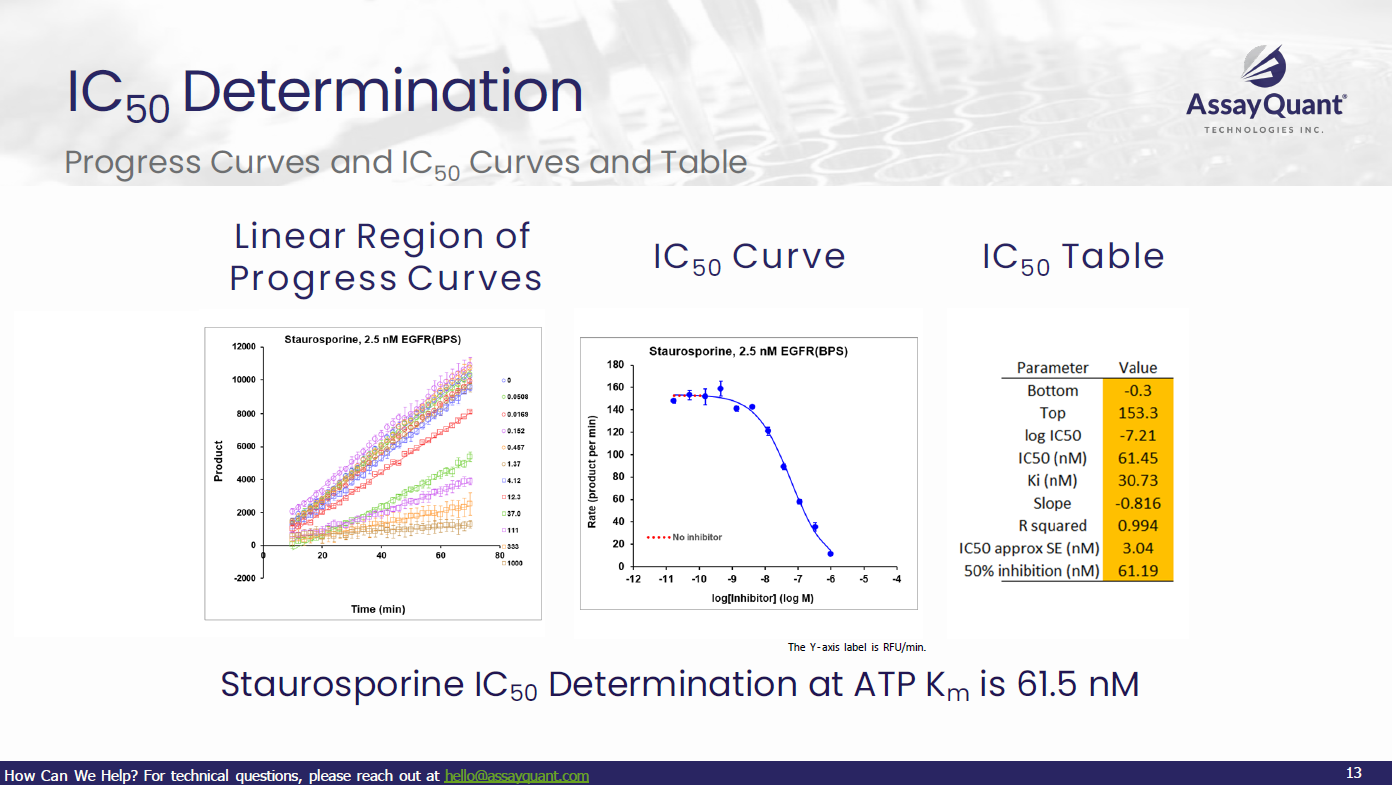
Each validation report provides experimental conditions and data showing:
Protocol
See how the PhosphoSens-Kinetic Assay can be used to find the IC50 of a kinase inhibitor.
Download Protocol →Webinar
Discover how continuous assay formats power deep understanding of kinase function. See how PhosphoSens® assays guide inhibitor profiling, selectivity assessment, and mechanistic characterization.
Watch the Webinar →Service
Need broader selectivity data? KinSight profiling runs your compounds across our full kinase panel under identical PhosphoSens conditions.
Learn about KinSight →Want to hear the latest about our technology? Be among the first to learn about our latest products and services.