Still have questions about our products?
Our scientists can help you choose the right assay format, substrate, and enzyme for your experiment.
Also known as: Polo like kinase 1 • PLK • STPK13 • ADRB2 • PLK-1
.jpg?width=450&name=PhosphoSens%20Packaging%20C%20(3).jpg)
Polo-like kinase 1 (PLK1) is the founding and best-characterized member of the polo-like kinase (PLK) family, which in humans includes PLK1–5. PLK1 is a Ser/Thr kinase defined by an N-terminal catalytic domain and a C-terminal polo-box domain (PBD) that mediates substrate docking via phosphoserine/phosphothreonine motifs. PLK1 is activated at mitotic entry through phosphorylation at T210 within the T-loop by Aurora A (in complex with Bora), creating a feed-forward activation cascade. Key substrates include CDC25C, WEE1, BUBR1, and the APC/C activator CDC20, positioning PLK1 as a master regulator of mitotic entry, spindle assembly checkpoint silencing, centrosome maturation, and cytokinesis. PLK1 is overexpressed in a broad spectrum of human cancers—including non-small-cell lung, colorectal, breast, and pancreatic cancers—where elevated expression correlates with poor prognosis and genomic instability. Its near-exclusive expression in proliferating cells and essential role in tumor cell division make PLK1 a compelling oncology drug target with a favorable therapeutic window.
PLK1 assay development presents several challenges: the kinase requires activation-loop phosphorylation for full activity, exhibits substrate selectivity influenced by PBD-mediated docking, and is frequently screened at near-physiological ATP concentrations to capture clinically relevant inhibitor potency. Traditional endpoint assays such as ADP-Glo and HTRF measure a single time point, masking non-linear kinetics caused by product inhibition, compound autofluorescence, or inhibitor solubility issues—artifacts that distort IC50 values and Ki determinations. Radiometric formats add handling complexity and waste-disposal costs. AssayQuant's PhosphoSens CSox-based peptide substrates enable continuous, real-time fluorescence monitoring of PLK1 phosphorylation throughout the full reaction progress curve, allowing detection of kinetic anomalies, accurate Km/Vmax determination at physiological ATP, and direct mechanistic characterization of covalent or slow-binding inhibitors through kinact/KI measurement—all in a homogeneous, no-wash, microplate format compatible with HTS and SAR campaigns.
Have questions about PLK1 assay design, selectivity panels, or covalent inhibitor characterization?
Ask Our Scientists →Continuous, real-time fluorescent assays optimized for quantitative PLK1 activity measurements, IC50 determination, and mechanistic studies.
PhosphoSens-Kinetic assays directly quantify enzyme activity by continuously monitoring substrate phosphorylation or dephosphorylation in real time, generating a full progress curve in every well.
Learn more about PhosphoSens-Kinetic →Need pricing or availability? Select a kit or substrate to request a quote below.
Kits
Ready-to-use assay kits containing substrate and all essential reagents.
Automatically save 10% when bundling 10ug recombinant enzyme with your 1,000 assay kit. View enzymes
Substrate
Bulk PhosphoSens® substrate for assay development and high-throughput workflows.
Automatically save 10% when bundling Reagent Packs with your substrate. View Reagent Packs
Select a kit, substrate, or enzyme above. Our team will confirm pricing, availability, and any applicable bundle discounts.
No PhosphoSens-Red format is currently available for PLK1.
Select a kit, substrate, or enzyme above. Our team will confirm pricing, availability, and any applicable bundle discounts.
Wild-type and mutant forms of PLK1 for assay development, kinase profiling, and mechanistic studies. Enzymes are supplied active and optimized for PhosphoSens® substrates.
Human • Baculovirus-Insect Cells
Price: $$348.00
AssayQuant provides PhosphoSens CSox-based peptide substrates engineered from validated PLK1 phosphorylation consensus sequences, enabling real-time fluorescent readout without antibodies or secondary detection reagents. The substrates are optimized for use at physiological ATP concentrations (1 mM), ensuring that inhibitor IC50 values are translationally relevant. Contact our technical team for current catalog options and custom substrate development.
PhosphoSens assays are performed with recombinant PLK1 that is pre-phosphorylated at T210 to ensure maximal and reproducible catalytic activity, mimicking the activated mitotic form of the kinase. The continuous progress-curve format immediately reveals any lot-to-lot variability in enzyme activity, allowing researchers to normalize data and detect activity anomalies before compound screening. This real-time visibility is not possible with single-endpoint formats such as ADP-Glo.
Yes. Because PhosphoSens generates a complete fluorescent progress curve in real time, it is uniquely suited to determine kinact/KI parameters for covalent inhibitors targeting PLK1's ATP-binding site or allosteric cysteine residues. The time-dependent curvature in reaction progress directly reports on inactivation kinetics, enabling mechanistic differentiation of covalent versus reversible inhibition that endpoint assays cannot provide.
Explore data and documents to support your kinase and phosphatase experiments. Download sample data, protocols and other resources to see how our assays perform and to help you get started in your own lab. All validation data generated using PhosphoSens® assays under recommended conditions.
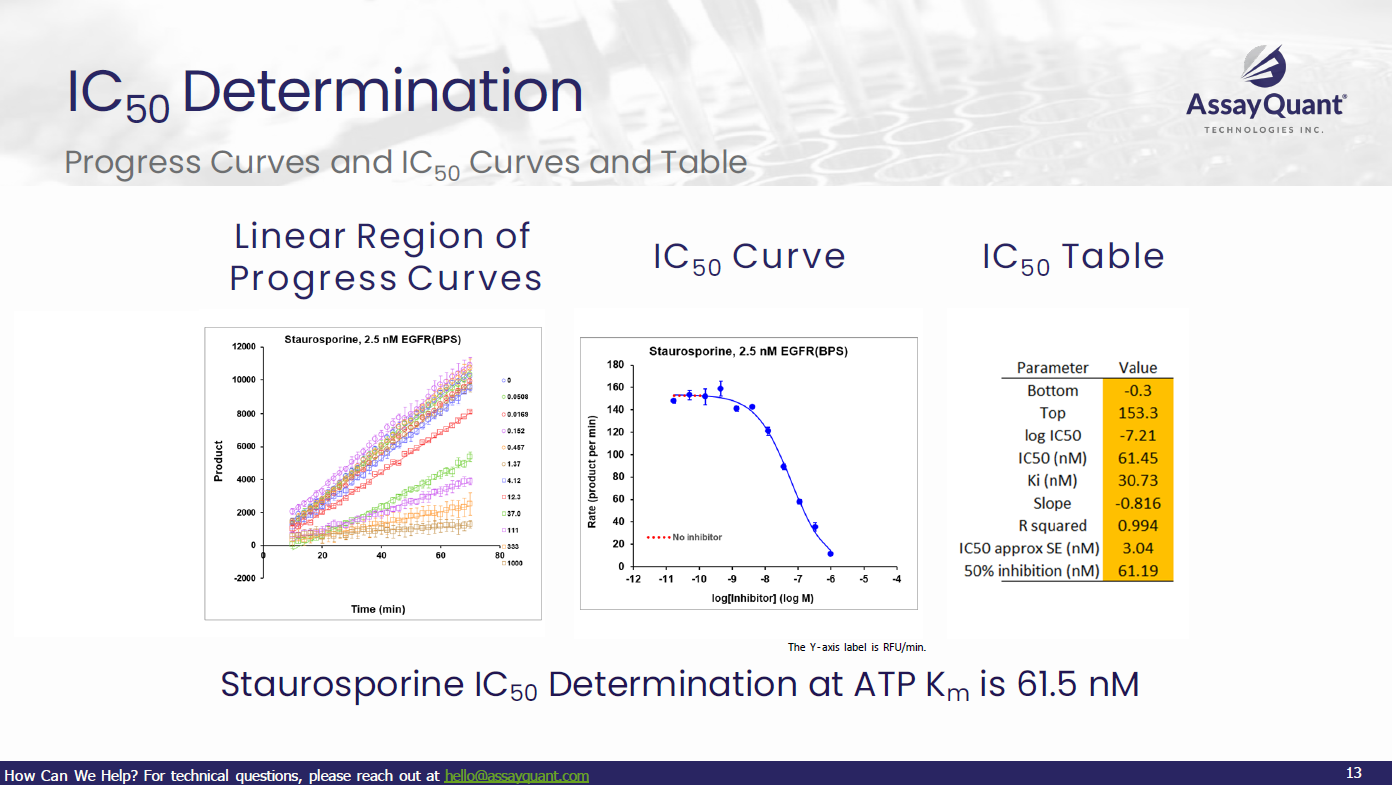
Each validation report provides experimental conditions and data showing:
Protocol
See how the PhosphoSens-Kinetic Assay can be used to find the IC50 of a kinase inhibitor.
Download Protocol →Webinar
Discover how continuous assay formats power deep understanding of kinase function. See how PhosphoSens® assays guide inhibitor profiling, selectivity assessment, and mechanistic characterization.
Watch the Webinar →Service
Need broader selectivity data? KinSight profiling runs your compounds across our full kinase panel under identical PhosphoSens conditions.
Learn about KinSight →Want to hear the latest about our technology? Be among the first to learn about our latest products and services.