Still have questions about our products?
Our scientists can help you choose the right assay format, substrate, and enzyme for your experiment.
Also known as: AKT Serine/Threonine Kinase 3 • PKBG • PRKBG • STK-2 • RAC-gamma • RAC-PK- gamma
.jpg?width=450&name=PhosphoSens%20Packaging%20C%20(3).jpg)
AKT3 (AKT Serine/Threonine Kinase 3, also known as PKBγ) belongs to the AGC kinase superfamily alongside AKT1 and AKT2. All three isoforms share a conserved domain architecture comprising a pleckstrin homology (PH) domain, a kinase domain, and a hydrophobic motif. AKT3 is activated downstream of PI3K via phosphoinositide-dependent kinase-1 (PDK1)-mediated phosphorylation at T305 and mTORC2-mediated phosphorylation at S472. Once active, AKT3 phosphorylates substrates including GSK3β, FOXO transcription factors, TSC2, and BAD, driving cell survival, proliferation, and metabolic reprogramming. AKT3 is predominantly expressed in the brain and is the dominant isoform in melanoma and glioblastoma. PTEN loss, PIK3CA gain-of-function mutations, and AKT3 amplification are frequent oncogenic drivers. The isoform-selective nature of AKT3 in CNS malignancies makes it an attractive target for precision oncology strategies, and understanding isoform-specific kinetics is critical for drug candidate differentiation.
A principal challenge in AKT3 drug discovery is distinguishing isoform-selective inhibition from pan-AKT activity in biochemical assays. Traditional endpoint methods such as ADP-Glo and HTRF measure single time-point signals that obscure mechanistic details and are highly sensitive to assay timing artifacts and compound interference. Radiometric assays offer sensitivity but introduce radioactive handling burdens and poor throughput. PhosphoSens continuous kinase assays overcome these limitations by generating real-time fluorescent progress curves using a sox-based peptide substrate at physiological ATP concentrations. This enables accurate Km, Vmax, and Ki determination, direct measurement of covalent kinact/KI parameters for irreversible or covalent-warhead inhibitors, and detection of slow-binding kinetics often missed at endpoint. The continuous format is fully compatible with AKT3 isoform selectivity profiling, reducing false positives and delivering mechanistically richer SAR data earlier in the discovery pipeline.
Have questions about AKT3 assay design, selectivity panels, or covalent inhibitor characterization?
Ask Our Scientists →Continuous, real-time fluorescent assays optimized for quantitative AKT3 activity measurements, IC50 determination, and mechanistic studies.
PhosphoSens-Kinetic assays directly quantify enzyme activity by continuously monitoring substrate phosphorylation or dephosphorylation in real time, generating a full progress curve in every well.
Learn more about PhosphoSens-Kinetic →Need pricing or availability? Select a kit or substrate to request a quote below.
Kits
Ready-to-use assay kits containing substrate and all essential reagents.
Automatically save 10% when bundling 10ug recombinant enzyme with your 1,000 assay kit. View enzymes
Substrate
Bulk PhosphoSens® substrate for assay development and high-throughput workflows.
Automatically save 10% when bundling Reagent Packs with your substrate. View Reagent Packs
Select a kit, substrate, or enzyme above. Our team will confirm pricing, availability, and any applicable bundle discounts.
Robust endpoint TRF assays optimized for high-throughput screening and quantitative AKT3 activity measurement in plate-based workflows.
PhosphoSens-Red assays use europium-based time-resolved fluorescence detection to enable robust, plate-based quantification of enzyme activity, making them well suited for high-throughput screening workflows.
Learn more about PhosphoSens-Red →Need pricing or availability? Select a kit or substrate to request a quote below.
Kits
Ready-to-use TRF assay kits containing substrate and essential reagents.
Automatically save 10% when bundling 10ug recombinant enzyme with your 1,000 assay kit. View enzymes
Substrate
Bulk substrate for PhosphoSens-Red TRF assays and high-throughput workflows.
Automatically save 10% when bundling Reagent Packs with your substrate. View Reagent Packs
Select a kit, substrate, or enzyme above. Our team will confirm pricing, availability, and any applicable bundle discounts.
Wild-type and mutant forms of AKT3 for assay development, kinase profiling, and mechanistic studies. Enzymes are supplied active and optimized for PhosphoSens® substrates.
Human • Baculovirus-Insect Cells
Price: $$348.00
PhosphoSens uses validated peptide substrates optimized for AKT family members, allowing side-by-side kinetic profiling of AKT1, AKT2, and AKT3 under identical, physiological ATP conditions. Continuous progress curves reveal differences in inhibitor potency, residence time, and binding kinetics across isoforms that single-endpoint assays routinely miss. This mechanistic resolution is essential for advancing isoform-selective candidates with the right selectivity profile.
Yes. The real-time continuous format is uniquely suited to characterize both covalent inhibitors, via kinact/KI determination from progress curve analysis, and allosteric inhibitors such as PH-domain binders, which can display slow-on or slow-off kinetics invisible to endpoint assays. This makes PhosphoSens particularly valuable for emerging AKT3 drug modalities beyond classical ATP-competitive inhibitors.
Inner filter effects, compound autofluorescence, and assay-timing variability at fixed endpoints can all produce false positives or negatives in conventional AKT3 assays. PhosphoSens continuous assays monitor the full fluorescent progress curve, allowing real-time identification of signal artifacts versus genuine inhibition. Running assays at physiological ATP concentrations also ensures inhibitor IC50 values are clinically translatable rather than artificially depressed by low-ATP conditions.
Explore data and documents to support your kinase and phosphatase experiments. Download sample data, protocols and other resources to see how our assays perform and to help you get started in your own lab. All validation data generated using PhosphoSens® assays under recommended conditions.
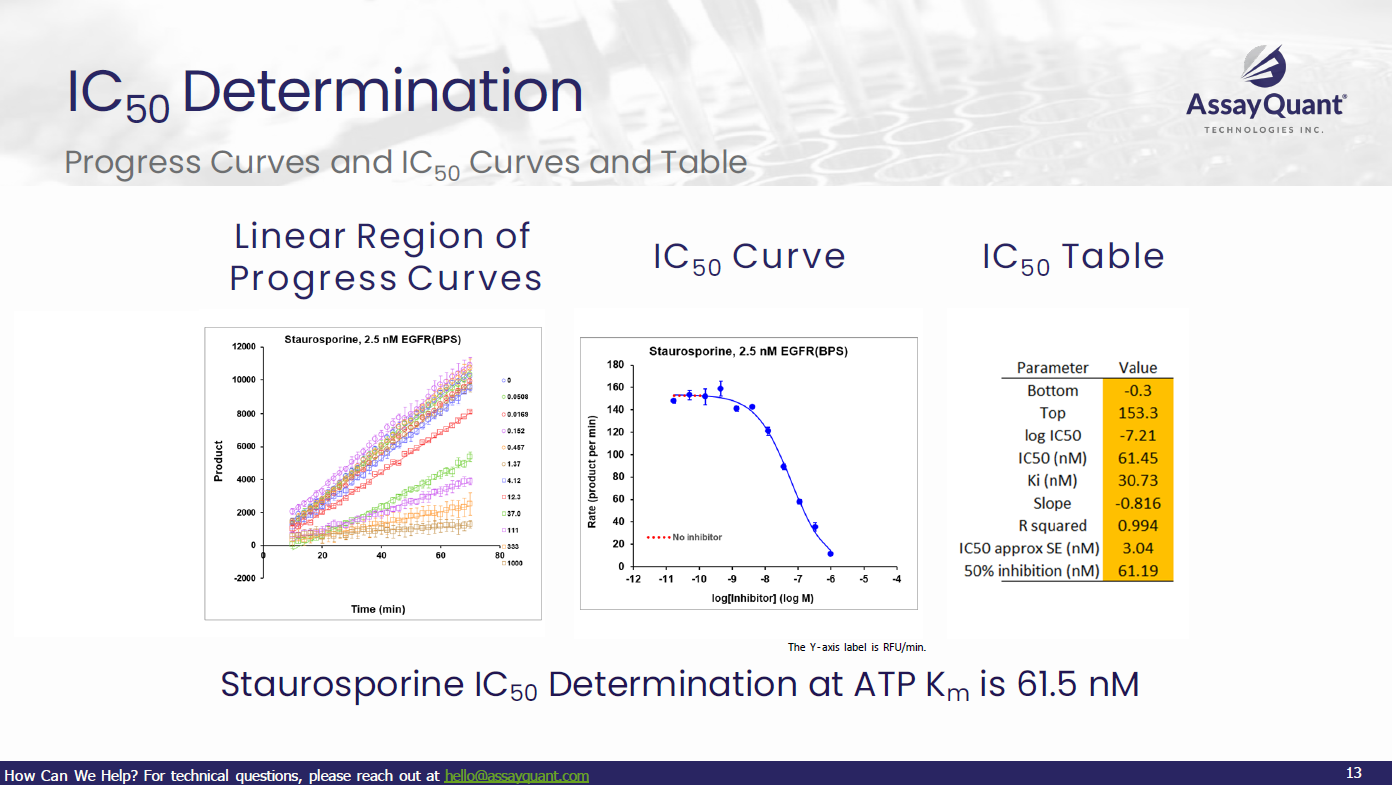
Each validation report provides experimental conditions and data showing:
Protocol
See how the PhosphoSens-Kinetic Assay can be used to find the IC50 of a kinase inhibitor.
Download Protocol →Webinar
Discover how continuous assay formats power deep understanding of kinase function. See how PhosphoSens® assays guide inhibitor profiling, selectivity assessment, and mechanistic characterization.
Watch the Webinar →Service
Need broader selectivity data? KinSight profiling runs your compounds across our full kinase panel under identical PhosphoSens conditions.
Learn about KinSight →Want to hear the latest about our technology? Be among the first to learn about our latest products and services.