Still have questions about our products?
Our scientists can help you choose the right assay format, substrate, and enzyme for your experiment.
Also known as: AKT Serine/Threonine Kinase 1 • RAC- ALPHA • AKT • PKB • PRKBA • RAC • PKB-alpha • V-akt murine thymoma viral oncogene 1 • Protein kinase B • RAC-PK-alpha • C-AKT
.jpg?width=450&name=PhosphoSens%20Packaging%20C%20(3).jpg)
AKT1 (Protein Kinase B alpha) is a serine/threonine kinase and the founding member of the Akt family, which also includes AKT2 and AKT3. Activated downstream of PI3K upon receptor tyrosine kinase or GPCR stimulation, AKT1 requires phosphorylation at Thr308 by PDK1 and Ser473 by mTORC2 for full activation. Once active, AKT1 phosphorylates a broad array of substrates including GSK-3alpha/beta, FOXO transcription factors, TSC2, MDM2, BAD, and PRAS40, coordinating cell survival, proliferation, metabolism, and protein synthesis. AKT1 sits at the nexus of the PI3K/AKT/mTOR pathway, one of the most frequently dysregulated axes in human cancer. Activating mutations—most notably the E17K hotspot mutation—amplification of the AKT1 gene, and upstream loss of PTEN drive oncogenic signaling across breast, colorectal, ovarian, and endometrial cancers. AKT1 is a high-priority therapeutic target, with multiple isoform-selective and pan-AKT inhibitors in clinical development.
AKT1 drug discovery presents several assay challenges: the enzyme requires precise activation state management, physiological ATP concentrations are critical because many allosteric inhibitors show strong ATP-dependence, and distinguishing isoform-selective compounds from pan-AKT inhibitors demands sensitive kinetic discrimination. Endpoint assays such as ADP-Glo and HTRF capture only a single time point, missing inhibition mechanism nuances and risking false results from compound interference with luciferase or fluorescent antibodies. Radiometric assays add throughput and safety constraints. PhosphoSens continuous kinase assays monitor substrate phosphorylation in real time at physiological ATP, generating full progress curves that reveal allosteric versus ATP-competitive inhibition modes, enable accurate Ki determination, and detect time-dependent inhibition kinetics including covalent inactivation parameters kinact and KI—all in a homogeneous, no-antibody, mix-and-read format ideal for high-throughput screening and mechanistic profiling.
Have questions about AKT1 assay design, selectivity panels, or covalent inhibitor characterization?
Ask Our Scientists →Continuous, real-time fluorescent assays optimized for quantitative AKT1 activity measurements, IC50 determination, and mechanistic studies.
PhosphoSens-Kinetic assays directly quantify enzyme activity by continuously monitoring substrate phosphorylation or dephosphorylation in real time, generating a full progress curve in every well.
Learn more about PhosphoSens-Kinetic →Need pricing or availability? Select a kit or substrate to request a quote below.
Kits
Ready-to-use assay kits containing substrate and all essential reagents.
Automatically save 10% when bundling 10ug recombinant enzyme with your 1,000 assay kit. View enzymes
Substrate
Bulk PhosphoSens® substrate for assay development and high-throughput workflows.
Automatically save 10% when bundling Reagent Packs with your substrate. View Reagent Packs
Select a kit, substrate, or enzyme above. Our team will confirm pricing, availability, and any applicable bundle discounts.
Robust endpoint TRF assays optimized for high-throughput screening and quantitative AKT1 activity measurement in plate-based workflows.
PhosphoSens-Red assays use europium-based time-resolved fluorescence detection to enable robust, plate-based quantification of enzyme activity, making them well suited for high-throughput screening workflows.
Learn more about PhosphoSens-Red →Need pricing or availability? Select a kit or substrate to request a quote below.
Kits
Ready-to-use TRF assay kits containing substrate and essential reagents.
Automatically save 10% when bundling 10ug recombinant enzyme with your 1,000 assay kit. View enzymes
Substrate
Bulk substrate for PhosphoSens-Red TRF assays and high-throughput workflows.
Automatically save 10% when bundling Reagent Packs with your substrate. View Reagent Packs
Select a kit, substrate, or enzyme above. Our team will confirm pricing, availability, and any applicable bundle discounts.
Wild-type and mutant forms of AKT1 for assay development, kinase profiling, and mechanistic studies. Enzymes are supplied active and optimized for PhosphoSens® substrates.
Human • Baculovirus-Insect Cells
Price: $$278.00
The PhosphoSens AKT1 assay is validated at physiological ATP concentrations (typically 1 mM), which is critical because many AKT inhibitorsu2014particularly allosteric compounds like MK-2206u2014display pronounced ATP-dependence in their potency. Using sub-physiological ATP, as required by ADP-Glo or coupled enzyme assays, can artificially inflate the apparent potency of ATP-competitive inhibitors and obscure the selectivity profile of allosteric candidates. Running assays at physiological ATP ensures IC50 and Ki values translate reliably to cellular and in vivo settings.
Yes. Because PhosphoSens generates continuous progress curves, researchers can apply kinetic modeling to differentiate competitive, non-competitive, and allosteric inhibition modes in a single experiment. Allosteric inhibitors such as MK-2206 produce characteristic progress curve signatures distinct from ATP-competitive compounds, allowing mechanism-of-action classification without secondary assays. This capability is unavailable with endpoint formats like HTRF or ADP-Glo, which provide only a single inhibition value per condition.
Absolutely. The real-time nature of PhosphoSens assays makes them ideally suited for characterizing covalent inhibitors by directly measuring time-dependent loss of AKT1 activity and enabling kinact/KI determination from progress curve data. This is a significant advantage over endpoint assays, which cannot distinguish reversible from irreversible inhibition without extensive additional experiments. Researchers developing covalent AKT inhibitor scaffolds can obtain complete mechanistic parameters in a single continuous fluorescence read.
Explore data and documents to support your kinase and phosphatase experiments. Download sample data, protocols and other resources to see how our assays perform and to help you get started in your own lab. All validation data generated using PhosphoSens® assays under recommended conditions.
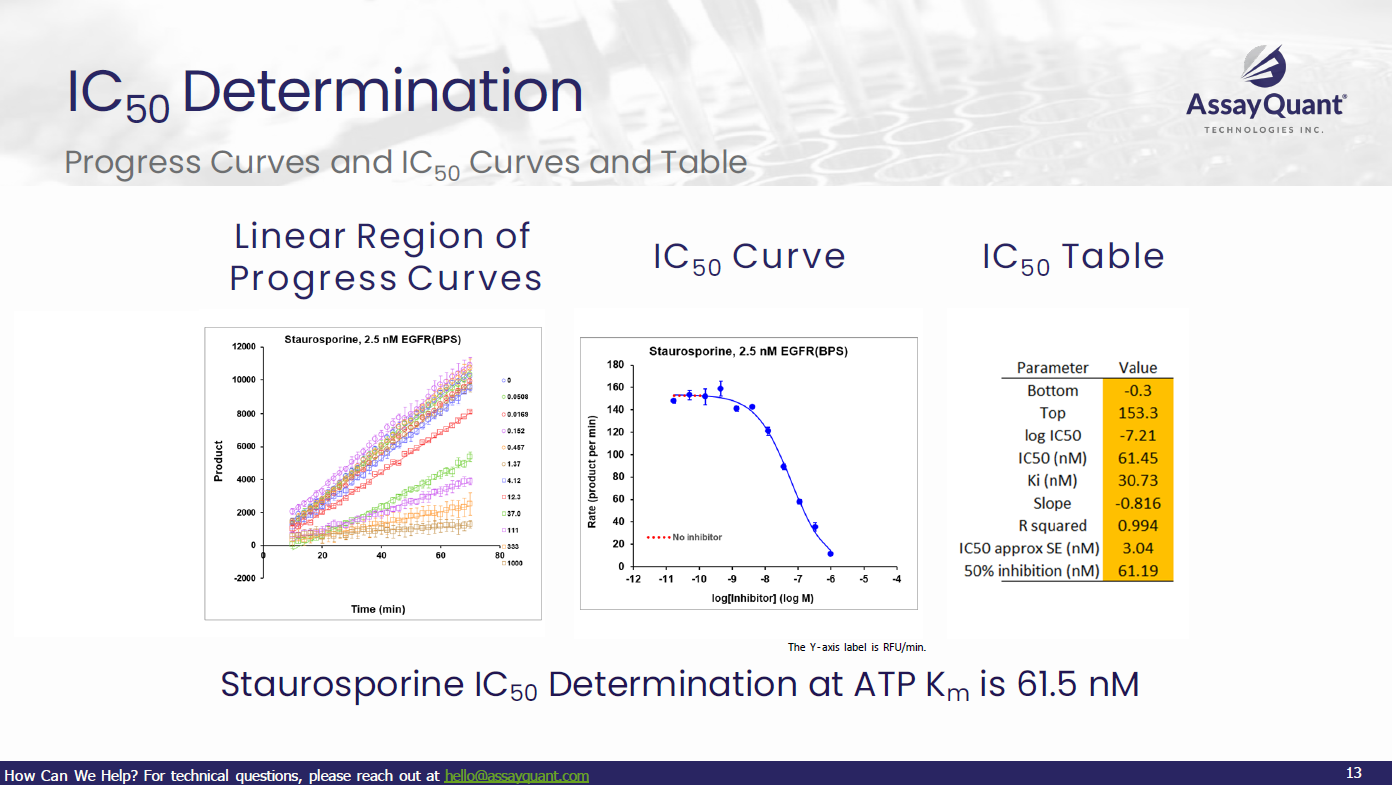
Each validation report provides experimental conditions and data showing:
Protocol
See how the PhosphoSens-Kinetic Assay can be used to find the IC50 of a kinase inhibitor.
Download Protocol →Webinar
Discover how continuous assay formats power deep understanding of kinase function. See how PhosphoSens® assays guide inhibitor profiling, selectivity assessment, and mechanistic characterization.
Watch the Webinar →Service
Need broader selectivity data? KinSight profiling runs your compounds across our full kinase panel under identical PhosphoSens conditions.
Learn about KinSight →Want to hear the latest about our technology? Be among the first to learn about our latest products and services.