Still have questions about our products?
Our scientists can help you choose the right assay format, substrate, and enzyme for your experiment.
Also known as: TTK protein kinase • CT96 • cancer/testis antigen 96 • MPH1, MPS1, MPS1L1 • monopolar spindle 1 kinase • PYT • Phosphotyrosine picked threonine-protein kinase • ESK • Esk1 • FLJ38280
.jpg?width=450&name=PhosphoSens%20Packaging%20C%20(3).jpg)
TTK protein kinase (also known as Mps1) is a dual-specificity kinase and master regulator of the spindle assembly checkpoint (SAC), the surveillance mechanism that ensures accurate chromosome segregation during mitosis. TTK autophosphorylates for activation and phosphorylates key SAC components including KNL1, Bub1, BubR1, and Mad1, orchestrating the kinetochore-based "wait anaphase" signal. It operates within the mitotic checkpoint complex (MCC) pathway, delaying anaphase onset until all kinetochores achieve proper bipolar attachment. TTK is overexpressed in a broad range of malignancies including breast, colorectal, lung, and hepatocellular carcinomas, correlating with chromosomal instability and poor prognosis. Because cancer cells with elevated aneuploidy are uniquely dependent on a robust SAC for survival, TTK represents a compelling synthetic-lethal target. Small-molecule TTK inhibitors induce catastrophic mitotic exit, premature chromosome segregation, and tumor cell death, driving intense drug discovery interest in oncology.
TTK assays present distinct challenges: its autophosphorylation activity complicates background subtraction in endpoint formats, and its preference for physiological ATP concentrations renders many ADP-Glo or HTRF assays unreliable when run at artificially low ATP. Radiometric methods offer sensitivity but impose throughput and safety constraints. PhosphoSens continuous kinetics eliminate these pitfalls by monitoring substrate phosphorylation in real time via ratiometric fluorescence, allowing full progress curves at physiological ATP. This is critical for TTK because covalent or slow-binding inhibitors—such as irreversible candidates targeting Cys604—require kinact/KI determination that only continuous assays can provide. Real-time data also instantly reveal biphasic kinetics from autophosphorylation interference, enabling researchers to deconvolute compound mechanism of action with confidence unavailable from single-timepoint endpoint methods.
Have questions about TTK assay design, selectivity panels, or covalent inhibitor characterization?
Ask Our Scientists →Continuous, real-time fluorescent assays optimized for quantitative TTK activity measurements, IC50 determination, and mechanistic studies.
PhosphoSens-Kinetic assays directly quantify enzyme activity by continuously monitoring substrate phosphorylation or dephosphorylation in real time, generating a full progress curve in every well.
Learn more about PhosphoSens-Kinetic →Need pricing or availability? Select a kit or substrate to request a quote below.
Kits
Ready-to-use assay kits containing substrate and all essential reagents.
Automatically save 10% when bundling 10ug recombinant enzyme with your 1,000 assay kit. View enzymes
Substrate
Bulk PhosphoSens® substrate for assay development and high-throughput workflows.
Automatically save 10% when bundling Reagent Packs with your substrate. View Reagent Packs
Select a kit, substrate, or enzyme above. Our team will confirm pricing, availability, and any applicable bundle discounts.
No PhosphoSens-Red format is currently available for TTK.
Select a kit, substrate, or enzyme above. Our team will confirm pricing, availability, and any applicable bundle discounts.
Wild-type and mutant forms of TTK for assay development, kinase profiling, and mechanistic studies. Enzymes are supplied active and optimized for PhosphoSens® substrates.
Human • Baculovirus-Insect Cells
Price: $$348.00
TTK inhibitors, particularly ATP-competitive compounds, display markedly different apparent potencies depending on the ATP concentration used in the assay. Running assays at or near cellular ATP levels (1-5 mM) with PhosphoSens provides IC50 values that better predict cellular and in vivo activity. Endpoint assays often use low ATP to boost signal, artificially inflating potency and misleading SAR decisions.
PhosphoSens peptide substrates derived from validated TTK phosphorylation sites (e.g., KNL1 or Bub1 motifs) report exclusively on substrate turnover rather than TTK autophosphorylation, cleanly separating the two activities. Real-time progress curves also reveal any lag phases associated with autophosphorylation-dependent activation, providing mechanistic insight that endpoint assays miss entirely.
Covalent TTK inhibitor candidates require kinact/KI determination, which demands continuous monitoring of enzyme inactivation over timeu2014data that cannot be obtained from endpoint formats. PhosphoSens generates full progress curves in real time, allowing direct fitting of inactivation kinetics without additional reagent additions or multiple stopped-reaction time points, dramatically streamlining covalent inhibitor profiling workflows.
Explore data and documents to support your kinase and phosphatase experiments. Download sample data, protocols and other resources to see how our assays perform and to help you get started in your own lab. All validation data generated using PhosphoSens® assays under recommended conditions.
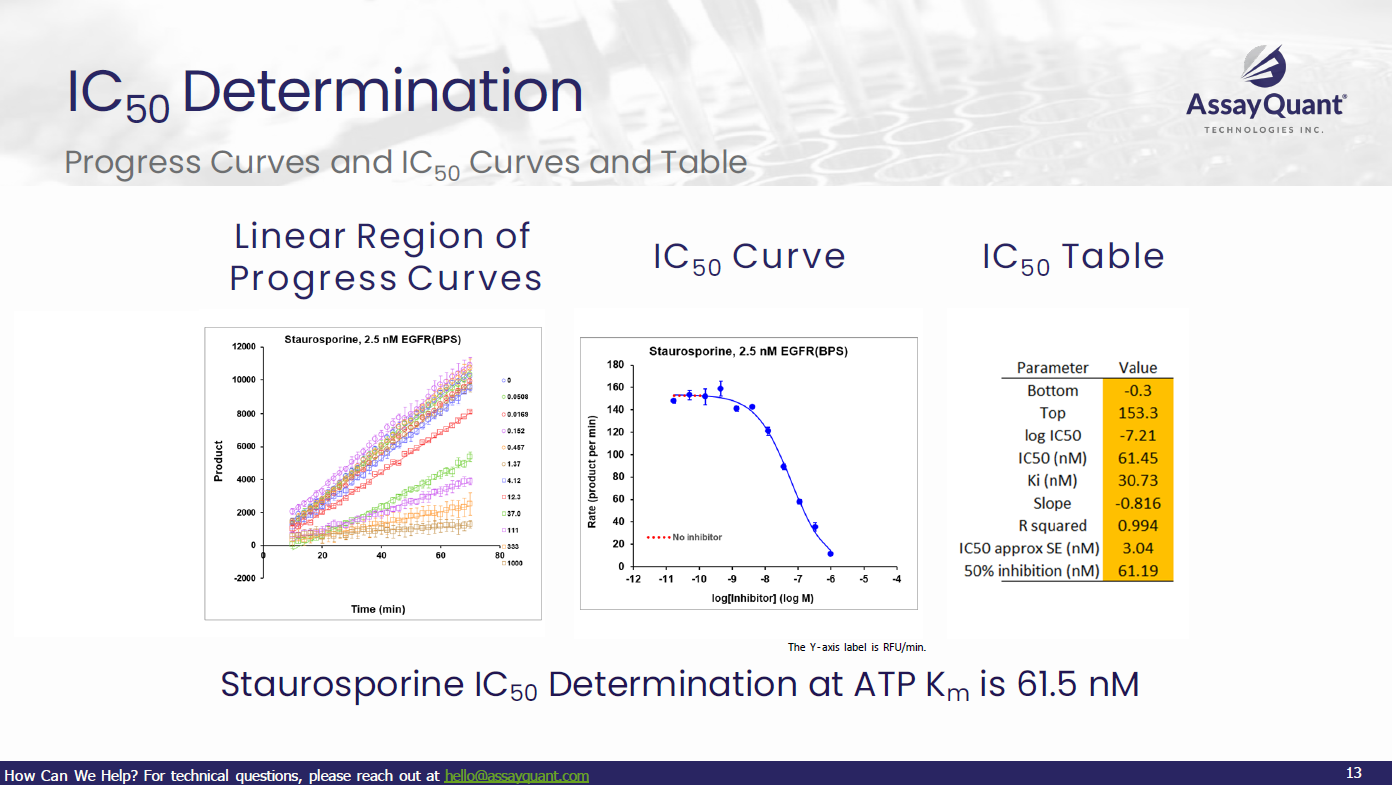
Each validation report provides experimental conditions and data showing:
Protocol
See how the PhosphoSens-Kinetic Assay can be used to find the IC50 of a kinase inhibitor.
Download Protocol →Webinar
Discover how continuous assay formats power deep understanding of kinase function. See how PhosphoSens® assays guide inhibitor profiling, selectivity assessment, and mechanistic characterization.
Watch the Webinar →Service
Need broader selectivity data? KinSight profiling runs your compounds across our full kinase panel under identical PhosphoSens conditions.
Learn about KinSight →Want to hear the latest about our technology? Be among the first to learn about our latest products and services.