Still have questions about our products?
Our scientists can help you choose the right assay format, substrate, and enzyme for your experiment.
Also known as: BUB1 mitotic checkpoint serine/threonine kinase • budding uninhibited by benzimidazoles 1 • BUB1A • BUB1L • hBUB1 • Mitotic checkpoint BUB1 • MBUB1
.jpg?width=450&name=PhosphoSens%20Packaging%20C%20(3).jpg)
BUB1 (BUB1 Mitotic Checkpoint Serine/Threonine Kinase) is a member of the BUB kinase family, which also includes BUBR1 (BUB1B), and plays a central role in the spindle assembly checkpoint (SAC). BUB1 is recruited to unattached kinetochores during mitosis, where it is activated through interactions with KNL1 and the MPS1 kinase. Key substrates include histone H2A (phosphorylated at Thr120), which facilitates chromosomal passenger complex (CPC) localization and proper chromosome segregation, as well as CDC20, modulating APC/C activity. BUB1 functions within the mitotic checkpoint complex (MCC) to prevent premature anaphase onset. Overexpression and gain-of-function mutations in BUB1 are frequently observed in colorectal, breast, and lung cancers, contributing to chromosomal instability (CIN) and tumor progression. As a non-essential kinase in normal cells but critical in CIN-driven cancers, BUB1 represents a compelling synthetic lethal drug target, particularly in tumors harboring aneuploidogenic vulnerabilities or co-occurring SAC defects.
BUB1 presents significant assay challenges due to its complex regulation, requirement for kinetochore-associated protein scaffolds, and relatively low intrinsic activity in recombinant formats. Traditional endpoint assays such as ADP-Glo and HTRF require fixed time points that can miss burst kinetics or plateau artifacts, and radiometric methods impose safety and throughput limitations. HTRF antibody-based assays may suffer from epitope inaccessibility on the physiologically relevant H2A Thr120 substrate. PhosphoSens continuous kinase assay technology uses fluorescent, chelation-enhanced substrate sensors to monitor BUB1 activity in real time under physiological ATP concentrations, generating full progress curves that capture kinact/KI for covalent inhibitors, enable mechanistic classification, and eliminate endpoint selection bias—dramatically improving hit quality and enabling robust SAR for BUB1 inhibitor campaigns.
Have questions about BUB1 assay design, selectivity panels, or covalent inhibitor characterization?
Ask Our Scientists →Continuous, real-time fluorescent assays optimized for quantitative BUB1 activity measurements, IC50 determination, and mechanistic studies.
PhosphoSens-Kinetic assays directly quantify enzyme activity by continuously monitoring substrate phosphorylation or dephosphorylation in real time, generating a full progress curve in every well.
Learn more about PhosphoSens-Kinetic →Need pricing or availability? Select a kit or substrate to request a quote below.
Kits
Ready-to-use assay kits containing substrate and all essential reagents.
Automatically save 10% when bundling 10ug recombinant enzyme with your 1,000 assay kit. View enzymes
Substrate
Bulk PhosphoSens® substrate for assay development and high-throughput workflows.
Automatically save 10% when bundling Reagent Packs with your substrate. View Reagent Packs
Select a kit, substrate, or enzyme above. Our team will confirm pricing, availability, and any applicable bundle discounts.
Robust endpoint TRF assays optimized for high-throughput screening and quantitative BUB1 activity measurement in plate-based workflows.
PhosphoSens-Red assays use europium-based time-resolved fluorescence detection to enable robust, plate-based quantification of enzyme activity, making them well suited for high-throughput screening workflows.
Learn more about PhosphoSens-Red →Need pricing or availability? Select a kit or substrate to request a quote below.
Kits
Ready-to-use TRF assay kits containing substrate and essential reagents.
Automatically save 10% when bundling 10ug recombinant enzyme with your 1,000 assay kit. View enzymes
Substrate
Bulk substrate for PhosphoSens-Red TRF assays and high-throughput workflows.
Automatically save 10% when bundling Reagent Packs with your substrate. View Reagent Packs
Select a kit, substrate, or enzyme above. Our team will confirm pricing, availability, and any applicable bundle discounts.
No recombinant enzymes are currently available for BUB1.
BUB1 displays complex kinetics that can be masked by endpoint assays, which capture only a single time point and may reflect substrate depletion or product inhibition artifacts. Real-time PhosphoSens assays generate continuous progress curves, enabling accurate determination of initial velocities, IC50 values, and mechanistic inhibition modes. This is especially critical for characterizing slow-binding or covalent BUB1 inhibitors where kinact and KI parameters are essential.
PhosphoSens BUB1 assays employ fluorescent CSox-based peptide substrates derived from the physiological H2A Thr120 phosphorylation site, enabling direct, continuous fluorescence readout without antibodies or coupled enzyme systems. Because assays run at physiological ATP concentrations, the resulting IC50 data are directly relevant to the cellular environment and are not confounded by ATP competition artifacts common in ADP-detection platforms.
Yes, the homogeneous, mix-and-read format of PhosphoSens assays is fully compatible with miniaturized HTS workflows in 384-well and 1536-well plate formats. The continuous fluorescence readout allows kinetic discrimination of true inhibitors from assay interferents such as fluorescent compounds or aggregators, substantially reducing false-positive rates compared to single-endpoint ADP-Glo or HTRF screens.
Explore data and documents to support your kinase and phosphatase experiments. Download sample data, protocols and other resources to see how our assays perform and to help you get started in your own lab. All validation data generated using PhosphoSens® assays under recommended conditions.
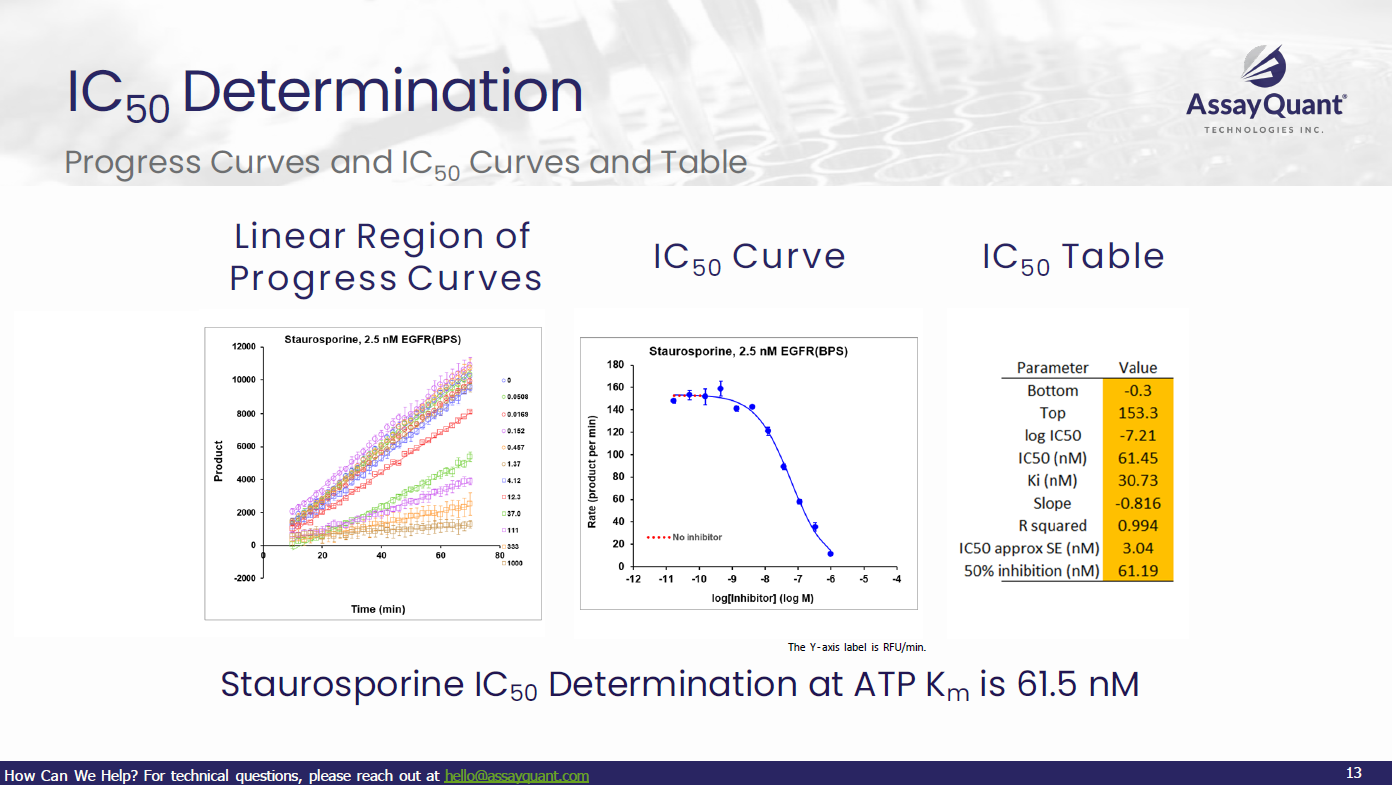
Each validation report provides experimental conditions and data showing:
Protocol
See how the PhosphoSens-Kinetic Assay can be used to find the IC50 of a kinase inhibitor.
Download Protocol →Webinar
Discover how continuous assay formats power deep understanding of kinase function. See how PhosphoSens® assays guide inhibitor profiling, selectivity assessment, and mechanistic characterization.
Watch the Webinar →Service
Need broader selectivity data? KinSight profiling runs your compounds across our full kinase panel under identical PhosphoSens conditions.
Learn about KinSight →Want to hear the latest about our technology? Be among the first to learn about our latest products and services.