Still have questions about our products?
Our scientists can help you choose the right assay format, substrate, and enzyme for your experiment.
Also known as: CDK4 • cyclin dependent kinase 4 • CMM3 • PSK-J3 • MGC14458 • CRK3
.jpg?width=450&name=PhosphoSens%20Packaging%20C%20(3).jpg)
CDK4 (Cyclin-Dependent Kinase 4) belongs to the CDK family of serine/threonine protein kinases that serve as master regulators of cell cycle progression. CDK4 forms an obligate complex with D-type cyclins (CycD1, CycD2, or CycD3) to become catalytically active; the CDK4/CycD2 complex is particularly prevalent in hematopoietic and neural progenitor contexts. The primary substrate of CDK4 is the retinoblastoma protein (Rb), which CDK4 phosphorylates at multiple serine and threonine residues to relieve transcriptional repression of E2F target genes, driving the G1-to-S phase transition. Additional substrates include FOXM1 and Smad3. CDK4 activity is regulated by INK4 family inhibitors (p16INK4a, p15INK4b) and is integrated into the PI3K/AKT/mTOR and RAS/MAPK signaling networks. CDK4 is amplified, overexpressed, or mutated in a broad spectrum of cancers including breast cancer, glioblastoma, liposarcoma, and melanoma, making it a validated and clinically proven oncology drug target.
CDK4/CycD2 poses distinct assay challenges: the complex requires co-expression and purification of both CDK4 and cyclin D2 subunits, and CDK4 exhibits relatively low intrinsic kinase activity, demanding sensitive detection methods. Conventional endpoint assays such as ADP-Glo or HTRF can miss transient kinetic behaviors, require quench steps that introduce variability, and fail to resolve slow-binding or covalent inhibition mechanisms. Radiometric formats add safety and throughput burdens. PhosphoSens continuous fluorescent assays monitor CDK4/CycD2 substrate phosphorylation in real time at physiological ATP concentrations, generating full progress curves that reveal true KM, kcat, and time-dependent inhibition parameters including kinact/KI for covalent or slow-binding candidates. This enables accurate selectivity profiling, mechanistic classification of inhibitor binding modes, and higher-quality SAR data across compound libraries without endpoint artifacts.
Have questions about CDK4/CycD2 assay design, selectivity panels, or covalent inhibitor characterization?
Ask Our Scientists →Continuous, real-time fluorescent assays optimized for quantitative CDK4/CycD2 activity measurements, IC50 determination, and mechanistic studies.
PhosphoSens-Kinetic assays directly quantify enzyme activity by continuously monitoring substrate phosphorylation or dephosphorylation in real time, generating a full progress curve in every well.
Learn more about PhosphoSens-Kinetic →Need pricing or availability? Select a kit or substrate to request a quote below.
Kits
Ready-to-use assay kits containing substrate and all essential reagents.
Automatically save 10% when bundling 10ug recombinant enzyme with your 1,000 assay kit. View enzymes
Substrate
Bulk PhosphoSens® substrate for assay development and high-throughput workflows.
Automatically save 10% when bundling Reagent Packs with your substrate. View Reagent Packs
Select a kit, substrate, or enzyme above. Our team will confirm pricing, availability, and any applicable bundle discounts.
No PhosphoSens-Red format is currently available for CDK4/CycD2.
Select a kit, substrate, or enzyme above. Our team will confirm pricing, availability, and any applicable bundle discounts.
No recombinant enzymes are currently available for CDK4/CycD2.
AssayQuant's PhosphoSens CDK4/CycD2 assay employs a proprietary CSox-based peptide substrate derived from the CDK4 phosphorylation site on Rb, incorporating a fluorescent chelation motif that reports phosphorylation continuously. This design mirrors the physiological substrate context while enabling real-time fluorescence readout without antibodies or secondary reagents, ensuring data are directly translatable to cellular CDK4 biology.
Yes. Because PhosphoSens captures full reaction progress curves in real time, it can resolve the time-dependent onset of inhibition characteristic of covalent and slow-binding inhibitors, allowing direct calculation of kinact and KI. Endpoint assays such as ADP-Glo would only capture a single time point and could severely underestimate or miss these inhibition mechanisms entirely.
PhosphoSens assays are run at or near the physiological Km for ATP (~10-100 uM range matched to the enzyme), avoiding the artificially low ATP concentrations used in many commercial kits that inflate apparent inhibitor potency. Running assays at physiological ATP ensures IC50 values are predictive of cellular activity and allows accurate Cheng-Prusoff corrections for competitive inhibitor Ki determination during CDK4/CycD2 selectivity profiling.
Explore data and documents to support your kinase and phosphatase experiments. Download sample data, protocols and other resources to see how our assays perform and to help you get started in your own lab. All validation data generated using PhosphoSens® assays under recommended conditions.
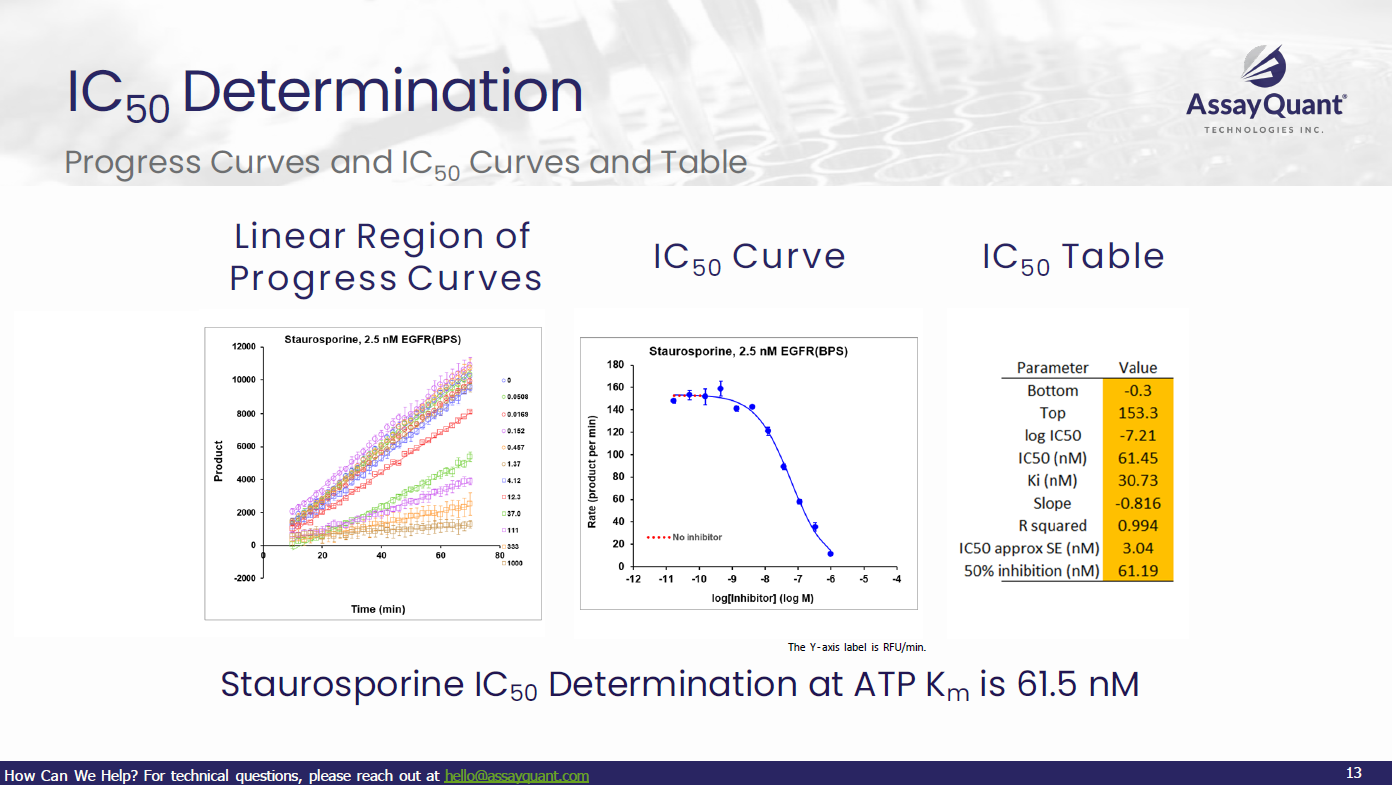
Each validation report provides experimental conditions and data showing:
Protocol
See how the PhosphoSens-Kinetic Assay can be used to find the IC50 of a kinase inhibitor.
Download Protocol →Webinar
Discover how continuous assay formats power deep understanding of kinase function. See how PhosphoSens® assays guide inhibitor profiling, selectivity assessment, and mechanistic characterization.
Watch the Webinar →Service
Need broader selectivity data? KinSight profiling runs your compounds across our full kinase panel under identical PhosphoSens conditions.
Learn about KinSight →Want to hear the latest about our technology? Be among the first to learn about our latest products and services.