Still have questions about our products?
Our scientists can help you choose the right assay format, substrate, and enzyme for your experiment.
Also known as: CDK1 • CDC2 • cyclin dependent kinase 1 • CDC28 • CDC28A • MPF • CDC2A • Cell division control protein 2
.jpg?width=450&name=PhosphoSens%20Packaging%20C%20(3).jpg)
Cyclin-dependent kinase 1 (CDK1), also known as CDC2, is the catalytic subunit of the maturation-promoting factor (MPF) and the master regulator of mitotic entry and progression in eukaryotes. CDK1 is activated by binding to its regulatory partners Cyclin B1 and Cyclin B2, with activity further controlled by phosphorylation at Thr161 by CAK and inhibitory phosphorylation at Thr14/Tyr15 by WEE1 and MYT1 kinases, which are removed by CDC25 phosphatases at the G2/M transition. Key substrates include Lamin A/C driving nuclear envelope breakdown, condensins and cohesins regulating chromosome condensation and segregation, and numerous cytoskeletal proteins orchestrating spindle assembly. CDK1 operates within the cell cycle checkpoint network intersecting with PLK1, Aurora kinases, and the spindle assembly checkpoint. Aberrant CDK1 activity is a hallmark of diverse cancers, where overexpression drives uncontrolled mitotic progression. CDK1 is an attractive oncology target because many cancer cells exhibit CDK1 dependency due to loss of complementary G1/S checkpoints, providing a therapeutic window.
CDK1/CycB1 poses significant assay challenges: its tight regulation requires co-expression of Cyclin B1 for full activity, and its preference for physiological ATP concentrations (low µM range in cells) means endpoint assays using supra-physiological ATP introduce artifact-driven IC50 shifts. ADP-Glo and HTRF detect single-timepoint signals, missing burst kinetics, substrate depletion artifacts, and compound interference from inner-filter effects or ATP competition at non-physiological concentrations. Radiometric assays generate hazardous waste and lack throughput scalability. PhosphoSens continuous fluorescent kinase assays use CSox-based peptide substrates to monitor phosphorylation in real time at physiological ATP, generating full progress curves that reveal mechanism of inhibition, detect covalent inactivators via kinact/KI determination, and flag assay interference instantly. This enables higher-quality SAR data, reliable selectivity profiling, and kinetic characterization of CDK1-targeted compounds in a homogeneous, mix-and-read format.
Have questions about CDK1/CycB1 assay design, selectivity panels, or covalent inhibitor characterization?
Ask Our Scientists →Continuous, real-time fluorescent assays optimized for quantitative CDK1/CycB1 activity measurements, IC50 determination, and mechanistic studies.
PhosphoSens-Kinetic assays directly quantify enzyme activity by continuously monitoring substrate phosphorylation or dephosphorylation in real time, generating a full progress curve in every well.
Learn more about PhosphoSens-Kinetic →Need pricing or availability? Select a kit or substrate to request a quote below.
Kits
Ready-to-use assay kits containing substrate and all essential reagents.
Automatically save 10% when bundling 10ug recombinant enzyme with your 1,000 assay kit. View enzymes
Substrate
Bulk PhosphoSens® substrate for assay development and high-throughput workflows.
Automatically save 10% when bundling Reagent Packs with your substrate. View Reagent Packs
Select a kit, substrate, or enzyme above. Our team will confirm pricing, availability, and any applicable bundle discounts.
Robust endpoint TRF assays optimized for high-throughput screening and quantitative CDK1/CycB1 activity measurement in plate-based workflows.
PhosphoSens-Red assays use europium-based time-resolved fluorescence detection to enable robust, plate-based quantification of enzyme activity, making them well suited for high-throughput screening workflows.
Learn more about PhosphoSens-Red →Need pricing or availability? Select a kit or substrate to request a quote below.
Kits
Ready-to-use TRF assay kits containing substrate and essential reagents.
Automatically save 10% when bundling 10ug recombinant enzyme with your 1,000 assay kit. View enzymes
Substrate
Bulk substrate for PhosphoSens-Red TRF assays and high-throughput workflows.
Automatically save 10% when bundling Reagent Packs with your substrate. View Reagent Packs
Select a kit, substrate, or enzyme above. Our team will confirm pricing, availability, and any applicable bundle discounts.
No recombinant enzymes are currently available for CDK1/CycB1.
CDK1 is catalytically inactive without its cyclin partner; Cyclin B1 binding induces conformational changes that open the substrate binding cleft and position catalytic residues for phosphotransfer. AssayQuant supplies recombinant CDK1/CycB1 complex validated for full activity in PhosphoSens assays. The continuous format confirms complex integrity through real-time progress curve linearity, catching partially active preparations that endpoint assays would miss.
Yes. The continuous, real-time fluorescence readout of PhosphoSens generates time-dependent progress curves that directly reveal covalent inactivation kinetics without the need for washout or secondary detection steps. By fitting progress curves across inhibitor concentrations, kinact and KI parameters are extracted in a single experiment, making PhosphoSens ideally suited for covalent CDK1 inhibitor programs.
We recommend running assays at or near the physiological ATP concentration (50u2013100 u00b5M), which approximates intracellular free ATP and avoids the IC50 inflation that occurs when supra-physiological ATP outcompetes ATP-competitive inhibitors. PhosphoSens substrates are fully compatible across this range, and the continuous format allows real-time confirmation that substrate turnover is linear, ensuring accurate kinetic constants and inhibitor potency measurements.
Explore data and documents to support your kinase and phosphatase experiments. Download sample data, protocols and other resources to see how our assays perform and to help you get started in your own lab. All validation data generated using PhosphoSens® assays under recommended conditions.
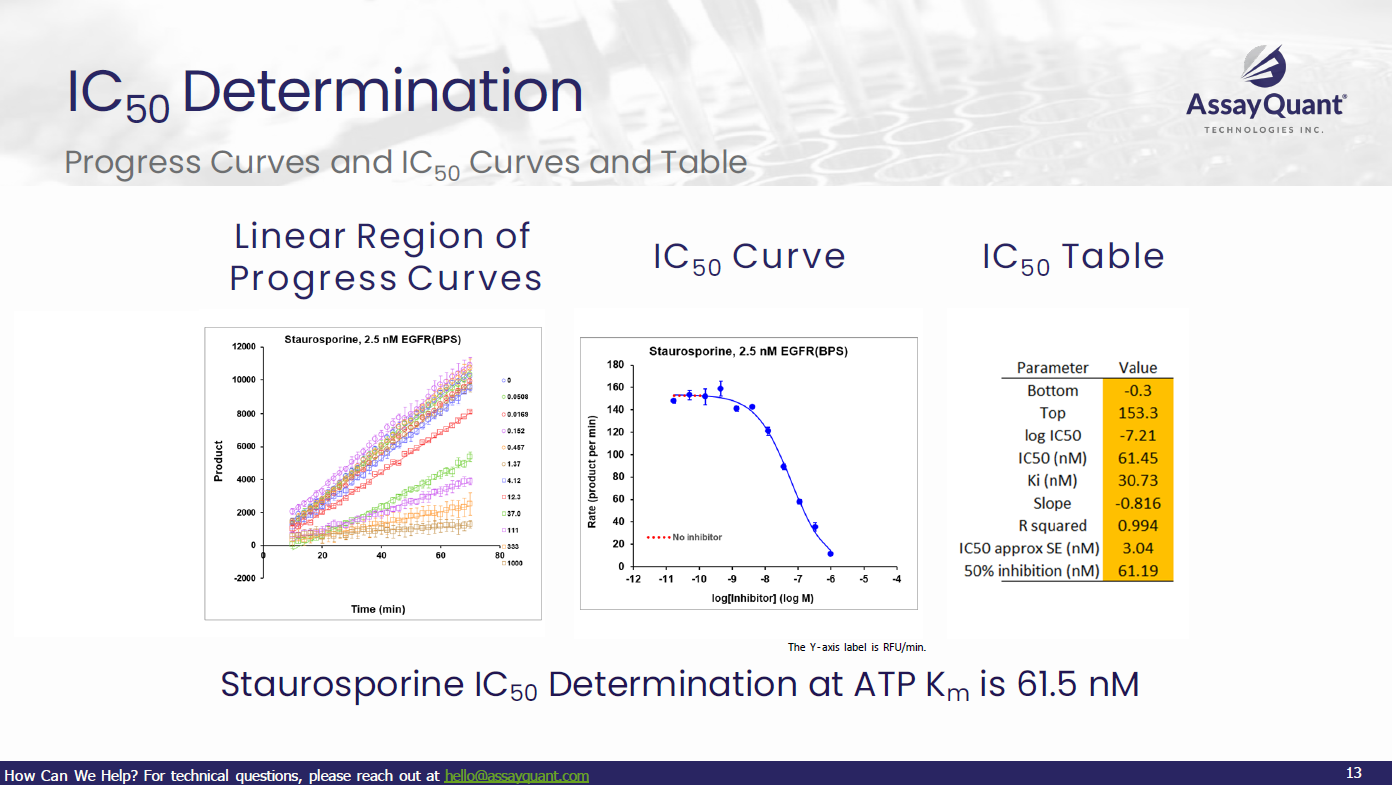
Each validation report provides experimental conditions and data showing:
Protocol
See how the PhosphoSens-Kinetic Assay can be used to find the IC50 of a kinase inhibitor.
Download Protocol →Webinar
Discover how continuous assay formats power deep understanding of kinase function. See how PhosphoSens® assays guide inhibitor profiling, selectivity assessment, and mechanistic characterization.
Watch the Webinar →Service
Need broader selectivity data? KinSight profiling runs your compounds across our full kinase panel under identical PhosphoSens conditions.
Learn about KinSight →Want to hear the latest about our technology? Be among the first to learn about our latest products and services.