Still have questions about our products?
Our scientists can help you choose the right assay format, substrate, and enzyme for your experiment.
Also known as: CDK2 • cyclin dependent kinase 2 • p33(CDK2)
.jpg?width=450&name=PhosphoSens%20Packaging%20C%20(3).jpg)
Cyclin-dependent kinase 2 (CDK2) is a serine/threonine kinase and a central regulator of the mammalian cell cycle, belonging to the CDK family of proline-directed kinases. CDK2 requires binding to its activating partner cyclin A2 (CCNA2) to form a catalytically competent complex, which is further regulated by T-loop phosphorylation at Thr160 by CDK-activating kinase (CAK) and inhibited by CIP/KIP family members such as p21 and p27. The CDK2/CycA2 complex is most active during S and G2/M phases, where it phosphorylates critical substrates including Rb family proteins, BRCA1, CDC6, and p27, driving DNA replication initiation and cell cycle progression. CDK2 integrates signals from the PI3K/AKT, RAS/MAPK, and p53/Rb tumor suppressor pathways. Hyperactivation of CDK2 through cyclin E or cyclin A overexpression, amplification, or loss of CDK inhibitors is a hallmark of multiple cancers, making CDK2 a compelling oncology drug target, particularly in contexts of CDK4/6 inhibitor resistance.
CDK2/CycA2 drug discovery presents significant assay challenges: the kinase requires stoichiometric cyclin partner assembly, is sensitive to ATP concentration (Km ~10 uM), and many CDK2 inhibitors are covalent or exhibit slow binding kinetics that are missed by endpoint formats. ADP-Glo and HTRF endpoint assays capture only a single time point, obscuring mechanistic information and causing errors when compound fluorescence or redox activity interferes. Radiometric assays offer sensitivity but are low-throughput and hazardous. PhosphoSens continuous fluorescent assays use a chelation-enhanced fluorescent substrate sensor to monitor phosphorylation in real time at physiological ATP, generating full progress curves that accurately capture IC50, Km, kcat, and covalent inhibitor kinact/KI parameters. This enables mechanistic differentiation of competitive, slow-binding, and irreversible inhibitors in a single homogeneous, no-wash experiment — dramatically accelerating CDK2 inhibitor characterization.
Have questions about CDK2/CycA2 assay design, selectivity panels, or covalent inhibitor characterization?
Ask Our Scientists →Continuous, real-time fluorescent assays optimized for quantitative CDK2/CycA2 activity measurements, IC50 determination, and mechanistic studies.
PhosphoSens-Kinetic assays directly quantify enzyme activity by continuously monitoring substrate phosphorylation or dephosphorylation in real time, generating a full progress curve in every well.
Learn more about PhosphoSens-Kinetic →Need pricing or availability? Select a kit or substrate to request a quote below.
Kits
Ready-to-use assay kits containing substrate and all essential reagents.
Automatically save 10% when bundling 10ug recombinant enzyme with your 1,000 assay kit. View enzymes
Substrate
Bulk PhosphoSens® substrate for assay development and high-throughput workflows.
Automatically save 10% when bundling Reagent Packs with your substrate. View Reagent Packs
Select a kit, substrate, or enzyme above. Our team will confirm pricing, availability, and any applicable bundle discounts.
No PhosphoSens-Red format is currently available for CDK2/CycA2.
Select a kit, substrate, or enzyme above. Our team will confirm pricing, availability, and any applicable bundle discounts.
No recombinant enzymes are currently available for CDK2/CycA2.
We recommend using ATP at or near the physiological Km for CDK2/CycA2, which is approximately 10 uM, to ensure inhibitor IC50 values reflect true cellular potency. PhosphoSens assays are compatible with a wide range of ATP concentrations, and running assays at multiple ATP levels enables rapid determination of inhibitor modality. Using near-Km ATP also avoids the artificial IC50 shifts common with high-ATP endpoint assays.
Yes. Because PhosphoSens generates continuous real-time progress curves, time-dependent inhibition signatures u2014 characteristic of covalent or slow-binding inhibitors u2014 are immediately apparent as curvature in the product-versus-time trace. Fitting these curves to kinetic models yields kinact and KI parameters that fully characterize covalent CDK2 inhibitors, data that endpoint formats fundamentally cannot provide. This is especially valuable as the field pursues selective covalent CDK2 strategies.
AssayQuant supplies CDK2/CycA2 as a pre-formed, co-expressed, and co-purified complex to ensure consistent stoichiometry and maximal activity in every experiment. This eliminates lot-to-lot variability associated with mixing separately produced CDK2 and cyclin A2 subunits, which can lead to incomplete complex formation and underestimation of inhibitor potency. The pre-assembled complex is validated against reference inhibitors to confirm expected IC50 values before use.
Explore data and documents to support your kinase and phosphatase experiments. Download sample data, protocols and other resources to see how our assays perform and to help you get started in your own lab. All validation data generated using PhosphoSens® assays under recommended conditions.
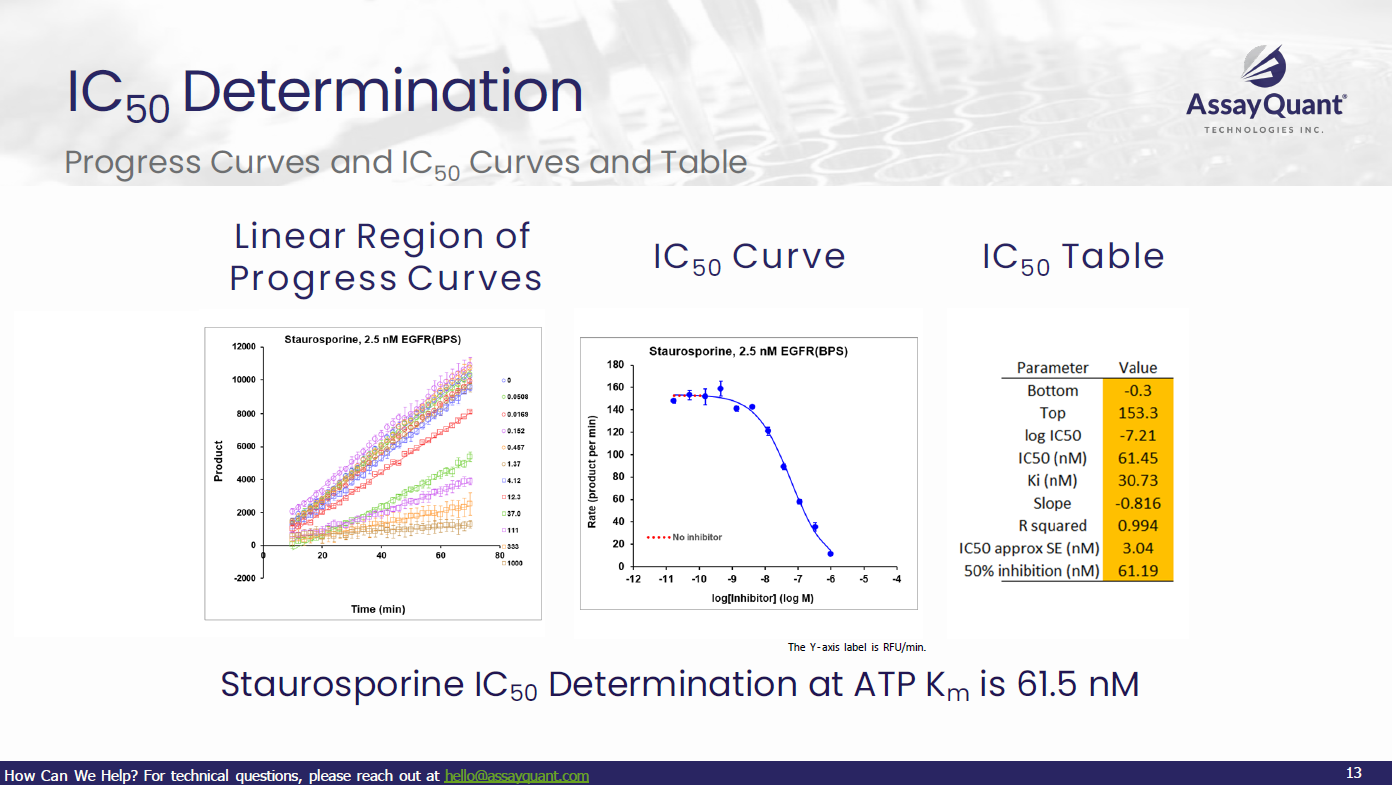
Each validation report provides experimental conditions and data showing:
Protocol
See how the PhosphoSens-Kinetic Assay can be used to find the IC50 of a kinase inhibitor.
Download Protocol →Webinar
Discover how continuous assay formats power deep understanding of kinase function. See how PhosphoSens® assays guide inhibitor profiling, selectivity assessment, and mechanistic characterization.
Watch the Webinar →Service
Need broader selectivity data? KinSight profiling runs your compounds across our full kinase panel under identical PhosphoSens conditions.
Learn about KinSight →Want to hear the latest about our technology? Be among the first to learn about our latest products and services.