Still have questions about our products?
Our scientists can help you choose the right assay format, substrate, and enzyme for your experiment.
Also known as: CDK3 • cyclin dependent kinase 3 • CDKN3
.jpg?width=450&name=PhosphoSens%20Packaging%20C%20(3).jpg)
Cyclin-dependent kinase 3 (CDK3) is a member of the CDK family of serine/threonine kinases that regulate cell cycle progression and transcription. CDK3 is activated through association with Cyclin E1 (CycE1) and requires phosphorylation of its T-loop threonine residue by CAK (CDK-activating kinase). The CDK3/CycE1 complex phosphorylates key substrates including retinoblastoma protein (Rb) at Ser807/Ser811, promoting E2F transcription factor release and G1-to-S phase transition. CDK3 also phosphorylates HDAC1 and ATF1, linking it to transcriptional regulation and stress responses. Dysregulation of CDK3 has been implicated in several cancers, including breast cancer, colorectal cancer, and skin malignancies, where overexpression drives aberrant cell proliferation. Because CDK3 shares structural homology with CDK2 yet retains distinct substrate selectivity, it represents a compelling drug target for selective anti-proliferative therapies, particularly in tumors with CDK inhibitor resistance mechanisms or elevated Cyclin E expression.
Characterizing CDK3/CycE1 biochemically presents several challenges: the kinase exhibits low basal activity without its cyclin partner, substrate selectivity overlaps with CDK2, and physiological ATP concentrations are critical for accurate potency ranking of competitive inhibitors. Endpoint assays such as ADP-Glo and HTRF require fixed incubation times that risk product inhibition artifacts and miss non-linear kinetics, while radiometric formats raise safety and throughput concerns. PhosphoSens continuous fluorescent kinase assays monitor CDK3/CycE1 substrate phosphorylation in real time across full progress curves at physiological ATP, enabling precise kcat and Km determination, early detection of mechanism-based inhibition, and accurate IC50 and kinact/KI measurements for covalent candidates — all without antibodies or radioactive reagents, dramatically accelerating lead optimization campaigns.
Have questions about CDK3/CycE1 assay design, selectivity panels, or covalent inhibitor characterization?
Ask Our Scientists →Continuous, real-time fluorescent assays optimized for quantitative CDK3/CycE1 activity measurements, IC50 determination, and mechanistic studies.
PhosphoSens-Kinetic assays directly quantify enzyme activity by continuously monitoring substrate phosphorylation or dephosphorylation in real time, generating a full progress curve in every well.
Learn more about PhosphoSens-Kinetic →Need pricing or availability? Select a kit or substrate to request a quote below.
Kits
Ready-to-use assay kits containing substrate and all essential reagents.
Automatically save 10% when bundling 10ug recombinant enzyme with your 1,000 assay kit. View enzymes
Substrate
Bulk PhosphoSens® substrate for assay development and high-throughput workflows.
Automatically save 10% when bundling Reagent Packs with your substrate. View Reagent Packs
Select a kit, substrate, or enzyme above. Our team will confirm pricing, availability, and any applicable bundle discounts.
No PhosphoSens-Red format is currently available for CDK3/CycE1.
Select a kit, substrate, or enzyme above. Our team will confirm pricing, availability, and any applicable bundle discounts.
No recombinant enzymes are currently available for CDK3/CycE1.
Many CDK3 inhibitors are ATP-competitive, and their apparent IC50 values shift substantially depending on the ATP concentration used in the assay. Using physiological ATP concentrations (~1 mM) with PhosphoSens assays ensures potency measurements reflect in-cell inhibitor behavior, improving the translatability of SAR data and preventing the under-estimation of inhibitor potency that occurs with artificially low ATP.
PhosphoSens offers substrate peptides optimized for CDK3/CycE1 selectivity windows, and real-time progress curve analysis enables detection of subtle kinetic differences in kcat and Km that are obscured in endpoint formats. This kinetic resolution allows researchers to deconvolute inhibitor selectivity between CDK3 and CDK2 without relying on antibody-based selectivity panels.
Yes. PhosphoSens continuous assays generate complete progress curves that directly report on time-dependent inhibition, enabling extraction of kinact and KI parameters essential for characterizing covalent inhibitors. This capability is not accessible with endpoint assays such as ADP-Glo or HTRF, making PhosphoSens the preferred platform for next-generation covalent CDK3 inhibitor programs.
Explore data and documents to support your kinase and phosphatase experiments. Download sample data, protocols and other resources to see how our assays perform and to help you get started in your own lab. All validation data generated using PhosphoSens® assays under recommended conditions.
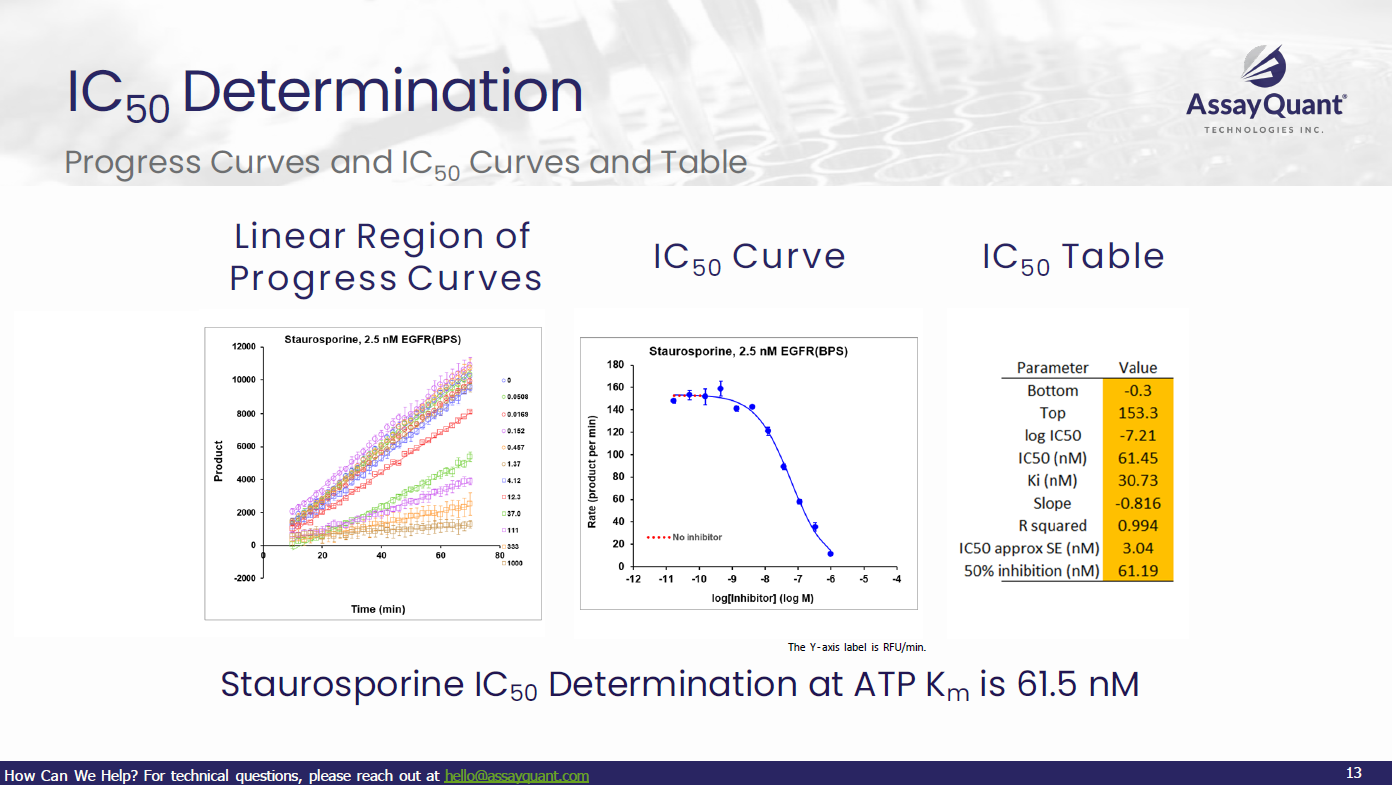
Each validation report provides experimental conditions and data showing:
Protocol
See how the PhosphoSens-Kinetic Assay can be used to find the IC50 of a kinase inhibitor.
Download Protocol →Webinar
Discover how continuous assay formats power deep understanding of kinase function. See how PhosphoSens® assays guide inhibitor profiling, selectivity assessment, and mechanistic characterization.
Watch the Webinar →Service
Need broader selectivity data? KinSight profiling runs your compounds across our full kinase panel under identical PhosphoSens conditions.
Learn about KinSight →Want to hear the latest about our technology? Be among the first to learn about our latest products and services.