Still have questions about our products?
Our scientists can help you choose the right assay format, substrate, and enzyme for your experiment.
Also known as: CDK17 • PCTAIRE2 • cyclin dependent kinase 17 • PCTK2 • KPT2
.jpg?width=450&name=PhosphoSens%20Packaging%20C%20(3).jpg)
CDK17 (cyclin-dependent kinase 17), also known as PCTK3, belongs to the PCTAIRE subfamily of CDKs, a group of atypical cyclin-dependent kinases characterized by replacement of the canonical PSTAIRE helix motif. CDK17 associates with cyclin Y (CycY) to form an active complex, and activation is further regulated by phosphorylation within the T-loop by upstream kinases. Unlike canonical cell-cycle CDKs, CDK17/CycY is implicated in neuronal differentiation, vesicle trafficking, and Wnt signaling through phosphorylation of substrates including p27Kip1, PP2A regulatory subunits, and components of the endocytic machinery. The kinase is expressed predominantly in brain and testis, implicating it in post-mitotic neuronal function. Emerging evidence links CDK17 overexpression or amplification to glioblastoma, breast cancer, and other solid tumors, where it may promote cell survival and chemoresistance. Its restricted tissue expression and roles in oncogenic signaling make CDK17 an attractive target for selective oncology drug discovery programs.
CDK17/CycY presents significant assay challenges: it requires co-expression of cyclin Y for catalytic activity, displays low intrinsic activity compared to canonical CDKs, and operates best at physiological ATP concentrations where endpoint luminescence assays such as ADP-Glo suffer from poor signal-to-noise at low substrate turnover. HTRF and radiometric formats require fixed timepoints that can miss burst kinetics or substrate depletion artifacts, and antibody-based readouts risk cross-reactivity with related PCTAIRE family members. PhosphoSens continuous fluorescent assays use chelation-enhanced fluorescent peptide substrates to generate real-time progress curves at physiological ATP, enabling accurate Km(ATP) determination critical for selectivity profiling against the CDK family. Continuous kinetics readily capture slow-binding or covalent inhibitor behavior through kinact/KI measurements, and eliminates endpoint variability that confounds low-activity kinase characterization.
Have questions about CDK17/CycY assay design, selectivity panels, or covalent inhibitor characterization?
Ask Our Scientists →Continuous, real-time fluorescent assays optimized for quantitative CDK17/CycY activity measurements, IC50 determination, and mechanistic studies.
PhosphoSens-Kinetic assays directly quantify enzyme activity by continuously monitoring substrate phosphorylation or dephosphorylation in real time, generating a full progress curve in every well.
Learn more about PhosphoSens-Kinetic →Need pricing or availability? Select a kit or substrate to request a quote below.
Kits
Ready-to-use assay kits containing substrate and all essential reagents.
Automatically save 10% when bundling 10ug recombinant enzyme with your 1,000 assay kit. View enzymes
Substrate
Bulk PhosphoSens® substrate for assay development and high-throughput workflows.
Automatically save 10% when bundling Reagent Packs with your substrate. View Reagent Packs
Select a kit, substrate, or enzyme above. Our team will confirm pricing, availability, and any applicable bundle discounts.
Robust endpoint TRF assays optimized for high-throughput screening and quantitative CDK17/CycY activity measurement in plate-based workflows.
PhosphoSens-Red assays use europium-based time-resolved fluorescence detection to enable robust, plate-based quantification of enzyme activity, making them well suited for high-throughput screening workflows.
Learn more about PhosphoSens-Red →Need pricing or availability? Select a kit or substrate to request a quote below.
Kits
Ready-to-use TRF assay kits containing substrate and essential reagents.
Automatically save 10% when bundling 10ug recombinant enzyme with your 1,000 assay kit. View enzymes
Substrate
Bulk substrate for PhosphoSens-Red TRF assays and high-throughput workflows.
Automatically save 10% when bundling Reagent Packs with your substrate. View Reagent Packs
Select a kit, substrate, or enzyme above. Our team will confirm pricing, availability, and any applicable bundle discounts.
No recombinant enzymes are currently available for CDK17/CycY.
AssayQuant offers PhosphoSens CSox-based peptide substrates optimized for CDK family members, including substrates derived from known CDK17 phosphorylation motifs. These substrates generate a real-time fluorescent signal upon phosphorylation, enabling continuous monitoring without antibodies or secondary detection reagents. Contact our assay development team for substrate selection guidance specific to CDK17.
CDK17 inhibitors are typically screened as part of broader CDK selectivity panels, and many competitive inhibitors show strong ATP-dependence in their apparent potency. Running assays at physiological ATP (1-5 mM) using PhosphoSens technology ensures that IC50 values accurately reflect cellular inhibitory potential, preventing false selectivity conclusions that arise from low-ATP endpoint assays like ADP-Glo.
Yes. Because PhosphoSens generates continuous real-time progress curves, time-dependent inhibition, slow-binding kinetics, and covalent inactivation are directly visible as curvature or progressive inhibition in the fluorescence signal over time. This allows determination of kinact and KI parameters essential for characterizing irreversible or pseudo-irreversible CDK17 inhibitor candidates.
Explore data and documents to support your kinase and phosphatase experiments. Download sample data, protocols and other resources to see how our assays perform and to help you get started in your own lab. All validation data generated using PhosphoSens® assays under recommended conditions.
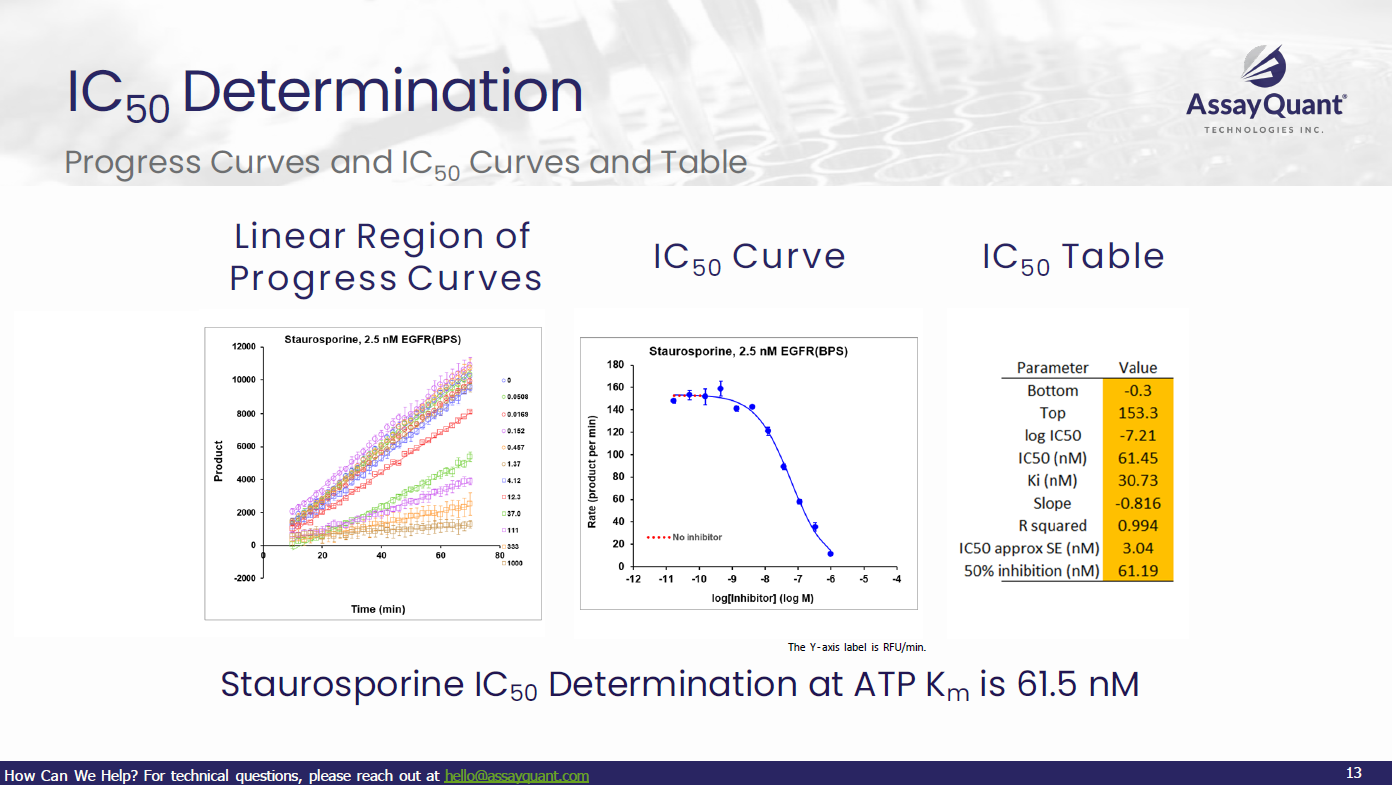
Each validation report provides experimental conditions and data showing:
Protocol
See how the PhosphoSens-Kinetic Assay can be used to find the IC50 of a kinase inhibitor.
Download Protocol →Webinar
Discover how continuous assay formats power deep understanding of kinase function. See how PhosphoSens® assays guide inhibitor profiling, selectivity assessment, and mechanistic characterization.
Watch the Webinar →Service
Need broader selectivity data? KinSight profiling runs your compounds across our full kinase panel under identical PhosphoSens conditions.
Learn about KinSight →Want to hear the latest about our technology? Be among the first to learn about our latest products and services.