Still have questions about our products?
Our scientists can help you choose the right assay format, substrate, and enzyme for your experiment.
Also known as: CDK16 • PCTAIRE1 • cyclin dependent kinase 16 • FLJ16665 • PCTGAIRE • PCTK1 • KPT1
.jpg?width=450&name=PhosphoSens%20Packaging%20C%20(3).jpg)
CDK16 (cyclin-dependent kinase 16), also known as PCTAIRE1, is an atypical member of the CDK family that requires binding to cyclin Y (CycY) for catalytic activation. Unlike canonical cell-cycle CDKs, CDK16/CycY is predominantly expressed in post-mitotic neurons and spermatogenic cells, where it regulates vesicle trafficking, neurite outgrowth, and exocytosis. Key substrates include SEPT7, synapsin-1, N-WASP, and components of the SNARE machinery. CDK16 activity is modulated by 14-3-3 proteins and upstream kinases such as PKA, which phosphorylates CycY to stabilize the complex. Pathway involvement spans PI3K/AKT signaling, autophagy regulation, and membrane trafficking. CDK16 is overexpressed in breast, prostate, and colorectal cancers, promoting tumor cell proliferation and survival. Its selective expression profile and oncogenic role in solid tumors make CDK16 an attractive drug target, with inhibition offering potential anti-proliferative effects while limiting toxicity in most normal tissues.
CDK16/CycY presents significant assay challenges due to its atypical activation mechanism, requirement for cyclin Y co-expression, and relatively low intrinsic catalytic activity compared to canonical CDKs. Endpoint assays such as ADP-Glo and HTRF fail to capture the full kinetic profile of this slow-turnover kinase, risking mischaracterization of inhibitor potency and mechanism. Radiometric methods add handling complexity and lack throughput. PhosphoSens continuous kinase assays provide real-time progress curves at physiological ATP concentrations, enabling accurate Km determination, detection of slow-on/slow-off inhibitors, and mechanistic classification of covalent inhibitors via kinact/KI measurement. Continuous monitoring also flags substrate depletion and non-linear kinetics that would produce artifacts in single-timepoint formats, making PhosphoSens uniquely suited for rigorous CDK16 inhibitor profiling in both primary screening and secondary characterization.
Have questions about CDK16/CycY assay design, selectivity panels, or covalent inhibitor characterization?
Ask Our Scientists →Continuous, real-time fluorescent assays optimized for quantitative CDK16/CycY activity measurements, IC50 determination, and mechanistic studies.
PhosphoSens-Kinetic assays directly quantify enzyme activity by continuously monitoring substrate phosphorylation or dephosphorylation in real time, generating a full progress curve in every well.
Learn more about PhosphoSens-Kinetic →Need pricing or availability? Select a kit or substrate to request a quote below.
Kits
Ready-to-use assay kits containing substrate and all essential reagents.
Automatically save 10% when bundling 10ug recombinant enzyme with your 1,000 assay kit. View enzymes
Substrate
Bulk PhosphoSens® substrate for assay development and high-throughput workflows.
Automatically save 10% when bundling Reagent Packs with your substrate. View Reagent Packs
Select a kit, substrate, or enzyme above. Our team will confirm pricing, availability, and any applicable bundle discounts.
Robust endpoint TRF assays optimized for high-throughput screening and quantitative CDK16/CycY activity measurement in plate-based workflows.
PhosphoSens-Red assays use europium-based time-resolved fluorescence detection to enable robust, plate-based quantification of enzyme activity, making them well suited for high-throughput screening workflows.
Learn more about PhosphoSens-Red →Need pricing or availability? Select a kit or substrate to request a quote below.
Kits
Ready-to-use TRF assay kits containing substrate and essential reagents.
Automatically save 10% when bundling 10ug recombinant enzyme with your 1,000 assay kit. View enzymes
Substrate
Bulk substrate for PhosphoSens-Red TRF assays and high-throughput workflows.
Automatically save 10% when bundling Reagent Packs with your substrate. View Reagent Packs
Select a kit, substrate, or enzyme above. Our team will confirm pricing, availability, and any applicable bundle discounts.
No recombinant enzymes are currently available for CDK16/CycY.
CDK16 has a relatively high Km for ATP, meaning assays run at artificially low ATP concentrations will overestimate inhibitor potency for ATP-competitive compounds. PhosphoSens assays operate at physiological ATP levels (1 mM), providing IC50 values that better predict cellular and in vivo activity. This is especially critical for distinguishing selective CDK16 inhibitors from pan-CDK chemotypes.
Because CDK16/CycY exhibits slower turnover than many canonical CDKs, endpoint assays risk sampling outside the linear range or missing early kinetic events. PhosphoSens continuously monitors fluorescence in real time, allowing researchers to identify the linear velocity window accurately and adjust enzyme concentrations without re-running full experiments. This saves time and reagent costs during assay development.
Yes. The continuous progress-curve format of PhosphoSens is ideally suited for characterizing covalent and irreversible inhibitors by enabling direct measurement of kinact and KI from time-dependent inhibition curves. This mechanistic data cannot be reliably obtained from ADP-Glo or HTRF endpoint formats, making PhosphoSens a preferred platform for covalent CDK16 drug discovery campaigns.
Explore data and documents to support your kinase and phosphatase experiments. Download sample data, protocols and other resources to see how our assays perform and to help you get started in your own lab. All validation data generated using PhosphoSens® assays under recommended conditions.
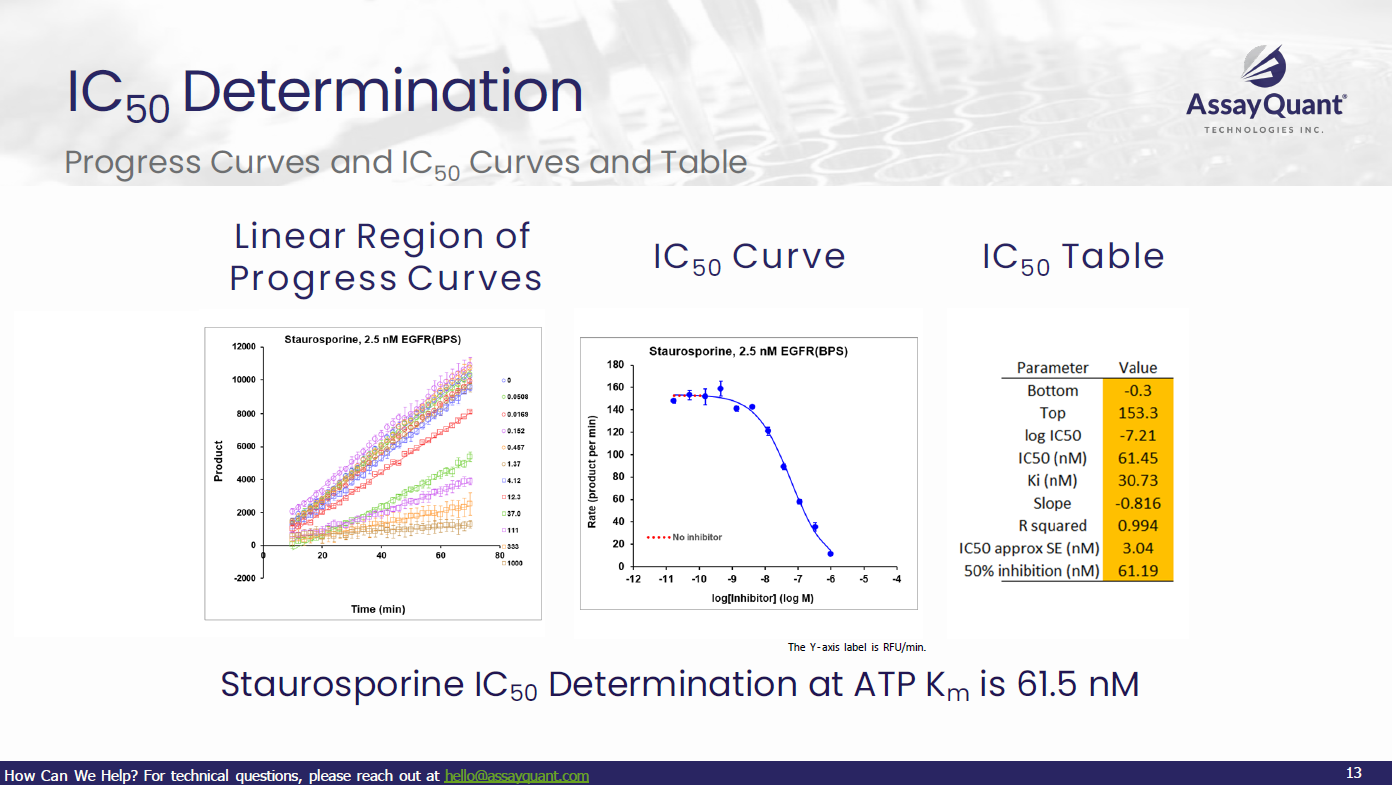
Each validation report provides experimental conditions and data showing:
Protocol
See how the PhosphoSens-Kinetic Assay can be used to find the IC50 of a kinase inhibitor.
Download Protocol →Webinar
Discover how continuous assay formats power deep understanding of kinase function. See how PhosphoSens® assays guide inhibitor profiling, selectivity assessment, and mechanistic characterization.
Watch the Webinar →Service
Need broader selectivity data? KinSight profiling runs your compounds across our full kinase panel under identical PhosphoSens conditions.
Learn about KinSight →Want to hear the latest about our technology? Be among the first to learn about our latest products and services.