Still have questions about our products?
Our scientists can help you choose the right assay format, substrate, and enzyme for your experiment.
Also known as: BUBR1 • BUB1 mitotic checkpoint serine/threonine kinase B • budding uninhibited by benzimidazoles 1 beta • Bub1A • MAD3L • hBUBR1 • MAD3/BUB1-related protein kinase
.jpg?width=450&name=PhosphoSens%20Packaging%20C%20(3).jpg)
BUB1B (also known as BUBR1 or MAD3L) is a member of the BUB kinase family, a group of serine/threonine kinases that are central orchestrators of the spindle assembly checkpoint (SAC). BUB1B is activated during mitotic entry and localizes to unattached kinetochores, where it integrates signals from the MCC (mitotic checkpoint complex) to delay anaphase onset until all chromosomes achieve proper bipolar attachment. Key substrates include CDC20, which BUB1B sequesters within the MCC to inhibit APC/C-mediated degradation of securin and cyclin B. Upstream regulators include Aurora B and MPS1, which phosphorylate BUB1B to promote kinetochore recruitment. Dysregulation of BUB1B leads to chromosomal instability (CIN), a hallmark of cancer, and BUB1B mutations or overexpression are observed in colorectal, lung, and breast cancers. Mosaic variegated aneuploidy (MVA) syndrome arises from germline BUB1B mutations. Its dual role as a checkpoint scaffold and kinase makes BUB1B an attractive target for cancer therapies exploiting mitotic vulnerabilities.
Developing BUB1B kinase assays presents significant challenges: its relatively low intrinsic kinase activity, dependence on scaffolding partners, and the need to distinguish catalytic from non-catalytic checkpoint functions complicate endpoint assays. ADP-Glo and HTRF methods require fixed-time sampling and are susceptible to compound interference, inner-filter effects, and luciferase inhibition artifacts that can generate false positives at physiological ATP concentrations. Radiometric assays add safety burdens and throughput limitations. AssayQuant's PhosphoSens CSox-based peptide substrates enable continuous, real-time fluorescent monitoring of BUB1B phosphorylation at physiological ATP levels, delivering full kinetic progress curves that capture true Km, kcat, and IC50 values. This approach is ideal for detecting covalent inhibitors via kinact/KI determination and for time-dependent inhibition studies, improving hit quality and reducing late-stage attrition in BUB1B drug discovery campaigns.
Have questions about BUB1B assay design, selectivity panels, or covalent inhibitor characterization?
Ask Our Scientists →Continuous, real-time fluorescent assays optimized for quantitative BUB1B activity measurements, IC50 determination, and mechanistic studies.
PhosphoSens-Kinetic assays directly quantify enzyme activity by continuously monitoring substrate phosphorylation or dephosphorylation in real time, generating a full progress curve in every well.
Learn more about PhosphoSens-Kinetic →Need pricing or availability? Select a kit or substrate to request a quote below.
Kits
Ready-to-use assay kits containing substrate and all essential reagents.
Automatically save 10% when bundling 10ug recombinant enzyme with your 1,000 assay kit. View enzymes
Substrate
Bulk PhosphoSens® substrate for assay development and high-throughput workflows.
Automatically save 10% when bundling Reagent Packs with your substrate. View Reagent Packs
Select a kit, substrate, or enzyme above. Our team will confirm pricing, availability, and any applicable bundle discounts.
No PhosphoSens-Red format is currently available for BUB1B.
Select a kit, substrate, or enzyme above. Our team will confirm pricing, availability, and any applicable bundle discounts.
Wild-type and mutant forms of BUB1B for assay development, kinase profiling, and mechanistic studies. Enzymes are supplied active and optimized for PhosphoSens® substrates.
Human • Baculovirus-Insect Cells
Price: $$348.00
BUB1B exhibits relatively low intrinsic kinase activity that is highly context-dependent, making it easy to miss subtle activity changes in fixed-endpoint formats. Endpoint assays such as ADP-Glo can also suffer from signal artifacts caused by compound interference with luciferase reporters, leading to false positives or false negatives. PhosphoSens continuous assays monitor phosphorylation in real time, capturing the full progress curve and flagging assay interference early.
Yes. Because PhosphoSens generates continuous fluorescence readouts over time, it captures the time-dependent loss of enzyme activity characteristic of covalent and slow-binding inhibitors. This enables direct calculation of kinact and KI parameters essential for characterizing irreversible or pseudo-irreversible inhibitor mechanisms, which would be missed or mischaracterized in single-timepoint ADP or phospho-antibody assays.
AssayQuant PhosphoSens assays are run at or near physiological ATP concentrations (typically 1 mM), which is critical for accurate IC50 determination and selectivity profiling. Many competing assay platforms use artificially low ATP concentrations to boost signal, which artificially inflates potency for ATP-competitive inhibitors and skews SAR decisions. Physiological ATP conditions ensure that inhibitor potency data translates more faithfully to cellular and in vivo contexts.
Explore data and documents to support your kinase and phosphatase experiments. Download sample data, protocols and other resources to see how our assays perform and to help you get started in your own lab. All validation data generated using PhosphoSens® assays under recommended conditions.
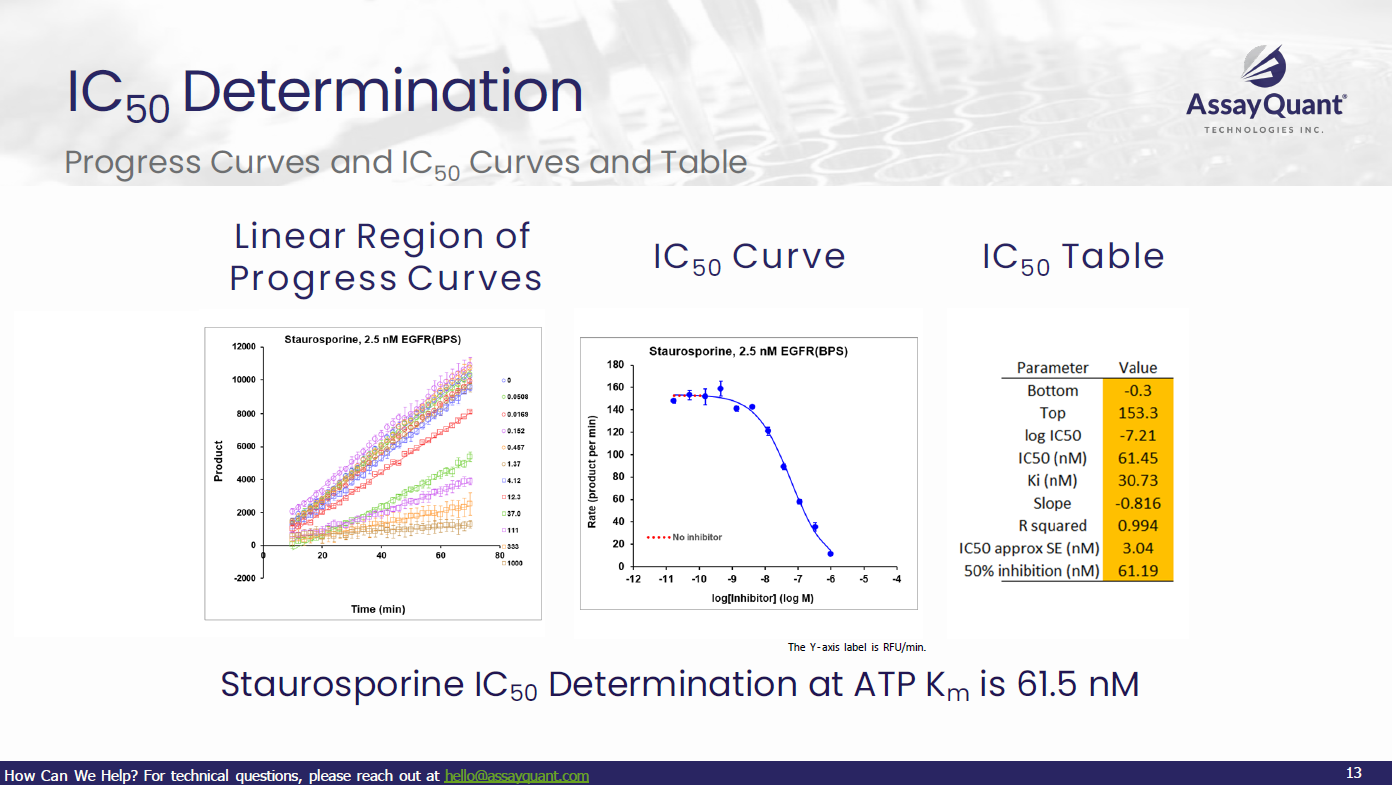
Each validation report provides experimental conditions and data showing:
Protocol
See how the PhosphoSens-Kinetic Assay can be used to find the IC50 of a kinase inhibitor.
Download Protocol →Webinar
Discover how continuous assay formats power deep understanding of kinase function. See how PhosphoSens® assays guide inhibitor profiling, selectivity assessment, and mechanistic characterization.
Watch the Webinar →Service
Need broader selectivity data? KinSight profiling runs your compounds across our full kinase panel under identical PhosphoSens conditions.
Learn about KinSight →Want to hear the latest about our technology? Be among the first to learn about our latest products and services.