ZAP70 is the kinase that turns T-cell receptor (TCR) engagement into downstream signaling. When the TCR is stimulated, ZAP70 is recruited to the receptor complex, activated, and goes on to phosphorylate adaptor proteins such as LAT and SLP-76. That central role has made ZAP70 a target of interest in autoimmune and inflammatory disease and a marker of interest in some lymphoid malignancies.
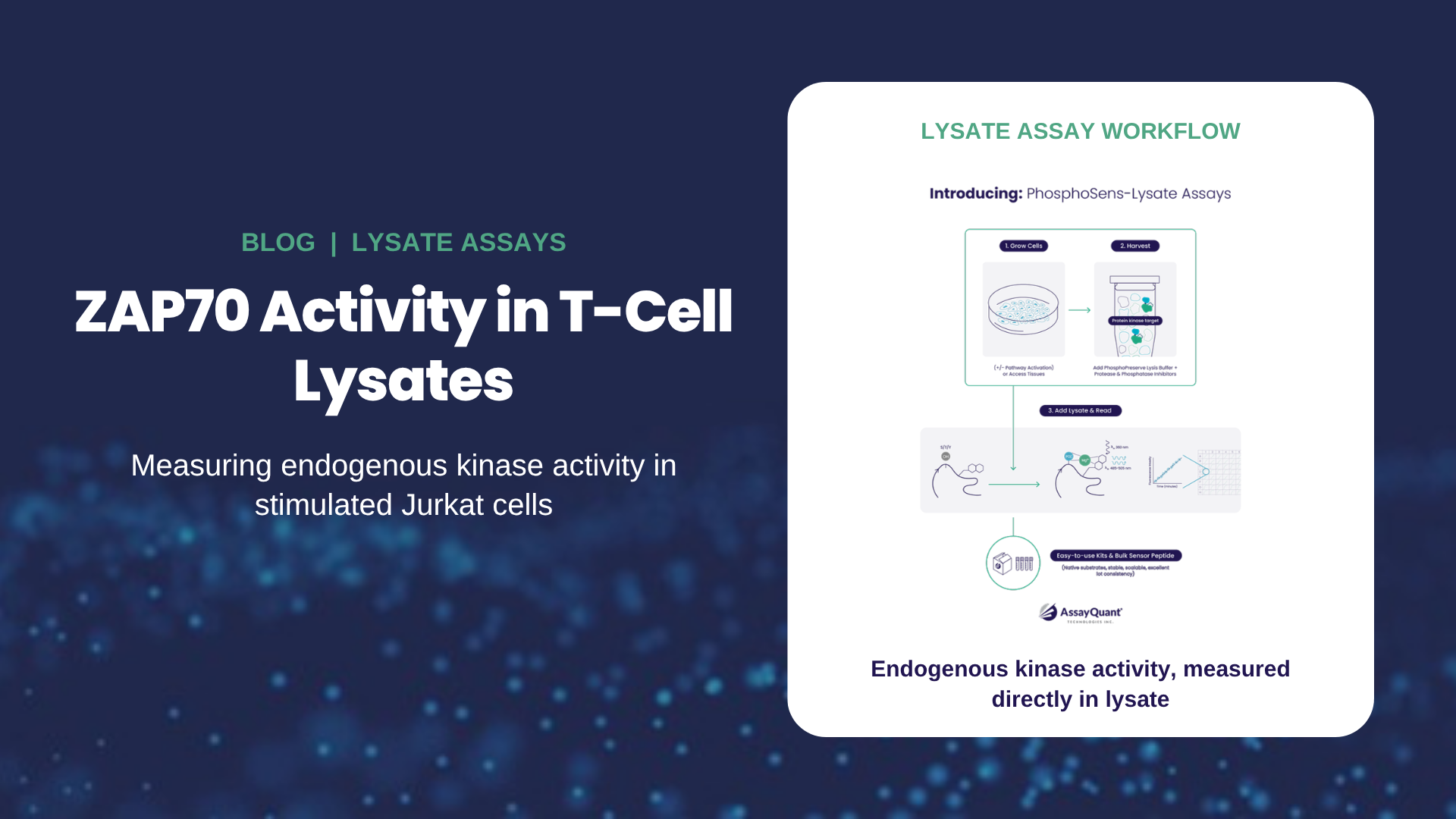
Measuring what ZAP70 is actually doing in cells has been harder than it sounds. This post explains why, and how the PhosphoSens® ZAP70 lysate assay measures endogenous ZAP70 activity directly in T-cell lysates.
Key takeaways
- Phospho-specific antibodies report ZAP70's phosphorylation state, not its catalytic activity, and the two can diverge.
- ZAP70's close relative SYK can phosphorylate many of the same substrates, so any activity readout has to separate the two.
- The AQT1450 sensor peptide is ZAP70-selective: in profiling against 411 wild-type kinases, SYK was the only off-target with more than 10% of ZAP70's activity.
- In stimulated Jurkat lysates, inhibitor pharmacology confirms that the signal is driven primarily by ZAP70, not SYK.
Why ZAP70 activity is hard to measure
The usual approach is to blot for phosphorylated ZAP70 or its substrates. Those readouts tell you a modification is present at one moment, but not how much catalytic work the enzyme is doing. Feedback, phosphatase activity, and inhibitor binding can all change phosphorylation without a matching change in activity. (A recent independent study of ERK inhibitors showed just how far apart the two can drift; see pERK Is Not ERK Activity.)
ZAP70 adds a second problem: SYK. The two kinases are close relatives with overlapping substrate preferences, and many inhibitors hit both. An activity assay is only useful if you can show which kinase is generating the signal.
A selective sensor for ZAP70
PhosphoSens-Lysate assays use a kinase-selective sensor peptide that fluoresces as it is phosphorylated, giving a continuous readout of catalytic activity with no antibodies and no wash steps. The ZAP70 substrate, AQT1450, was profiled against 411 wild-type kinases. Except for SYK, every off-target kinase showed less than 10% of ZAP70's activity on the substrate.
Validation in stimulated Jurkat lysates
To test the assay in a native setting, Jurkat T cells were serum-starved and then stimulated through the TCR with anti-CD3 (OKT3) and anti-CD28 antibodies plus a crosslinker. Stimulated lysates showed up to a 1.9-fold increase in phosphorylation rate over unstimulated controls. Key performance characteristics from the validation:
- Sample requirement: linear response up to 1.25 µg total lysate protein per well
- Substrate Km in lysate: 8.4 µM
- DMSO tolerance: no significant loss in rate up to 2% DMSO, so compound testing is straightforward
Separating ZAP70 from SYK with inhibitor pharmacology
The clearest test of which kinase drives the lysate signal is to compare inhibitor potency in lysate with potency against each recombinant enzyme. Three inhibitors with different ZAP70/SYK preferences were used:
| Inhibitor | Recombinant ZAP70 IC50 | Recombinant SYK IC50 | Jurkat lysate IC50 |
|---|
| RDN2150 | 267 nM | 9,200 nM | 183 nM |
| PRT062607 | 53 nM | 2 nM | 48 nM |
| RO9021 | 411 nM | 12 nM | 670 nM |
In every case, the lysate IC50 tracks the ZAP70 value, not the SYK value. The two SYK-preferring inhibitors would have shut down a SYK-driven signal at low-nanomolar concentrations; instead they inhibited the lysate signal only at concentrations matching their ZAP70 potency. The conclusion: AQT1450 phosphorylation in stimulated Jurkat lysate is driven primarily by ZAP70.
Where a ZAP70 activity assay fits
- Target engagement for ZAP70 programs: confirm that compounds inhibit endogenous ZAP70 in a cellular context, not just the recombinant enzyme.
- ZAP70 vs. SYK selectivity in context: pair lysate data with recombinant ZAP70 and SYK assays to see which kinase a compound is really hitting.
- Pathway and stimulation studies: quantify how TCR stimulation, co-stimulation, or genetic perturbations change ZAP70 output.
- Pharmacodynamic readouts: track ZAP70 suppression after dosing in cell or tissue lysates.
Get started
The ZAP70 lysate assay (substrate AQT1450) is part of the PhosphoSens-Lysate portfolio, alongside assays for ERK1/2, AKT1/2/3, GSK3α/β, DNA-PK, JNK1/2/3, p38α/β/γ/δ, CDK1/2/3/5, and CDK2/Cyclin E1. You can download the ZAP70 validation report, and for broader selectivity work, ZAP70 and SYK are both available in our KinSight™ profiling panels. Questions about your T-cell model? Talk to an AssayQuant scientist →