AssayQuant Awarded NIA SBIR for Neurodegeneration Kinase Assays
AssayQuant receives an NIA Direct-to-Phase II SBIR (R44AG102290) to develop selective sensor peptide substrates for kinase activity assays in neurodegeneration.
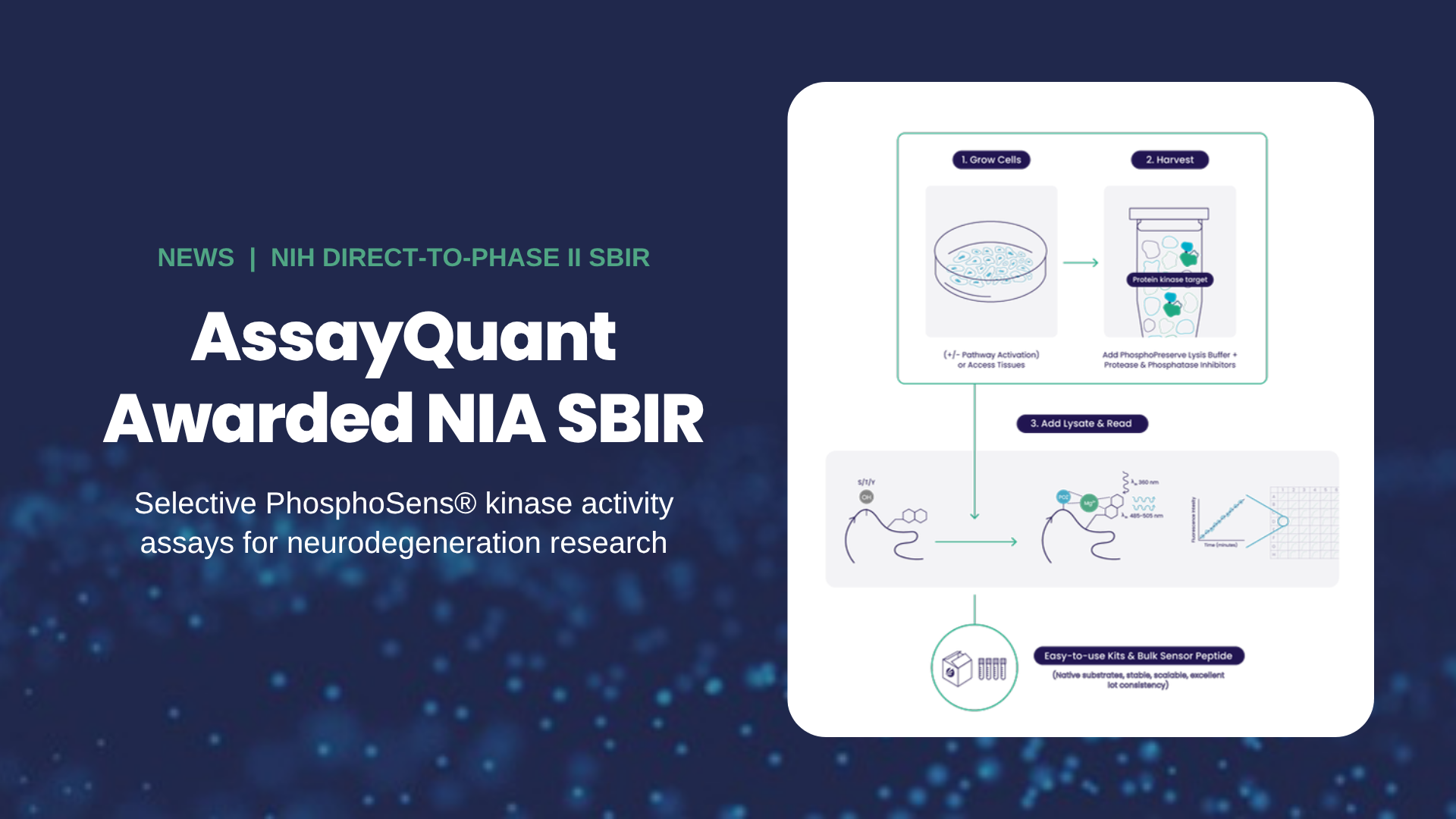
MARLBOROUGH, Mass., October 2026 — AssayQuant Technologies, Inc. has been awarded a Direct-to-Phase II Small Business Innovation Research (SBIR) grant from the National Institute on Aging (NIA) of the National Institutes of Health (NIH). The two-year project, Selective Sensor Peptides for High-throughput, Kinetic Biomarker Assays of Kinase Activity in Neurodegeneration and Related Disorders, is funded through NIH’s Alzheimer’s Disease Initiative.
What the project will do
The program will develop new PhosphoSens® sensor peptide substrates that are selective for high-profile kinases implicated in neurodegenerative disease. The goal is continuous, high-throughput assays that quantitatively measure kinase activity, not just protein levels, directly in complex biological samples.
Why it matters
Dysregulated kinase signaling is implicated in Alzheimer’s disease and related disorders, including in the abnormal phosphorylation of proteins such as tau. Most available tools measure how much of a kinase is present or infer activity indirectly. Activity-based, kinetic readouts provide researchers with a direct functional proteomic view of disease biology and of how drug candidates change it.
Building on our lysate platform
The award extends work that began with our 2024 NCI Direct-to-Phase II SBIR. That work enabled the development of our first 11 PhosphoSens lysate assay products, covering 23 kinases (AKT1/2/3, CDK2/Cyclin E1, pan-CDK1-3/5, CDK4/6, cKit D816V, DNA-PK, ERK1/2, GSK3α/β, JNK1-3, p38α/β/γ/δ, and ZAP70), for use in cell lysates and tissue homogenates.
“These new assays for oncology-centric kinases provide a more physiological context and serve as a bridge between biochemical results with recombinant proteins and cell-based assays. Importantly, we have shown that the high sensitivity of these assays allows detection of kinase activity across commonly used cancer cell models with minimal sample and without overexpression.
Our second Phase II SBIR focuses on neurology- and neurodegeneration-centric kinases, including kinases that phosphorylate tau, stress kinases, and those involved in neuroinflammation, learning and memory, and age-related dementias.
These PhosphoSens lysate activity assays enable high-throughput interrogation of specific target enzymes, or serve as functional biomarkers to understand pathway regulation in normal and disease states and the effectiveness of drug treatments. This approach is providing greater insight, better decisions, and a path to personalized medicine that can be applied across therapeutic areas.”
— Erik Schaefer, PhD, Chief Scientific Officer, Co-founder, and Principal Investigator, AssayQuant Technologies
For researchers
If you study kinase biology in neurodegeneration, we’d like to hear what targets and sample types matter most to you. Talk to an AssayQuant scientist →
About AssayQuant Technologies
Founded in 2015 as an MIT spinout and based in Marlborough, Massachusetts, AssayQuant develops real-time kinase and phosphatase activity assays powered by patented PhosphoSens® technology, along with KinSight™ selectivity profiling services, for academic, biotech, and pharmaceutical researchers, to further the understanding of phosphoregulation and accelerate drug discovery.
Research reported in this publication is supported by the National Institute on Aging of the National Institutes of Health under Award Number R44AG102290. The content is solely the responsibility of the authors and does not necessarily represent the official views of the National Institutes of Health.