Our Best Price, Guaranteed. Good science shouldn't stall on budget. Reach out and we'll find pricing that works for your program. Plus, get our lowest IC50 pricing to follow up on any hits from your profiling results.
New-customer offer — existing customers, contact our team about volume pricing.
Kinome Profiling Services That Show You More Than % Inhibition
KinSight™ profiles your compounds against 560+ validated kinases using continuous, real-time assays — delivering true selectivity data, TDI detection, and MOA insights that endpoint platforms systematically miss.
560+
Protein kinases available
n=2
All assays run in duplicate
Customizable
Design your own panel
2 wks
Detailed report turnaround
Selectivity is a central problem in kinase drug discovery
Kinase inhibitors work by occupying a catalytic pocket that's structurally conserved across hundreds of related enzymes. That conservation is precisely why selectivity is hard to achieve: a compound designed against one kinase will often show meaningful activity against dozens of others, and unrecognized off-target inhibition remains one of the most common reasons candidates fail late in development.
Profiling that measures actual catalytic turnover — not a proxy for it — gives medicinal chemistry a real number to optimize against, and gives safety teams visibility into liabilities while they're still cheap to fix.
How KinSight Kinome Profiling Works
-
1
Panel selection
Test against a single kinase, a focused subfamily, or the full 560+ kinase panel — single-concentration screening or full dose-response, your choice..
-
2
Continuous kinetic measurement, not a single frame
An endpoint read captures one moment after the reaction has already stopped — like judging a movie from a single frame. PhosphoSens® instead monitors every well throughout the entire reaction, so what you get is the full sequence, not a still.
-
3
Kinetics that separate compounds an endpoint can't
Two compounds can show nearly identical inhibition at a single timepoint and still be doing very different things underneath — one fast and reversible, one slow and time-dependent, one covalent. KinSight's progress-curve analysis resolves that difference directly, flagging TDI, slow-binding behavior, and mechanism-of-action signals that a single % inhibition value collapses into one indistinguishable number.
-
4
Reporting built for a decision, not just a data pull.
Waterfall plots, an interactive kinome tree overlay, tabular exports, and annotated progress curves for every well — reviewed by our scientists before you receive it — delivered within two weeks.
What's in your data package?
- ✓Waterfall plots ranked by % inhibition across all targets
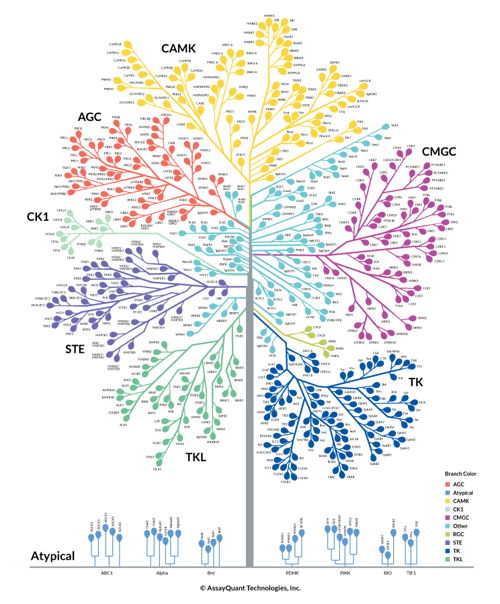
- ✓Annotated kinome tree visualization
- ✓Tabular % inhibition data export
- ✓Progress curves for every well (not just endpoint)
- ✓TDI, slow-binding, and unusual kinetics flagged by scientists
- ✓MOA insights and selectivity score summary
Standard turnaround: 2 weeks
Rush timelines available on request. No minimum compound quantity required for feasibility discussion.
Start Your ProjectActivity vs. Binding vs. Endpoint: Know What You're Actually Measuring
Most kinome profiling platforms compress an entire enzyme reaction into a single number at one timepoint. KinSight measures the full reaction in real time — revealing not just which kinases are inhibited, but how and how confidently.
| Features | KinSight | Competition Binding | Radiometric Assay |
|---|---|---|---|
| Measures kinase activityActual enzyme velocity, not an indirect signal | ✓ | – | ✓ |
| Real-time progress curve per wellFull reaction trajectory, not a single endpoint read | ✓ | – | – |
| Detects TDI & slow-binding inhibitorsInvisible to endpoint assays | ✓ | – | – |
| Built-in reaction QC per wellCurve shape reveals artifacts and interference | ✓ | – | – |
| Versatile ATP concentrationsATP Km for potency, 1 mM for physiological relevance | ✓ | – | Partial |
| Native peptide sequencesDerived from authentic biological substrates | ✓ | – | Varies |
| Expert MOA annotation in reportScientists flag TDI, unusual kinetics, liabilities | ✓ | – | – |
* "Detects TDI & slow-binding inhibitors" requires a continuous readout by definition — time-dependent inhibition is a kinetic phenomenon that collapses to a single value at any endpoint read. "ATP Km conditions (Partial)" indicates some ATP concentration flexibility, but not true enzyme-specific Km as standard. "Optimized substrate (Varies)" reflects that substrate selection and quality varies across kinases on those platforms. KINOMEscan (Eurofins/DiscoverX) measures binding displacement, not catalytic activity — a fundamentally different biological question.
What This Looks Like In Practice
True initial rates, no artifacts
Calculated from the linear region of the curve, before drift or degradation distort the signal.
TDI and slow-binding detection
Time-dependent inhibition shows up as curvature — invisible at a single endpoint.
Physiologically relevant ATP
Profile at ATP Km, 1 mM, or both — not locked to one concentration.
Kinetic selectivity, not rank order
Distinguishes competitive, slow-binding, and irreversible inhibitors across the panel.
Continuous profiling does more than rank kinases by % inhibition.
It reveals whether the assay is linear, curvy, delayed, or time-dependent — that's the difference between data you can act on and data that looks right until it isn't.
Kinase Selectivity Panels
| Panel Name | Panel Size | ATP Options | Use Case | |
|---|---|---|---|---|
| Wild-Type Protein Kinase Panel | 397 | ATP Km and 1 mM | Broad selectivity, safety tox, off-target ID | View Panel → |
| Complete Protein Kinase Panel | 564 | ATP Km and 1 mM | Comprehensive off-target screening | View Panel → |
| Tyrosine Kinase (TK) Panel | 83 | ATP Km and 1 mM | RTK / non-RTK selectivity profiling | View Panel → |
| Cyclin-Dependent Kinase (CDK) Panel | 32 | ATP Km and 1 mM | Cell cycle & oncology selectivity | View Panel → |
| Mutant Protein Kinase Panel | 163 | ATP Km and 1 mM | Resistance mutation profiling | View Panel → |
| KiNode Panel | 71 | ATP Km and 1 mM | Focused selectivity screening | View Panel → |
| Kinase Safety (TOX) Panel | 16† | ATP Km and 1 mM | Early off-target safety liability screening | View Panel → |
| Custom Panel Design Your Own | 1–150 | ATP Km and 1 mM | Any program-specific target list | Contact Us → |
* Kinase selectivity profiling is conducted on a biweekly schedule, with assays run at the appropriate ATP Km (by available research pathway assessments) or at 1 mM ATP (approximate physiological conditions). Alternative ATP concentrations can be accommodated upon request.
† The TOX Panel evaluates your compound against kinases identified as safety-associated targets by the IQ DruSafe In Vitro Secondary Pharmacology Working Group (Brennan, R.J. et al., Nat Rev Drug Discov, 2024), reflecting the value of early in vitro profiling in reducing late-stage attrition from adverse pharmacology. We currently have validated assays for 16 of the 19 recommended targets; the remaining targets are in development.
Don't See the Right Fit?
Work directly with our scientists to design a custom panel around your program's specific targets — any combination of 1–150 kinases, any ATP condition, any concentration format.
Related Services
Phosphatase Selectivity Profiling
The same continuous-assay approach applied to 45 serine/threonine and tyrosine phosphatases — a companion service when off-target phosphatase liability is part of your program. See phosphatase profiling →
Time-Dependent Inhibition (TDI) Characterization
Deeper kinetic characterization for compounds showing slow-binding or time-dependent behavior — residence time, kobs, and mechanism-of-inhibition studies beyond a standard panel. See TDI characterization →
Custom Assay Development
Need a target outside our standard catalog? Our team designs and validates a PhosphoSens substrate for it, typically within 8–12 weeks. See custom assay development →
Compound Testing Services
Flexible potency and profiling services scoped to your specific compound and program needs, beyond standard panel formats. See testing services →
These Two Targets Report ~60% Inhibition at 2 Hours
Look at the full progress curve, though, and the story changes completely — from clean linear kinetics, to a hard plateau, to a slow-building lag phase.
Most profiling platforms stop the reaction and read a single time point, meaning you may never catch these differences.
Frequently Asked Questions
What is kinome profiling?
Kinome profiling tests a compound against a broad panel of kinases to measure selectivity — how much it inhibits its intended target relative to other kinases — supporting off-target liability, safety, and mechanism-of-action decisions.
What is a PhosphoSens® kinase assay?
PhosphoSens® assays are continuous, real-time kinase activity assays that directly measure phosphorylation of a substrate peptide throughout the reaction. Unlike endpoint assays that capture a single time point, PhosphoSens generates a full progress curve — enabling true kinetic analysis including IC₅₀, Kᵢ, kobs, and time-dependent inhibition (TDI) from a single experiment.
How does a continuous kinase assay detect time-dependent inhibition (TDI)?
TDI compounds produce a characteristic change in the progress curve shape — the inhibition deepens over time as the compound slowly occupies or covalently modifies the enzyme. Because PhosphoSens monitors activity continuously, this curve deviation is directly visible. Endpoint assays that measure at a single time point will either miss TDI entirely or mischaracterize its potency, depending on when they sample the reaction.
Can't find my target in the catalog?
We offer custom assay development for kinase targets not currently in our catalog. Our team can design and validate a PhosphoSens substrate for your target, typically within 8–12 weeks. Contact us to discuss your target, timeline, and project requirements.
How is KinSight different from KINOMEscan, HotSpot, or KinaseProfiler?
KINOMEscan, HotSpot, and KinaseProfiler are all endpoint assays — they take a single read after a fixed incubation and report % inhibition or binding. KinSight uses continuous PhosphoSens® assays that monitor the full reaction in real time, generating a progress curve for every well. That means we detect TDI, slow-binding, and unusual kinetics that endpoint platforms will miss — and we can run at physiologically relevant ATP Km conditions rather than a fixed 10 µM ATP that systematically overestimates potency.
Can I design a custom kinase panel?
Yes — custom panels are a core part of what we do. You can specify any combination of 1–150 kinases from our catalog of 400+ validated targets. Our scientists will work with you to confirm availability, recommend complementary targets based on your program, and confirm ATP conditions. Contact us to get started — there's no minimum order for a custom panel feasibility conversation.
Can KinSight be used for safety/tox screening, not just drug discovery?
Yes, and it's increasingly used for exactly that. Broad-panel profiling at 1 mM ATP provides a physiologically relevant view of off-target kinase liabilities early — before they surface in cell-based or animal studies. The TDI detection capability is particularly relevant for tox screening, since time-dependent inhibition of off-target kinases can drive delayed or mechanism-based toxicity that endpoint assays miss entirely.
How do you identify off-target liabilities from the data?
Our scientists review every result — not just the hits. The report flags: (1) unexpected high-inhibition targets outside your intended pharmacology, (2) TDI signals that suggest irreversible or slow-onset binding, (3) kinases with structural similarity to your primary target that warrant follow-up, and (4) any results with unusual kinetics that might indicate assay artifacts vs. real biology. You get a curated interpretation, not a raw data dump.
What does the kinome tree visualization show me?
The kinome tree maps all human kinases in their evolutionary/phylogenetic relationships. Your profiling results are overlaid on this map — targets with high inhibition are shown as larger, colored circles, making it immediately visible whether your compound is hitting a tight cluster (suggesting on-target pharmacology with known selectivity) or scattered across unrelated families (suggesting promiscuity). It's the fastest way to communicate selectivity to internal stakeholders or in a partner presentation.
Can you profile phosphatase selectivity as well as kinases?
Yes. We offer phosphatase selectivity profiling as a companion service using the same continuous assay approach. This is especially valuable when your compound or program involves phosphatase-adjacent biology, or when you want a complete picture of off-target activity that kinase profiling alone won't capture. See our Phosphatase Profiling page for panel details.
How many compounds can I screen in a single run?
Profiling runs are scheduled biweekly. You can submit multiple compounds per run — contact us to discuss batch sizing, compound requirements (amount, concentration, solvent), and turnaround expectations. Single-compound rush submissions can be accommodated on a case-by-case basis.
Resources for Kinase Assay Scientists
Deep Kinetic Characterization: When IC50 Isn't Enough
A continuous assay, like our PhosphoSens assay, that measures the catalytic event of phosphorylation in real time enables determination of kinetic parameters that power your drug discovery research.
Continuous vs. Endpoint Kinase Assays: What You Need to Know
Kinome Profiling With a Continuous Assay
Have you ever heard of Anscombe’s Quartet? It emphasizes the significance of data visualization and teaches us that descriptive statistics may be misleading.
Profile Your Compound With Confidence
Whether you are confirming a single hit, mapping kinome-wide selectivity, or resolving mechanism of action, our team will match the assay format and panel to your program and target constraints.
Stay Informed
Want to hear the latest about our technology? Be among the first to learn about our latest products and services.