
The Advantages of Continuous Assays in Kinome Profiling

Most profiling platforms stop the reaction and read a single time point.


That snapshot assumes the enzyme stayed perfectly linear — but in reality, enzyme activity is dynamic. As a result, endpoint assays can distort potency, overlook time-dependent inhibition, and hide mechanistic behaviors that influence drug discovery outcomes.

The Limitations of Endpoint Kinase Assays

Although endpoint assays remain widely used, they measure only a single timepoint after the reaction has stopped — providing an incomplete picture of enzyme behavior and masking key kinetic information. It’s like judging a movie from a single frame, missing critical information. 

Single Timepoint Measurement:
Endpoint assays capture data only after the enzyme reaction is halted, offering a static snapshot that fails to reflect how activity evolved over time.
Assumed Linearity:
They rely on the assumption that enzyme activity stays constant throughout the reaction, even though most enzymes exhibit changing rates as substrates deplete or inhibitors engage.
Hidden Artifacts:
Solubility issues, compound aggregation, or assay interference can distort endpoint signals, creating false impressions of inhibition or activation.
Lost Mechanistic Insight:
Critical kinetic behaviors — such as lag phases, slow-binding inhibition, or reversible interactions — remain invisible, preventing a full understanding of inhibitor mechanism.
 

Continuous assays overcome these challenges by capturing enzyme activity in real time rather than at a single endpoint.

Instead of inferring behavior from a static value, they directly monitor reaction progress — revealing how activity changes second by second as substrates are converted and inhibitors interact.
This approach provides a full kinetic profile that exposes subtle but critical behaviors — such as time-dependent inhibition, reversibility, and off-rate effects — delivering data that truly reflect enzyme mechanism.

Continuous Assays Capture True Enzyme Behavior

A Single Timepoint Can’t Tell the Whole Story

AssayQuant’s PhosphoSens® technology continuously measures enzyme activity in real time — directly tracking substrate phosphorylation rather than relying on indirect coupling reactions.
Each well produces a complete progress curve with dozens of timepoints, revealing exactly how enzyme activity changes throughout the reaction. This allows for accurate, rate-based % inhibition values tailored to each of the 400+ wild-type kinases profiled in our KinSight™ selectivity screens.

Unlike endpoint assays that provide a single snapshot, the PhosphoSens continuous format captures the entire story — every frame of enzyme behavior. By measuring catalytic activity kinetically, it reveals true selectivity and mechanism of action, giving researchers the mechanistic clarity needed to drive drug development forward with confidence.

This approach forms the foundation of AssayQuant’s KinSight Profiling Service, which delivers kinetic insight into kinome-wide selectivity and mechanism of action (MOA) — helping discovery teams make data-driven decisions about therapeutic opportunities and off-target liabilities with greater confidence and precision.

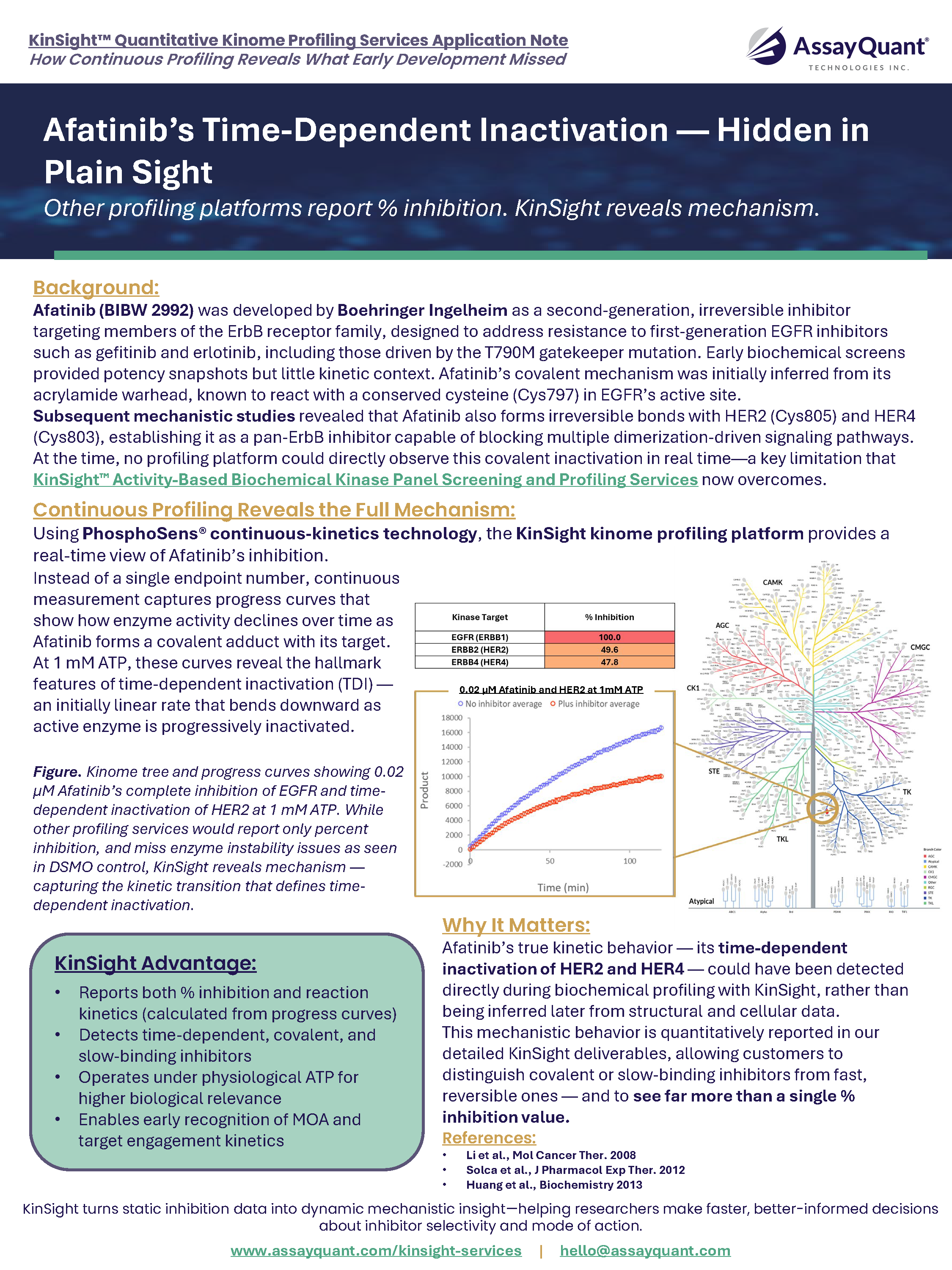
Afatinib’s Time-Dependent Inactivation — Hidden in Plain Sight_v2
 

Afatinib’s Time-Dependent Inactivation — Hidden in Plain Sight

Learn how KinSight reveals Afatinib’s covalent pan-ErbB mechanism that other profiling platforms missed.

What Continuous Profiling Reveals That Endpoints Miss

AssayQuant’s Quartet: Same Endpoint, Different Story

In a comparative example, four kinases — TTBK1, FGFR3, BTK, and HCK — each appeared to show ~60–65% inhibition in a standard endpoint assay.
Each mechanism produces similar endpoint values — yet radically different kinetics and implications for inhibitor optimization.

On paper, they look the same, but continuous progress curves tell a very different story:

Target % Inhibition
TTBK1 65%
FGFR3 61%
BTK 61%
HCK 60%
+ or - inhibitor
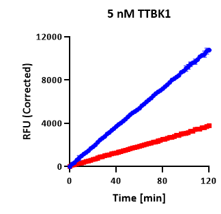
5mM TTBK1 AC Poster
TTBK1 — Linear, predictable kinetics

This is what you expect a clean enzymatic reaction to look like.
Continuous data confirm stable kinetics and reliable rate determination — with 60+ timepoints per replicate instead of one.
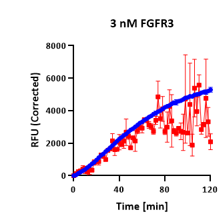
 

3mM FGFR3 AC Poster
FGFR3 — Noisy data reveal solubility artifacts

The continuous trace exposes experimental noise likely caused by compound insolubility — something a single endpoint could never flag.
Detecting such issues early prevents false conclusions and wasted follow-up.
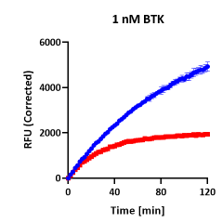
1mM BTK AC Poster
BTK — Saturation & time-dependent inhibition

The curve flattens over time, revealing possible substrate depletion, product inhibition, or slow off-rate behavior.
Early detection of time-dependent inhibition (TDI) provides key clues to mechanism of action (MOA) and compound reversibility.
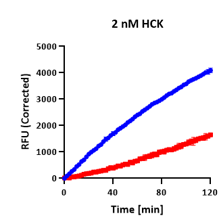
2nM HCK AC Poster
HCK — Lag phase indicates mechanistic nuance

The lag before steady-state activity hints at conformational effects — for example, the inhibitor preferring an inactive or oligomeric kinase form.
These kinetic patterns are invisible to endpoint assays but critical for mechanistic discovery.

"AssayQuant's PhosphoSens technology is uniquely suited to advance Vibliome's kinase inhibitor program. PhosphoSens provides a deep understanding of our compounds including specificity, potency, mode-of-inhibition, reversibility, and time-dependent inhibition. This, along with AssayQuant's world-class scientific support and fast turnaround times powered by automation, will make this a highly productive partnership that will accelerate Vibliome's drug development programs."

KEY TAKEAWAYS

PhosphoSens: Direct Measurement of True Catalytic Activity

Direct, Assumption-Free Measurement:

Continuous assays track catalytic activity in real time, eliminating the need to assume reaction linearity. It yields an actual reaction rate determined from dozens of data points, generating a full progress curve in every well, enabling accurate rate-based % inhibition values grounded in actual enzymatic behavior.

Mechanistic Resolution for Confident Interpretation

By capturing the full reaction progress curve, continuous assays reveal subtle kinetic behaviors such as time-dependent inhibition, partial reversibility, or slow-binding effects. These insights help distinguish between compounds with similar endpoint inhibition but very different mechanisms of action.

Improved Reproducibility and Biological Relevance:

PhosphoSens assays can be performed at physiological ATP concentrations & cofactor conditions and use peptide substrates derived from biologically relevant sequences to measure enzyme activity directly. The resulting data are both reproducible and physiologically meaningful.

Better Decision-Making Across Discovery Programs:

Continuous assays provide mechanistic clarity across hundreds of kinases, allowing researchers to identify off-target liabilities early and prioritize the most promising therapeutic leads. This data-driven understanding accelerates optimization and reduces the risk of late-stage failure.

Ready to see how continuous kinome profiling can guide your inhibitor development?

Whether you’re optimizing a lead compound or exploring kinase selectivity across hundreds of targets, KinSight™ continuous profiling delivers the mechanistic clarity you need to make confident, data-driven decisions.

Stay Informed

Want to hear the latest about our technology? Be among the first to learn about our latest products and services.