Still have questions about our products?
Our scientists can help you choose the right assay format, substrate, and enzyme for your experiment.
Also known as: WEE1 G2 checkpoint kinase • WEE1A • WEE1hu
.jpg?width=450&name=PhosphoSens%20Packaging%20C%20(3).jpg)
WEE1 (WEE1 G2 Checkpoint Kinase) belongs to the WEE family of nuclear tyrosine kinases and serves as a critical guardian of genomic integrity. WEE1 phosphorylates CDK1 at Tyr15 and CDK2 at Tyr15, inactivating these cyclin-dependent kinases to enforce the G2/M and S-phase checkpoints, respectively. This phosphorylation prevents mitotic entry until DNA repair is complete. WEE1 activity is itself regulated by ATR/ATM-mediated checkpoint signaling, PLK1-dependent degradation, and autophosphorylation. In cancer, WEE1 is frequently overexpressed, allowing tumor cells to survive replication stress by sustaining checkpoint arrest rather than undergoing apoptosis. Conversely, p53-deficient tumors rely heavily on the WEE1-CDK1 axis as their primary DNA damage checkpoint, rendering them exquisitely sensitive to WEE1 inhibition. This synthetic lethality rationale has driven intense drug discovery interest, particularly in combination with DNA-damaging agents, PARP inhibitors, and ATR inhibitors across ovarian, uterine, and hematologic malignancies.
WEE1 presents distinct assay challenges: its dual-specificity kinase activity on CDK1/CDK2 tyrosine substrates demands carefully optimized peptide substrates that reflect physiological context, and its relatively low intrinsic catalytic rate can make endpoint assays prone to signal artifacts at low ATP concentrations. ADP-Glo and HTRF approaches require fixed time-point sampling, risking nonlinear kinetics and missing early inhibitor-driven rate changes critical for covalent or slow-binding compounds. Radiometric assays add throughput and safety burdens. PhosphoSens continuous fluorescent kinase assays resolve these issues by generating real-time progress curves at physiological ATP concentrations, enabling direct KM(ATP) determination, accurate IC50 measurements, and full kinact/KI characterization for irreversible inhibitors — all without antibodies or coupled enzymes that can confound WEE1's moderate activity profile.
Have questions about WEE1 assay design, selectivity panels, or covalent inhibitor characterization?
Ask Our Scientists →Continuous, real-time fluorescent assays optimized for quantitative WEE1 activity measurements, IC50 determination, and mechanistic studies.
PhosphoSens-Kinetic assays directly quantify enzyme activity by continuously monitoring substrate phosphorylation or dephosphorylation in real time, generating a full progress curve in every well.
Learn more about PhosphoSens-Kinetic →Need pricing or availability? Select a kit or substrate to request a quote below.
Kits
Ready-to-use assay kits containing substrate and all essential reagents.
Automatically save 10% when bundling 10ug recombinant enzyme with your 1,000 assay kit. View enzymes
Substrate
Bulk PhosphoSens® substrate for assay development and high-throughput workflows.
Automatically save 10% when bundling Reagent Packs with your substrate. View Reagent Packs
Select a kit, substrate, or enzyme above. Our team will confirm pricing, availability, and any applicable bundle discounts.
Robust endpoint TRF assays optimized for high-throughput screening and quantitative WEE1 activity measurement in plate-based workflows.
PhosphoSens-Red assays use europium-based time-resolved fluorescence detection to enable robust, plate-based quantification of enzyme activity, making them well suited for high-throughput screening workflows.
Learn more about PhosphoSens-Red →Need pricing or availability? Select a kit or substrate to request a quote below.
Kits
Ready-to-use TRF assay kits containing substrate and essential reagents.
Automatically save 10% when bundling 10ug recombinant enzyme with your 1,000 assay kit. View enzymes
Substrate
Bulk substrate for PhosphoSens-Red TRF assays and high-throughput workflows.
Automatically save 10% when bundling Reagent Packs with your substrate. View Reagent Packs
Select a kit, substrate, or enzyme above. Our team will confirm pricing, availability, and any applicable bundle discounts.
Wild-type and mutant forms of WEE1 for assay development, kinase profiling, and mechanistic studies. Enzymes are supplied active and optimized for PhosphoSens® substrates.
Human • Baculovirus-Insect Cells
Price: $$348.00
AssayQuant offers PhosphoSens peptide substrates derived from the CDK1 Tyr15 phosphorylation site, optimized for WEE1 catalytic activity. These substrates incorporate the proprietary Sox-based fluorophore to provide continuous, real-time signal output proportional to phosphorylation state. Substrate selection is validated against WEE1 kinetic parameters to ensure linear assay windows suitable for inhibitor profiling.
Yes u2014 PhosphoSens continuous kinetics are ideally suited for covalent inhibitor characterization because real-time progress curves directly capture the time-dependent loss of enzyme activity needed to calculate kinact and KI. Unlike endpoint assays that provide only a snapshot, full progress curve analysis with PhosphoSens accurately resolves slow-binding and irreversible inhibition mechanisms critical for next-generation WEE1 inhibitor development.
Many WEE1 inhibitors are ATP-competitive, so IC50 values are highly sensitive to ATP concentration used in the assay. PhosphoSens assays run at or near physiological ATP levels (1-5 mM), producing IC50 data that is more predictive of cellular potency compared to the artificially low ATP concentrations (typically 10 u00b5M) required by luminescence-based ADP-detection platforms. This reduces the need for Cheng-Prusoff corrections and improves translation to cellular and in vivo models.
Explore data and documents to support your kinase and phosphatase experiments. Download sample data, protocols and other resources to see how our assays perform and to help you get started in your own lab. All validation data generated using PhosphoSens® assays under recommended conditions.
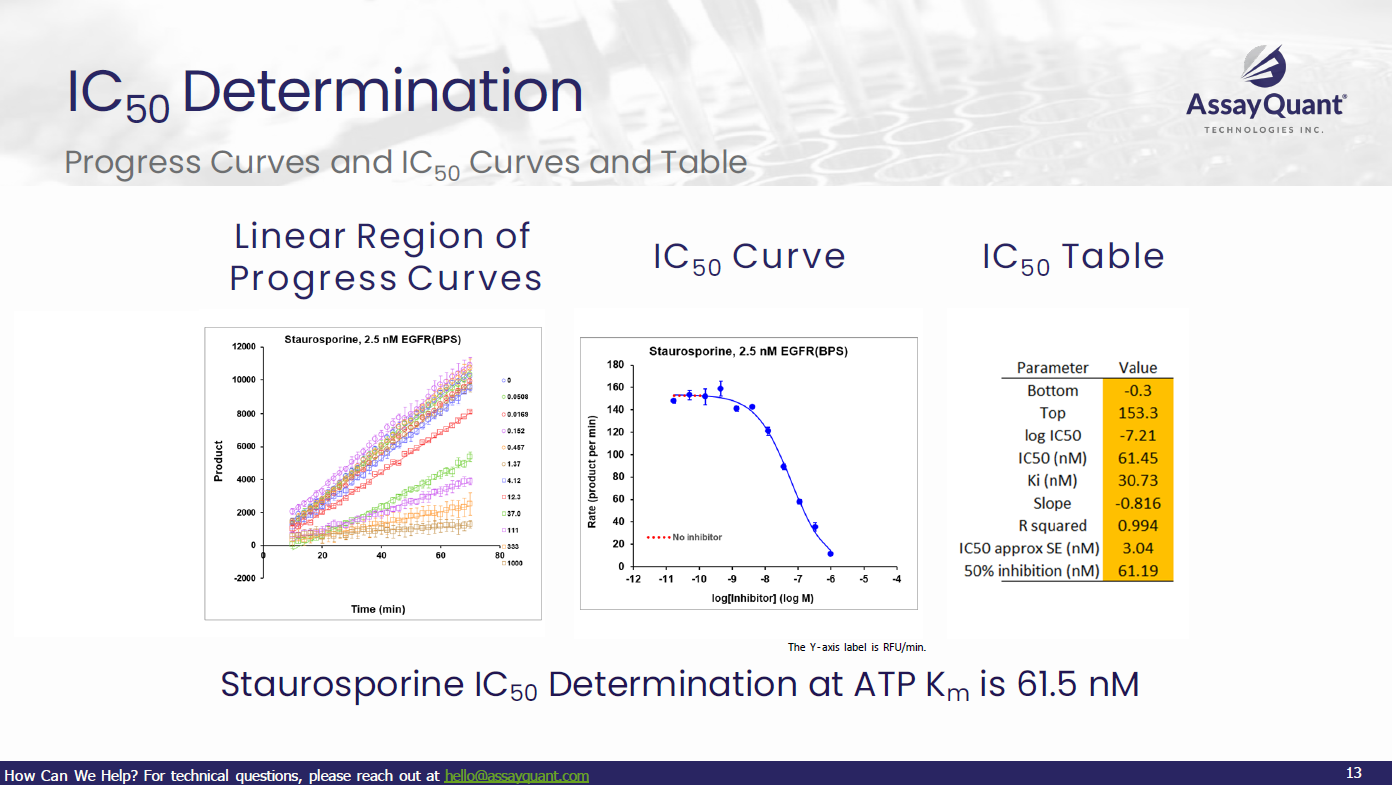
Each validation report provides experimental conditions and data showing:
Protocol
See how the PhosphoSens-Kinetic Assay can be used to find the IC50 of a kinase inhibitor.
Download Protocol →Webinar
Discover how continuous assay formats power deep understanding of kinase function. See how PhosphoSens® assays guide inhibitor profiling, selectivity assessment, and mechanistic characterization.
Watch the Webinar →Service
Need broader selectivity data? KinSight profiling runs your compounds across our full kinase panel under identical PhosphoSens conditions.
Learn about KinSight →Want to hear the latest about our technology? Be among the first to learn about our latest products and services.