Still have questions about our products?
Our scientists can help you choose the right assay format, substrate, and enzyme for your experiment.
Also known as: CDK1 • CDC2 • cyclin dependent kinase 1 • CDC28 • CDC28A • MPF • CDC2A • Cell division control protein 2
.jpg?width=450&name=PhosphoSens%20Packaging%20C%20(3).jpg)
Cyclin-dependent kinase 1 (CDK1) is the master regulator of mitotic entry and progression in eukaryotic cells, functioning as the catalytic subunit of the Maturation Promoting Factor (MPF). CDK1 requires binding to cyclin partners — primarily Cyclin B for canonical mitotic entry, but also Cyclin A1 and A2 during S-phase and early mitosis — to achieve full activation. Activating phosphorylation by CAK (CDK7/Cyclin H) at Thr161 and removal of inhibitory Wee1/Myt1-mediated phosphorylations at Thr14 and Tyr15 by CDC25 phosphatases complete the activation cascade. Key substrates include nuclear lamins, condensins, Separase inhibitor Securin, and APC/C activator Cdh1, orchestrating chromosome condensation, spindle assembly, and cytokinesis. CDK1/CyclinA1 is particularly implicated in germ cell development and acute myeloid leukemia (AML), where CyclinA1 is overexpressed. Dysregulated CDK1 activity drives genomic instability across multiple cancers, making it an attractive oncology drug target for synthetic lethal strategies and combination therapies.
CDK1 presents notable assay challenges: it is unstable as a monomer and requires co-expression with its cyclin partner, has narrow substrate selectivity windows versus related CDKs, and operates physiologically at low-micromolar ATP concentrations that many endpoint assays fail to replicate. ADP-Glo and HTRF approaches require reaction termination, missing early kinetic events and covalent binding signatures critical for irreversible inhibitor characterization. Radiometric assays offer sensitivity but impose throughput and safety limitations incompatible with modern compound screening. PhosphoSens continuous fluorescent kinase assays use chelation-enhanced fluorescent (CSox-based) peptide substrates to monitor CDK1/CyclinA1 phosphorylation in real time at physiological ATP, generating full progress curves. This enables accurate Km(ATP) determination for selectivity profiling, direct kinact/KI measurement for covalent inhibitors, and early detection of substrate depletion artifacts — providing richer mechanistic data in a single homogeneous, no-wash format.
Have questions about CDK1/CycA1 assay design, selectivity panels, or covalent inhibitor characterization?
Ask Our Scientists →Continuous, real-time fluorescent assays optimized for quantitative CDK1/CycA1 activity measurements, IC50 determination, and mechanistic studies.
PhosphoSens-Kinetic assays directly quantify enzyme activity by continuously monitoring substrate phosphorylation or dephosphorylation in real time, generating a full progress curve in every well.
Learn more about PhosphoSens-Kinetic →Need pricing or availability? Select a kit or substrate to request a quote below.
Kits
Ready-to-use assay kits containing substrate and all essential reagents.
Automatically save 10% when bundling 10ug recombinant enzyme with your 1,000 assay kit. View enzymes
Substrate
Bulk PhosphoSens® substrate for assay development and high-throughput workflows.
Automatically save 10% when bundling Reagent Packs with your substrate. View Reagent Packs
Select a kit, substrate, or enzyme above. Our team will confirm pricing, availability, and any applicable bundle discounts.
No PhosphoSens-Red format is currently available for CDK1/CycA1.
Select a kit, substrate, or enzyme above. Our team will confirm pricing, availability, and any applicable bundle discounts.
No recombinant enzymes are currently available for CDK1/CycA1.
AssayQuant offers optimized CSox-based PhosphoSens peptide substrates derived from validated CDK1 consensus sequences, designed to report phosphorylation continuously via fluorescence enhancement. The substrates are validated for use with CDK1/CyclinA1 at physiological ATP concentrations to ensure kinetically accurate IC50 and Km determinations.
PhosphoSens assays are fully compatible with CDK1 supplied as a pre-formed CDK1/CyclinA1 heterodimeric complex, which is required for catalytic activity. AssayQuant provides optimized buffer and co-factor conditions that stabilize the complex throughout the assay, ensuring consistent activity and reproducible kinetic parameters across compound screens.
Yes. Because PhosphoSens generates continuous real-time progress curves, time-dependent inhibition signatures characteristic of covalent mechanisms are directly observable without secondary confirmation assays. The platform enables direct fitting of kinact and KI parameters from a single experiment, providing a significant advantage over endpoint ADP-Glo or HTRF formats that cannot resolve covalent inactivation kinetics.
Explore data and documents to support your kinase and phosphatase experiments. Download sample data, protocols and other resources to see how our assays perform and to help you get started in your own lab. All validation data generated using PhosphoSens® assays under recommended conditions.
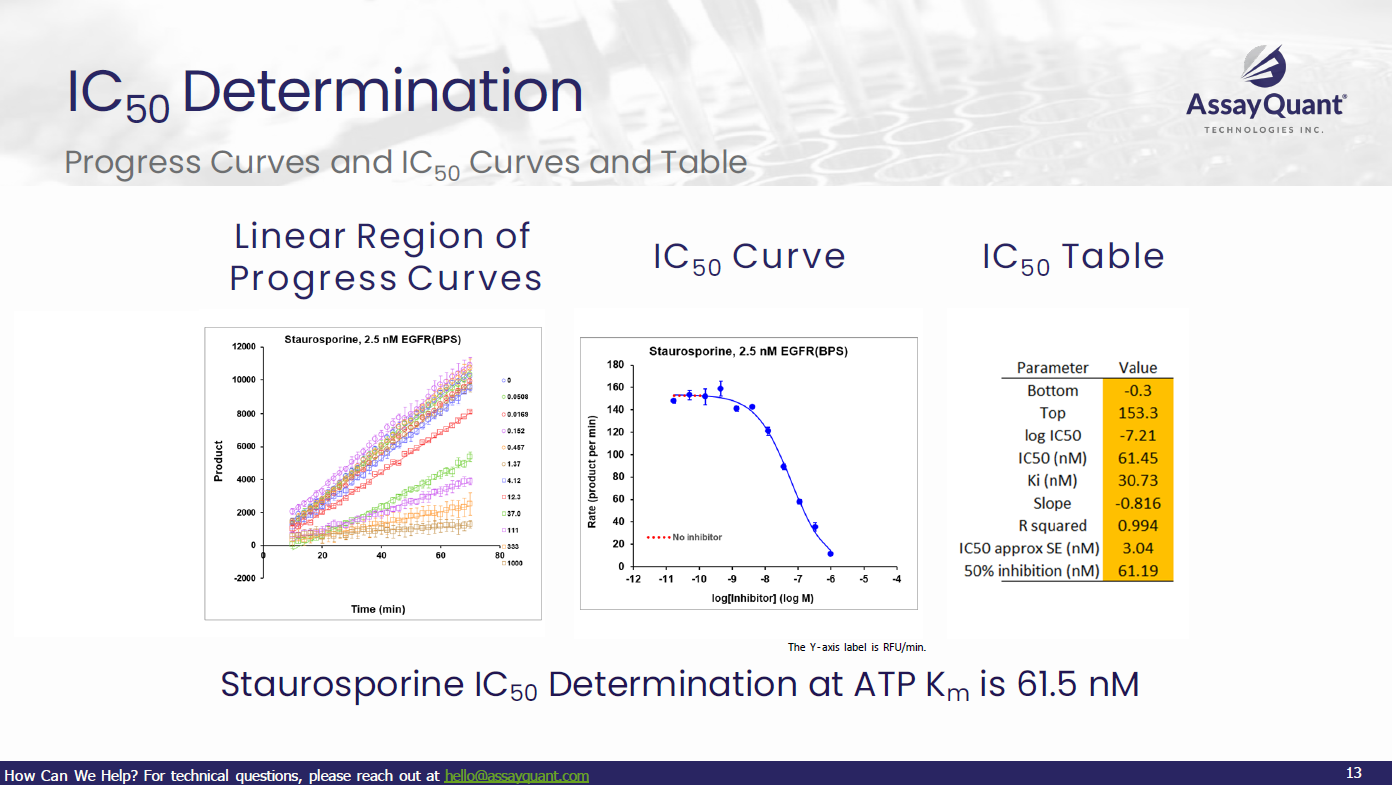
Each validation report provides experimental conditions and data showing:
Protocol
See how the PhosphoSens-Kinetic Assay can be used to find the IC50 of a kinase inhibitor.
Download Protocol →Webinar
Discover how continuous assay formats power deep understanding of kinase function. See how PhosphoSens® assays guide inhibitor profiling, selectivity assessment, and mechanistic characterization.
Watch the Webinar →Service
Need broader selectivity data? KinSight profiling runs your compounds across our full kinase panel under identical PhosphoSens conditions.
Learn about KinSight →Want to hear the latest about our technology? Be among the first to learn about our latest products and services.