Still have questions about our products?
Our scientists can help you choose the right assay format, substrate, and enzyme for your experiment.
Also known as: CDK2 • cyclin dependent kinase 2 • p33(CDK2)
.jpg?width=450&name=PhosphoSens%20Packaging%20C%20(3).jpg)
Cyclin-dependent kinase 2 (CDK2) is a serine/threonine kinase and founding member of the CDK family, which coordinates cell cycle progression, transcription, and DNA damage responses. CDK2 is activated upon binding to its cyclin partners, primarily Cyclin E during G1/S transition and Cyclin A (CycA1 or CycA2) during S phase and G2/M progression. The CDK2/CyclinA complex phosphorylates key substrates including Rb family members, p27Kip1, CDC25A, and components of the pre-replication complex, driving S-phase entry and DNA replication licensing. CDK2 activity is tightly regulated by CDK-activating kinase (CAK)-mediated phosphorylation at Thr160 and by inhibitory phosphorylations at Thr14/Tyr15 removed by CDC25 phosphatases. Dysregulation of CDK2 is implicated in a broad spectrum of cancers, including breast, ovarian, colorectal, and hematologic malignancies, frequently driven by Cyclin E amplification or loss of endogenous inhibitors such as p21 and p27. CDK2 represents a compelling oncology drug target, particularly in tumors with CDK4/6 inhibitor resistance.
CDK2 assay development presents several challenges: the requirement for a stoichiometric cyclin partner (CyclinA1) for full activation, sensitivity to ATP concentration relative to physiological levels, and difficulty capturing covalent or slow-binding inhibitor kinetics with endpoint methods. ADP-Glo and HTRF assays capture only a single time point, missing inhibitor mechanism-of-action nuances and producing artifacts when inhibitor compound interference occurs at the endpoint. Radiometric assays require isotope handling and lack real-time resolution. AssayQuant's PhosphoSens CSox-based continuous fluorescent assay monitors CDK2/CycA1-mediated substrate phosphorylation in real time, enabling full progress curve analysis, accurate kinact/KI determination for covalent inhibitors, physiological ATP conditions, and rapid detection of assay artifacts — delivering richer kinetic data with higher throughput and greater confidence for CDK2 drug discovery programs.
Have questions about CDK2/CycA1 assay design, selectivity panels, or covalent inhibitor characterization?
Ask Our Scientists →Continuous, real-time fluorescent assays optimized for quantitative CDK2/CycA1 activity measurements, IC50 determination, and mechanistic studies.
PhosphoSens-Kinetic assays directly quantify enzyme activity by continuously monitoring substrate phosphorylation or dephosphorylation in real time, generating a full progress curve in every well.
Learn more about PhosphoSens-Kinetic →Need pricing or availability? Select a kit or substrate to request a quote below.
Kits
Ready-to-use assay kits containing substrate and all essential reagents.
Automatically save 10% when bundling 10ug recombinant enzyme with your 1,000 assay kit. View enzymes
Substrate
Bulk PhosphoSens® substrate for assay development and high-throughput workflows.
Automatically save 10% when bundling Reagent Packs with your substrate. View Reagent Packs
Select a kit, substrate, or enzyme above. Our team will confirm pricing, availability, and any applicable bundle discounts.
No PhosphoSens-Red format is currently available for CDK2/CycA1.
Select a kit, substrate, or enzyme above. Our team will confirm pricing, availability, and any applicable bundle discounts.
No recombinant enzymes are currently available for CDK2/CycA1.
CDK2 requires a cyclin partner for catalytic activation; Cyclin A1 binding induces conformational changes in the T-loop that permit substrate access and full kinase activity. AssayQuant supplies pre-activated CDK2/CycA1 complex validated for consistent specific activity, eliminating lot-to-lot variability from separate cyclin reconstitution. This ensures reproducible assay performance across compound screening campaigns.
Yes. Unlike luminescence-based ADP detection assays that lose sensitivity at higher ATP concentrations, PhosphoSens fluorescent peptide substrates report phosphorylation directly and maintain robust signal across a wide ATP range including physiological levels near 1-2 mM. This is critical for accurately determining Ki values and avoiding artifactual potency shifts caused by non-physiological ATP conditions.
Endpoint assays cannot resolve the time-dependent inhibition kinetics essential for characterizing covalent or slow-binding CDK2 inhibitors, leading to underestimation of potency or misclassification of mechanism. PhosphoSens continuous progress curve monitoring captures the full kinetic profile in a single experiment, enabling direct calculation of kinact and KI from real-time fluorescence data without additional reagent additions or wash steps.
Explore data and documents to support your kinase and phosphatase experiments. Download sample data, protocols and other resources to see how our assays perform and to help you get started in your own lab. All validation data generated using PhosphoSens® assays under recommended conditions.
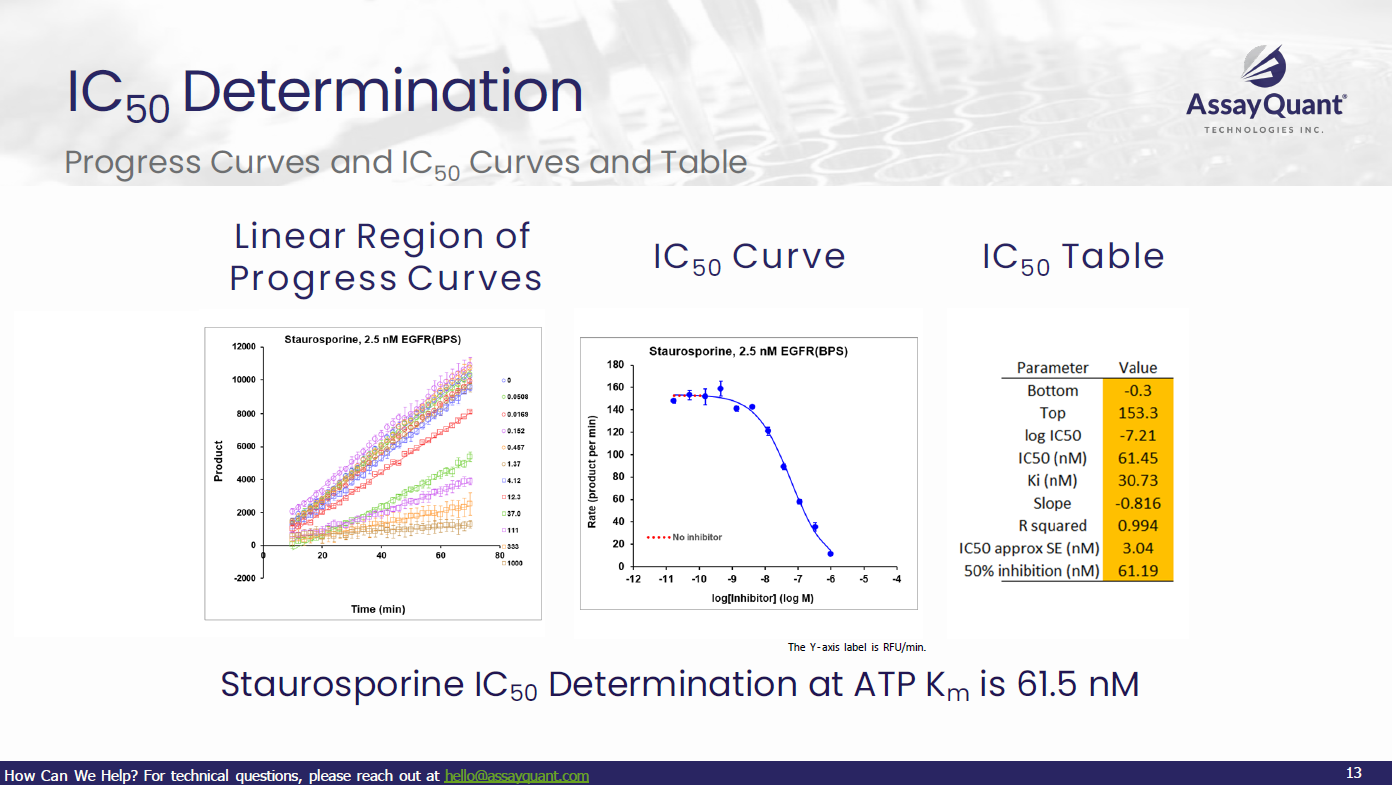
Each validation report provides experimental conditions and data showing:
Protocol
See how the PhosphoSens-Kinetic Assay can be used to find the IC50 of a kinase inhibitor.
Download Protocol →Webinar
Discover how continuous assay formats power deep understanding of kinase function. See how PhosphoSens® assays guide inhibitor profiling, selectivity assessment, and mechanistic characterization.
Watch the Webinar →Service
Need broader selectivity data? KinSight profiling runs your compounds across our full kinase panel under identical PhosphoSens conditions.
Learn about KinSight →Want to hear the latest about our technology? Be among the first to learn about our latest products and services.