Still have questions about our products?
Our scientists can help you choose the right assay format, substrate, and enzyme for your experiment.
Also known as: FRAP • FRAP1 • FRAP2 • RAFT1 • RAPT1 • mechanistic target of rapamycin kinase • FK506 binding protein 12-rapamycin associated protein 1 • dJ576K7.1 • FLJ44809 • FKBP12-rapamycin complex-associated protein 1 • FKBP-rapamycin associated protein
.jpg?width=450&name=PhosphoSens%20Packaging%20C%20(3).jpg)
mTOR (mechanistic target of rapamycin) is a serine/threonine kinase and founding member of the phosphatidylinositol 3-kinase-related kinase (PIKK) family. It assembles into two structurally and functionally distinct complexes: mTORC1, which is rapamycin-sensitive and regulated by nutrients, growth factors, and energy status via the PI3K/AKT and RAS/MAPK axes; and mTORC2, which phosphorylates AKT at Ser473 and regulates cytoskeletal organization. Key mTORC1 substrates include S6K1 (Thr389) and 4E-BP1 (Thr37/46), driving ribosome biogenesis and cap-dependent translation. mTOR integrates upstream signals from AMPK, TSC1/2, and Rheb GTPase to coordinate anabolic metabolism, autophagy, and cell growth. Hyperactivation of mTOR is documented in renal cell carcinoma, breast cancer, PTEN-null tumors, TSC1/TSC2 mutations, and metabolic disorders including type 2 diabetes. Its central role in oncogenesis and metabolic dysregulation makes mTOR a validated, high-priority drug target across multiple therapeutic areas.
mTOR presents significant assay challenges: its large molecular weight (~289 kDa), multi-subunit complex architecture, and low intrinsic catalytic rate make robust biochemical assay development difficult. Endpoint methods such as ADP-Glo and HTRF require fixed ATP concentrations that rarely reflect physiological levels (~1-5 mM), distorting Ki measurements and missing time-dependent inhibition kinetics critical for allosteric and covalent inhibitors. Radiometric assays offer sensitivity but lack real-time resolution and pose handling constraints. AssayQuant's PhosphoSens technology continuously monitors phosphorylation of validated mTOR peptide substrates (e.g., derived from S6K1 or 4E-BP1) via fluorescent chelation-enhanced sensors, generating full progress curves at physiological ATP. This enables accurate KM(ATP) determination, kinact/KI measurement for covalent probes, mechanistic mode-of-inhibition profiling, and early detection of compound interference — all in a homogeneous, no-wash, real-time format compatible with HTS workflows.
Have questions about MTOR assay design, selectivity panels, or covalent inhibitor characterization?
Ask Our Scientists →Continuous, real-time fluorescent assays optimized for quantitative MTOR activity measurements, IC50 determination, and mechanistic studies.
PhosphoSens-Kinetic assays directly quantify enzyme activity by continuously monitoring substrate phosphorylation or dephosphorylation in real time, generating a full progress curve in every well.
Learn more about PhosphoSens-Kinetic →Need pricing or availability? Select a kit or substrate to request a quote below.
Kits
Ready-to-use assay kits containing substrate and all essential reagents.
Automatically save 10% when bundling 10ug recombinant enzyme with your 1,000 assay kit. View enzymes
Substrate
Bulk PhosphoSens® substrate for assay development and high-throughput workflows.
Automatically save 10% when bundling Reagent Packs with your substrate. View Reagent Packs
Select a kit, substrate, or enzyme above. Our team will confirm pricing, availability, and any applicable bundle discounts.
No PhosphoSens-Red format is currently available for MTOR.
Select a kit, substrate, or enzyme above. Our team will confirm pricing, availability, and any applicable bundle discounts.
No recombinant enzymes are currently available for MTOR.
AssayQuant employs PhosphoSens peptide substrates derived from validated physiological mTOR substrates such as S6K1 (Thr389 site) and 4E-BP1, engineered to incorporate the Sox-based fluorescent chelation sensor. These substrates enable continuous, real-time detection of phosphorylation without antibodies or secondary reagents, ensuring signal specificity and compatibility with complex compound libraries.
Yes. Because PhosphoSens generates full kinetic progress curves at variable ATP and substrate concentrations, researchers can determine mode of inhibition (competitive, non-competitive, mixed) directly from a single experiment. This is particularly valuable for mTOR, where rapalogs act allosterically at FRB/FKBP12 while ATP-competitive inhibitors (e.g., Torin1, INK128) show distinct kinetic signatures that endpoint assays cannot resolve.
Most endpoint assays use low ATP concentrations (10-100 uM) to maximize signal window, which artificially inflates potency for ATP-competitive inhibitors relative to their cellular activity. PhosphoSens assays can be run at near-physiological ATP (1-5 mM), yielding Ki values that better predict cellular and in vivo potency, reducing late-stage attrition caused by misleading biochemical IC50 data.
Explore data and documents to support your kinase and phosphatase experiments. Download sample data, protocols and other resources to see how our assays perform and to help you get started in your own lab. All validation data generated using PhosphoSens® assays under recommended conditions.
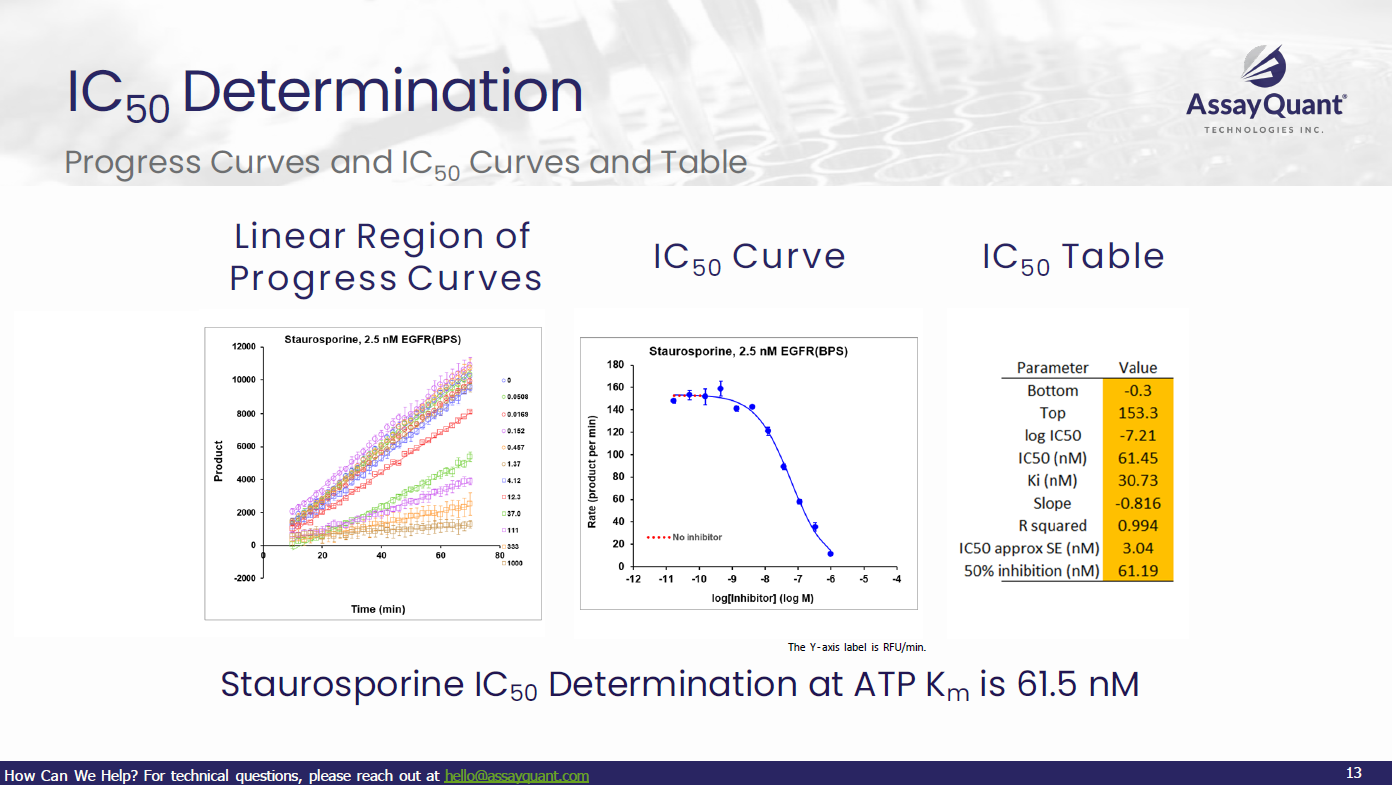
Each validation report provides experimental conditions and data showing:
Protocol
See how the PhosphoSens-Kinetic Assay can be used to find the IC50 of a kinase inhibitor.
Download Protocol →Webinar
Discover how continuous assay formats power deep understanding of kinase function. See how PhosphoSens® assays guide inhibitor profiling, selectivity assessment, and mechanistic characterization.
Watch the Webinar →Service
Need broader selectivity data? KinSight profiling runs your compounds across our full kinase panel under identical PhosphoSens conditions.
Learn about KinSight →Want to hear the latest about our technology? Be among the first to learn about our latest products and services.