Still have questions about our products?
Our scientists can help you choose the right assay format, substrate, and enzyme for your experiment.
Also known as: glycogen synthase kinase 3 beta
.jpg?width=450&name=PhosphoSens%20Packaging%20C%20(3).jpg)
Glycogen synthase kinase 3 beta (GSK3B) is a serine/threonine kinase belonging to the CMGC superfamily and the GSK family, closely related to GSK3A. Unlike most kinases, GSK3B is constitutively active in resting cells and is inactivated upon stimulation. Activation is regulated through inhibitory phosphorylation at Ser9 by upstream kinases including AKT, PKA, and p90RSK, or through activating phosphorylation at Tyr216. GSK3B phosphorylates a remarkably broad substrate repertoire — including glycogen synthase, beta-catenin, tau, c-Myc, and CRMP2 — making it a central node in PI3K/AKT, Wnt/beta-catenin, Hedgehog, and insulin signaling pathways. Dysregulation of GSK3B is implicated in Alzheimer's disease (tau hyperphosphorylation), type 2 diabetes, bipolar disorder, cancer, and neurodegeneration. Its role in multiple oncogenic and neuropathological cascades, combined with its druggability, makes GSK3B one of the most intensively pursued therapeutic targets in kinase drug discovery.
GSK3B presents several assay challenges: its constitutive activity requires precise control of inhibitory pre-phosphorylation states, and many GSK3B substrates require prior priming phosphorylation, complicating endpoint-based formats. ADP-Glo and HTRF assays capture only a single time point, missing kinetic nuances of slow-binding or covalent inhibitors and introducing artifacts from substrate depletion or inner-filter effects. Radiometric assays add radioactive waste concerns and poor throughput. PhosphoSens continuous kinase assays overcome these limitations by providing real-time fluorescent progress curves at physiological ATP concentrations, enabling accurate Km(ATP) determination critical for selectivity profiling. Full kinetic curves allow confident measurement of kinact/KI for covalent inhibitors and early detection of non-linear kinetics indicative of tight-binding or allosteric inhibition — delivering richer SAR data per experiment with significantly reduced compound consumption.
Have questions about GSK3B assay design, selectivity panels, or covalent inhibitor characterization?
Ask Our Scientists →Continuous, real-time fluorescent assays optimized for quantitative GSK3B activity measurements, IC50 determination, and mechanistic studies.
PhosphoSens-Kinetic assays directly quantify enzyme activity by continuously monitoring substrate phosphorylation or dephosphorylation in real time, generating a full progress curve in every well.
Learn more about PhosphoSens-Kinetic →Need pricing or availability? Select a kit or substrate to request a quote below.
Kits
Ready-to-use assay kits containing substrate and all essential reagents.
Automatically save 10% when bundling 10ug recombinant enzyme with your 1,000 assay kit. View enzymes
Substrate
Bulk PhosphoSens® substrate for assay development and high-throughput workflows.
Automatically save 10% when bundling Reagent Packs with your substrate. View Reagent Packs
Select a kit, substrate, or enzyme above. Our team will confirm pricing, availability, and any applicable bundle discounts.
No PhosphoSens-Red format is currently available for GSK3B.
Select a kit, substrate, or enzyme above. Our team will confirm pricing, availability, and any applicable bundle discounts.
No recombinant enzymes are currently available for GSK3B.
Many GSK3B inhibitors are ATP-competitive, meaning their apparent potency is highly sensitive to ATP concentration. Running assays at physiological ATP levels (1-5 mM) with PhosphoSens provides IC50 and Ki values that better predict cellular and in vivo activity compared to artificially low ATP concentrations used in conventional endpoint assays. This avoids systematic overestimation of inhibitor potency during lead optimization.
Yes. PhosphoSens peptide substrates for GSK3B are designed to incorporate the consensus phosphopriming motif, ensuring the kinase recognizes and phosphorylates the substrate efficiently without requiring a separate priming kinase in the reaction. This simplifies assay setup and reduces variability introduced by multi-enzyme cascade formats used in some endpoint assay systems.
Allosteric inhibitors often display slow on-rates, biphasic kinetics, or time-dependent inhibition that are invisible to single-timepoint endpoint assays. PhosphoSens real-time progress curves reveal these kinetic signatures immediately, allowing researchers to distinguish competitive from allosteric or slow-binding mechanisms early in the discovery process. This kinetic resolution supports more informed decisions during lead selection and candidate advancement.
Explore data and documents to support your kinase and phosphatase experiments. Download sample data, protocols and other resources to see how our assays perform and to help you get started in your own lab. All validation data generated using PhosphoSens® assays under recommended conditions.
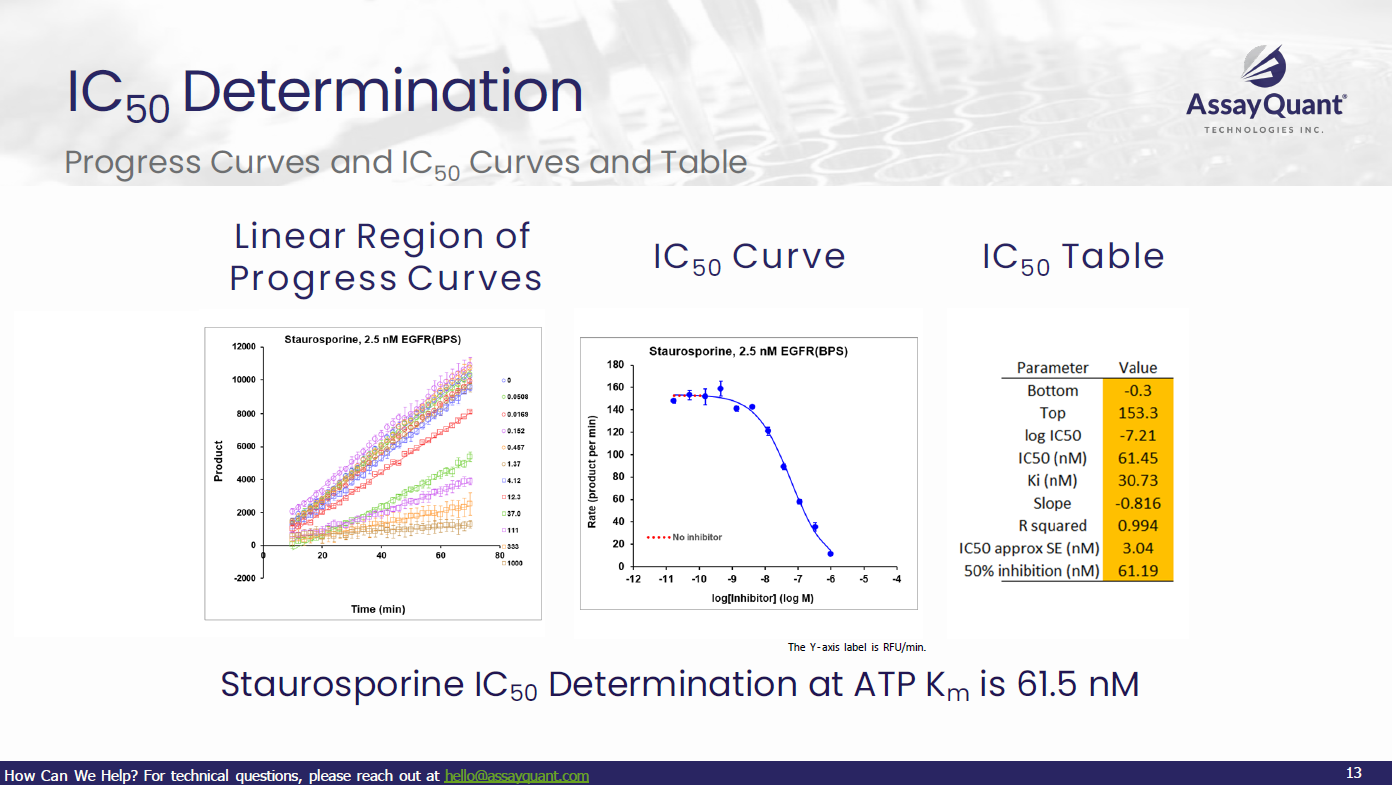
Each validation report provides experimental conditions and data showing:
Protocol
See how the PhosphoSens-Kinetic Assay can be used to find the IC50 of a kinase inhibitor.
Download Protocol →Webinar
Discover how continuous assay formats power deep understanding of kinase function. See how PhosphoSens® assays guide inhibitor profiling, selectivity assessment, and mechanistic characterization.
Watch the Webinar →Service
Need broader selectivity data? KinSight profiling runs your compounds across our full kinase panel under identical PhosphoSens conditions.
Learn about KinSight →Want to hear the latest about our technology? Be among the first to learn about our latest products and services.