Still have questions about our products?
Our scientists can help you choose the right assay format, substrate, and enzyme for your experiment.
Also known as: dual specificity tyrosine phosphorylation regulated kinase 1A • DYRK • DYRK1 • HP86 • MNB • MNBH • DYR1A
.jpg?width=450&name=PhosphoSens%20Packaging%20C%20(3).jpg)
DYRK1A (Dual Specificity Tyrosine Phosphorylation-Regulated Kinase 1A) belongs to the DYRK subfamily of the CMGC kinase group, characterized by their ability to phosphorylate both tyrosine and serine/threonine residues. DYRK1A undergoes autophosphorylation on a conserved tyrosine residue (Tyr321) within its activation loop during translation, a unique cis-autophosphorylation mechanism that locks the kinase in a constitutively active conformation. Key substrates include tau (phosphorylation at Thr212), NFAT transcription factors, cyclin D1, and the splicing factor SRSF6, placing DYRK1A at the crossroads of neuronal development, cell cycle regulation, and alternative splicing. The kinase is encoded on chromosome 21 and is overexpressed in Down syndrome (trisomy 21), contributing to intellectual disability and early-onset Alzheimer's disease pathology. DYRK1A haploinsufficiency causes a distinct intellectual disability syndrome, underscoring its dosage sensitivity. These roles make DYRK1A a compelling therapeutic target in neurodegenerative disease, Down syndrome cognitive deficits, and certain cancers including glioblastoma and leukemia.
DYRK1A drug discovery faces several assay challenges: the kinase phosphorylates both Tyr and Ser/Thr residues, complicating antibody-based detection; its constitutive activity requires careful enzyme titration to avoid substrate depletion artifacts in endpoint formats. ADP-Glo and HTRF measure single time-point endpoints, masking nonlinear kinetics caused by substrate inhibition or slow-binding inhibitors common among DYRK1A chemotypes such as harmine-class alkaloids. Radiometric assays require hazardous isotopes and lack temporal resolution. PhosphoSens continuous fluorescent assays monitor phosphorylation in real time using CSox-based peptide substrates, generating complete progress curves at physiological ATP concentrations. This enables accurate Km(ATP) determination critical for selectivity profiling, captures covalent inhibitor kinact/KI parameters without specialized secondary assays, and eliminates inner-filter artifacts. Real-time kinetics also reveal mechanistic nuances of DYRK1A inhibition mode, accelerating structure-activity relationship campaigns.
Have questions about DYRK1A assay design, selectivity panels, or covalent inhibitor characterization?
Ask Our Scientists →Continuous, real-time fluorescent assays optimized for quantitative DYRK1A activity measurements, IC50 determination, and mechanistic studies.
PhosphoSens-Kinetic assays directly quantify enzyme activity by continuously monitoring substrate phosphorylation or dephosphorylation in real time, generating a full progress curve in every well.
Learn more about PhosphoSens-Kinetic →Need pricing or availability? Select a kit or substrate to request a quote below.
Kits
Ready-to-use assay kits containing substrate and all essential reagents.
Automatically save 10% when bundling 10ug recombinant enzyme with your 1,000 assay kit. View enzymes
Substrate
Bulk PhosphoSens® substrate for assay development and high-throughput workflows.
Automatically save 10% when bundling Reagent Packs with your substrate. View Reagent Packs
Select a kit, substrate, or enzyme above. Our team will confirm pricing, availability, and any applicable bundle discounts.
No PhosphoSens-Red format is currently available for DYRK1A.
Select a kit, substrate, or enzyme above. Our team will confirm pricing, availability, and any applicable bundle discounts.
Wild-type and mutant forms of DYRK1A for assay development, kinase profiling, and mechanistic studies. Enzymes are supplied active and optimized for PhosphoSens® substrates.
Rat • E. coli
Price: $$378.00
AssayQuant offers optimized CSox-based peptide substrates derived from validated DYRK1A phosphorylation consensus sequences, designed to report phosphorylation via real-time fluorescence. The substrates are validated for linearity, Km determination, and compatibility with compound libraries, ensuring robust signal windows across a range of enzyme concentrations.
Yes. Because PhosphoSens generates continuous progress curves at variable ATP and substrate concentrations, full Michaelis-Menten analysis can be performed to resolve competitive, uncompetitive, and mixed inhibition modes. This mechanistic detail is unavailable from single-timepoint ADP-Glo or HTRF readouts and is critical for understanding selectivity among DYRK family members.
PhosphoSens assays are routinely run at or near physiological ATP concentrations (1 mM), unlike radiometric or luminescence assays that artificially lower ATP to maximize signal. Running at physiological ATP provides IC50 values that better reflect cellular potency and enables accurate selectivity comparisons across DYRK1A, DYRK1B, CLK1, and related kinases.
Explore data and documents to support your kinase and phosphatase experiments. Download sample data, protocols and other resources to see how our assays perform and to help you get started in your own lab. All validation data generated using PhosphoSens® assays under recommended conditions.
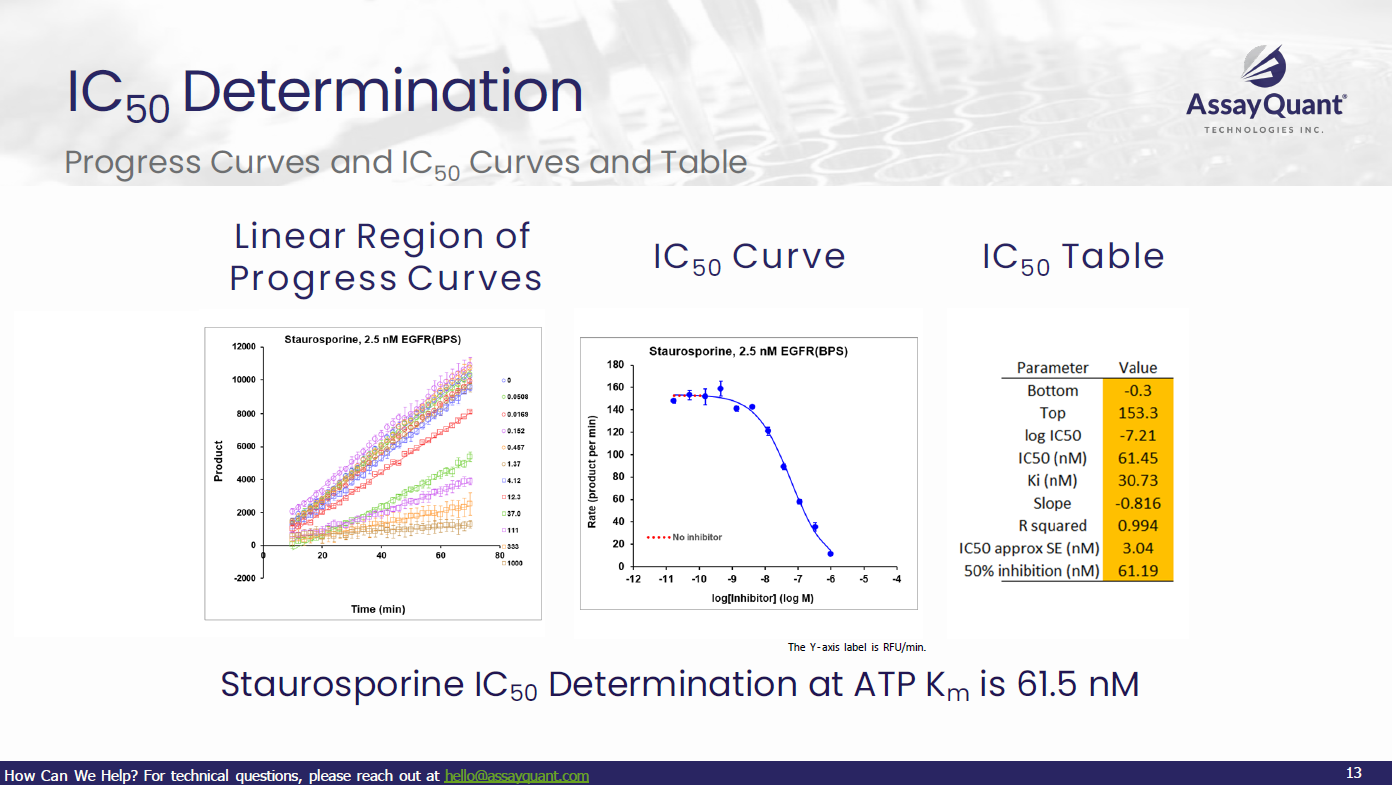
Each validation report provides experimental conditions and data showing:
Protocol
See how the PhosphoSens-Kinetic Assay can be used to find the IC50 of a kinase inhibitor.
Download Protocol →Webinar
Discover how continuous assay formats power deep understanding of kinase function. See how PhosphoSens® assays guide inhibitor profiling, selectivity assessment, and mechanistic characterization.
Watch the Webinar →Service
Need broader selectivity data? KinSight profiling runs your compounds across our full kinase panel under identical PhosphoSens conditions.
Learn about KinSight →Want to hear the latest about our technology? Be among the first to learn about our latest products and services.