Still have questions about our products?
Our scientists can help you choose the right assay format, substrate, and enzyme for your experiment.
Also known as: CDK1 • CDC2 • cyclin dependent kinase 1 • CDC28 • CDC28A • MPF • CDC2A • Cell division control protein 2
.jpg?width=450&name=PhosphoSens%20Packaging%20C%20(3).jpg)
Cyclin-dependent kinase 1 (CDK1) is the founding and most conserved member of the CDK family, functioning as the master regulator of mitotic entry and progression in all eukaryotes. CDK1 requires association with its regulatory partner Cyclin A2 (CCNA2) or Cyclin B1 to achieve catalytic competence; Cyclin A2 drives S-phase and early mitotic functions, while Cyclin B1 governs late mitosis. Activation requires phosphorylation at Thr161 by CDK-activating kinase (CAK) and removal of inhibitory phosphorylations at Thr14 and Tyr15 by the CDC25 phosphatase family. Key substrates include Lamin A/C, nuclear pore complexes, condensins, and the APC/C activator CDC20, coordinating nuclear envelope breakdown, chromosome condensation, and spindle assembly checkpoint satisfaction. CDK1 sits at the convergence of the RB/E2F, DNA-damage checkpoint (ATM/ATR-CHK1/CHK2), and WEE1/MYT1 signaling axes. Dysregulation through Cyclin A2 overexpression, CDK1 amplification, or checkpoint pathway loss is observed across breast, colorectal, hepatocellular, and hematological cancers, making CDK1/CycA2 a compelling oncology drug target.
CDK1/CycA2 presents several assay challenges: the complex is highly active and consumes ATP rapidly, causing endpoint assays such as ADP-Glo and HTRF to underestimate activity or misreport IC50 values when measured at substrate-depletion plateaus. Radiometric filter-binding assays are sensitive but discontinuous, hazardous, and labor-intensive, providing only single time-point snapshots that miss biphasic kinetics. CDK1 is also a frequent off-target for pan-CDK inhibitors, demanding precise selectivity profiling at physiological ATP concentrations. AssayQuant's PhosphoSens CSox-based peptide substrates enable continuous, real-time fluorescence monitoring of CDK1/CycA2 activity, generating full progress curves that faithfully capture initial velocities, covalent inhibitor kinact/KI parameters, and tight-binding compound behavior — all without antibodies or coupled enzymes. Assays run at physiological ATP (1 mM), eliminating Km-ATP bias and enabling direct translation of IC50 to cellular context.
Have questions about CDK1/CycA2 assay design, selectivity panels, or covalent inhibitor characterization?
Ask Our Scientists →Continuous, real-time fluorescent assays optimized for quantitative CDK1/CycA2 activity measurements, IC50 determination, and mechanistic studies.
PhosphoSens-Kinetic assays directly quantify enzyme activity by continuously monitoring substrate phosphorylation or dephosphorylation in real time, generating a full progress curve in every well.
Learn more about PhosphoSens-Kinetic →Need pricing or availability? Select a kit or substrate to request a quote below.
Kits
Ready-to-use assay kits containing substrate and all essential reagents.
Automatically save 10% when bundling 10ug recombinant enzyme with your 1,000 assay kit. View enzymes
Substrate
Bulk PhosphoSens® substrate for assay development and high-throughput workflows.
Automatically save 10% when bundling Reagent Packs with your substrate. View Reagent Packs
Select a kit, substrate, or enzyme above. Our team will confirm pricing, availability, and any applicable bundle discounts.
Robust endpoint TRF assays optimized for high-throughput screening and quantitative CDK1/CycA2 activity measurement in plate-based workflows.
PhosphoSens-Red assays use europium-based time-resolved fluorescence detection to enable robust, plate-based quantification of enzyme activity, making them well suited for high-throughput screening workflows.
Learn more about PhosphoSens-Red →Need pricing or availability? Select a kit or substrate to request a quote below.
Kits
Ready-to-use TRF assay kits containing substrate and essential reagents.
Automatically save 10% when bundling 10ug recombinant enzyme with your 1,000 assay kit. View enzymes
Substrate
Bulk substrate for PhosphoSens-Red TRF assays and high-throughput workflows.
Automatically save 10% when bundling Reagent Packs with your substrate. View Reagent Packs
Select a kit, substrate, or enzyme above. Our team will confirm pricing, availability, and any applicable bundle discounts.
No recombinant enzymes are currently available for CDK1/CycA2.
AssayQuant offers PhosphoSens CSox-labeled peptide substrates derived from validated CDK1 consensus sequences, optimized for CDK1/CycA2 to provide high signal-to-background and linear initial velocity windows. These substrates are provided ready-to-use and have been kinetically characterized for Km and Vmax with the CDK1/CycA2 holoenzyme. Contact our technical team for current catalog substrate recommendations specific to your screening format.
Yes. Because PhosphoSens assays run continuously under identical physiological ATP conditions for both CDK1/CycA2 and CDK2/CycA2, direct side-by-side IC50 comparisons are fully quantitative without ATP-concentration bias that confounds endpoint methods. This enables precise selectivity ratios essential for advancing selective CDK1 chemical probes and avoiding off-target CDK2 liabilities in drug discovery campaigns.
PhosphoSens continuous progress curves capture the full time-dependent inhibition profile required to calculate covalent kinact and KI parameters in a single well without the labor of time-point dilution assays. The real-time fluorescence readout resolves the biphasic kinetics of initial noncovalent binding followed by irreversible inactivation, providing mechanistic insight that endpoint assays such as ADP-Glo or HTRF cannot resolve.
Explore data and documents to support your kinase and phosphatase experiments. Download sample data, protocols and other resources to see how our assays perform and to help you get started in your own lab. All validation data generated using PhosphoSens® assays under recommended conditions.
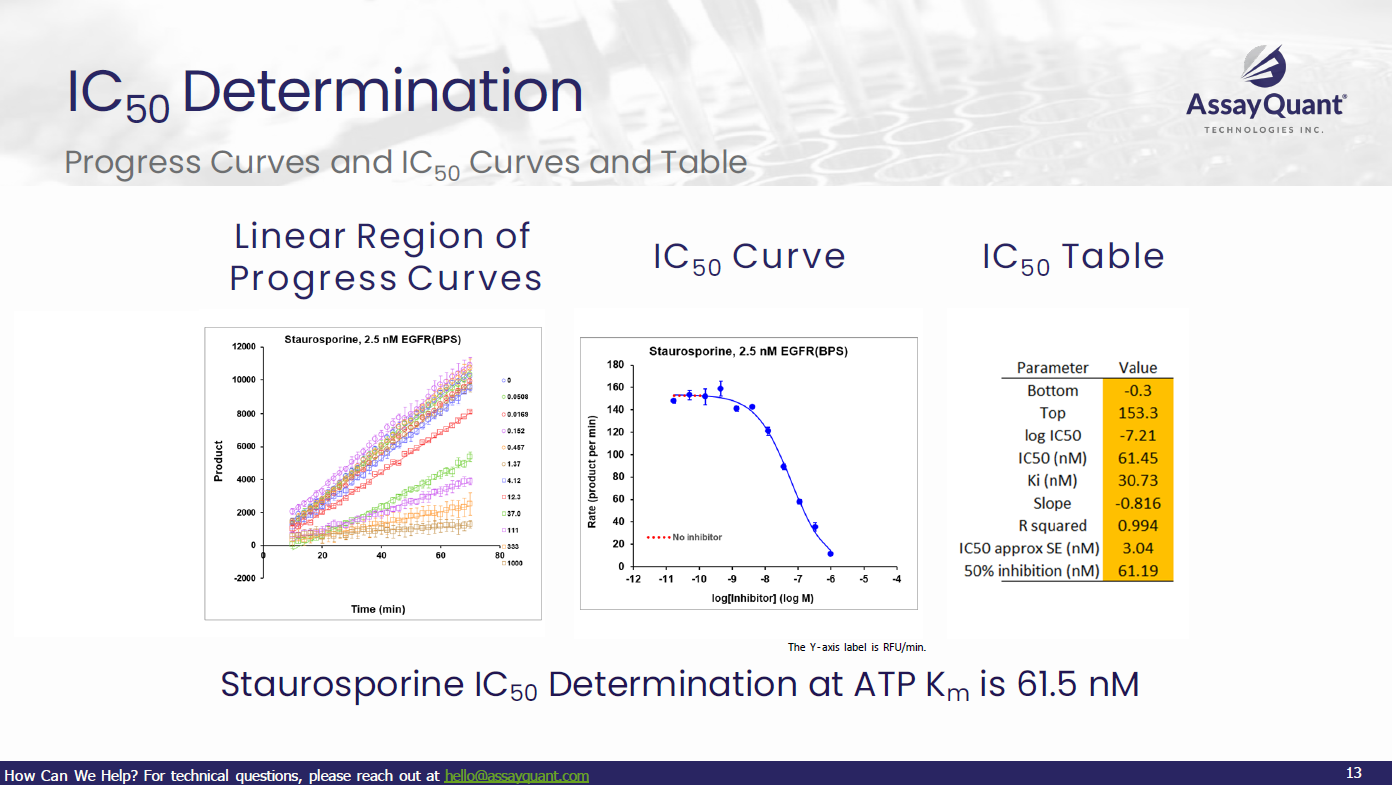
Each validation report provides experimental conditions and data showing:
Protocol
See how the PhosphoSens-Kinetic Assay can be used to find the IC50 of a kinase inhibitor.
Download Protocol →Webinar
Discover how continuous assay formats power deep understanding of kinase function. See how PhosphoSens® assays guide inhibitor profiling, selectivity assessment, and mechanistic characterization.
Watch the Webinar →Service
Need broader selectivity data? KinSight profiling runs your compounds across our full kinase panel under identical PhosphoSens conditions.
Learn about KinSight →Want to hear the latest about our technology? Be among the first to learn about our latest products and services.