Still have questions about our products?
Our scientists can help you choose the right assay format, substrate, and enzyme for your experiment.
Also known as: CDK12 • CRK7 • cyclin dependent kinase 12 • CDC2 related protein kinase 7 • CRKR • KIAA0904 • CRKRS • CD2L7
.jpg?width=450&name=PhosphoSens%20Packaging%20C%20(3).jpg)
CDK12 is a transcriptional cyclin-dependent kinase that pairs obligatorily with its regulatory partner Cyclin K (CycK) to form an active heterodimeric complex. Unlike cell-cycle CDKs, CDK12/CycK primarily phosphorylates the C-terminal domain (CTD) of RNA Polymerase II at Ser2, coupling transcription elongation with co-transcriptional RNA processing, splicing, and 3'-end cleavage. CDK12 also plays a critical role in maintaining genomic stability by sustaining expression of homologous recombination (HR) repair genes including BRCA1, BRCA2, and FANCD2. Loss-of-function mutations in CDK12 are recurrent in high-grade serous ovarian cancer, metastatic castration-resistant prostate cancer (mCRPC), and breast cancer, producing a distinctive tandem duplication genomic scar and HR deficiency. CDK12-mutant tumors exhibit sensitivity to PARP inhibitors and immunotherapy due to elevated neoantigen burden, making CDK12 both a biomarker and a direct drug target. Selective CDK12 inhibition is being explored as a strategy to collapse HR capacity in HR-proficient cancers and to sensitize tumors to DNA-damaging agents.
CDK12/CycK presents significant assay challenges: it requires co-expression with Cyclin K for catalytic activity, is sensitive to ATP concentration artifacts that distort IC50 values at non-physiological ATP, and many inhibitors are time-dependent covalent binders where standard endpoint assays miss kinact/KI kinetics. ADP-Glo and HTRF capture only single time points, masking inhibitor mechanism and failing to distinguish competitive from covalent irreversible engagement. Radiometric assays offer sensitivity but are discontinuous and hazardous. PhosphoSens continuous fluorescent peptide substrates enable real-time progress curve acquisition at physiological ATP (1 mM), directly resolving time-dependent inhibition, covalent inactivation constants, and true kinetic parameters in a single experiment. This eliminates endpoint artifacts, accelerates SAR campaigns, and supports mechanistic characterization of CDK12-targeted covalent probes such as THZ531 and SR-4835 without reformatting or secondary assays.
Have questions about CDK12/CycK assay design, selectivity panels, or covalent inhibitor characterization?
Ask Our Scientists →Continuous, real-time fluorescent assays optimized for quantitative CDK12/CycK activity measurements, IC50 determination, and mechanistic studies.
PhosphoSens-Kinetic assays directly quantify enzyme activity by continuously monitoring substrate phosphorylation or dephosphorylation in real time, generating a full progress curve in every well.
Learn more about PhosphoSens-Kinetic →Need pricing or availability? Select a kit or substrate to request a quote below.
Kits
Ready-to-use assay kits containing substrate and all essential reagents.
Automatically save 10% when bundling 10ug recombinant enzyme with your 1,000 assay kit. View enzymes
Substrate
Bulk PhosphoSens® substrate for assay development and high-throughput workflows.
Automatically save 10% when bundling Reagent Packs with your substrate. View Reagent Packs
Select a kit, substrate, or enzyme above. Our team will confirm pricing, availability, and any applicable bundle discounts.
No PhosphoSens-Red format is currently available for CDK12/CycK.
Select a kit, substrate, or enzyme above. Our team will confirm pricing, availability, and any applicable bundle discounts.
No recombinant enzymes are currently available for CDK12/CycK.
Most CDK12 inhibitors compete with ATP, so IC50 values shift dramatically with ATP concentration. Running assays at or near physiological ATP (1 mM) with PhosphoSens substrates yields IC50 values that better predict cellular potency and reduce late-stage attrition. Endpoint assay platforms typically require low ATP to maximize signal, introducing a systematic bias that inflates apparent potency.
PhosphoSens generates continuous fluorescence progress curves, so time-dependent loss of enzyme velocity is immediately visible as a characteristic curve-flattening pattern. From these real-time data, kinact and KI can be extracted in a single experiment without secondary gel or mass spectrometry confirmation. This is impossible with ADP-Glo or HTRF, which capture only the endpoint activity remaining after a fixed incubation.
Yes, CDK12 is catalytically dependent on Cyclin K and should be used as the CDK12/CycK heterodimer for meaningful biochemical assays. AssayQuant's optimized assay conditions are developed with the fully activated complex, ensuring that inhibitor potency data reflects the physiologically relevant conformation. Using CDK12 without Cyclin K can produce artifactually low activity and misleading SAR data.
Explore data and documents to support your kinase and phosphatase experiments. Download sample data, protocols and other resources to see how our assays perform and to help you get started in your own lab. All validation data generated using PhosphoSens® assays under recommended conditions.
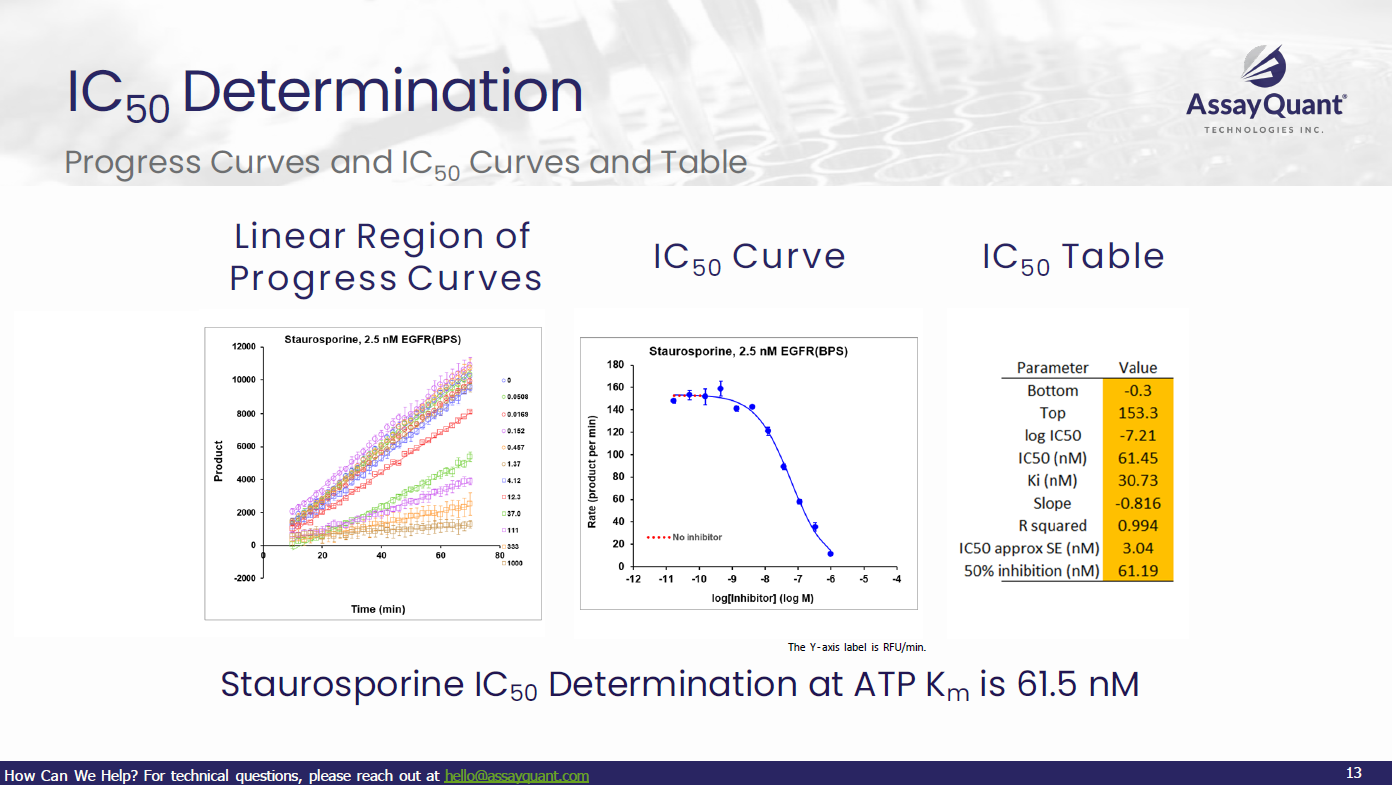
Each validation report provides experimental conditions and data showing:
Protocol
See how the PhosphoSens-Kinetic Assay can be used to find the IC50 of a kinase inhibitor.
Download Protocol →Webinar
Discover how continuous assay formats power deep understanding of kinase function. See how PhosphoSens® assays guide inhibitor profiling, selectivity assessment, and mechanistic characterization.
Watch the Webinar →Service
Need broader selectivity data? KinSight profiling runs your compounds across our full kinase panel under identical PhosphoSens conditions.
Learn about KinSight →Want to hear the latest about our technology? Be among the first to learn about our latest products and services.