Still have questions about our products?
Our scientists can help you choose the right assay format, substrate, and enzyme for your experiment.
Also known as: BR serine/threonine kinase 1 • KIAA1811 • SAD1 • SAD1A
.jpg?width=450&name=PhosphoSens%20Packaging%20C%20(3).jpg)
BRSK1 (Brain-Specific Serine/Threonine Kinase 1), also known as SAD-B, belongs to the CAMK-like (CAMKL) superfamily and is a close relative of AMPK and MARK kinases. BRSK1 is activated by LKB1-mediated phosphorylation at Thr189 within its activation loop, placing it downstream of the master energy-sensing LKB1-AMPK axis. Key substrates include tau protein, CDC25 phosphatases, and components of the cell polarity machinery. BRSK1 plays a central role in neuronal polarity establishment, axon differentiation, and synaptic vesicle trafficking. Beyond the central nervous system, BRSK1 participates in cell cycle checkpoint regulation and DNA damage responses. Dysregulation of BRSK1 has been implicated in Alzheimer's disease through aberrant tau hyperphosphorylation, as well as in various cancers where LKB1 pathway mutations are prevalent. Its selective expression pattern and participation in LKB1-driven tumor suppressor networks make BRSK1 an emerging drug target for neurodegenerative disease and oncology.
BRSK1 presents several assay challenges in drug discovery: it requires physiological ATP concentrations to accurately model inhibitor potency, its low intrinsic activity demands sensitive detection, and covalent or allosteric inhibitor characterization is obscured by endpoint-only formats such as ADP-Glo or HTRF. Radiometric assays offer sensitivity but generate radioactive waste and lack temporal resolution. PhosphoSens continuous kinetic technology addresses these issues by generating real-time fluorescent progress curves at physiological ATP, enabling direct measurement of kinact/KI for covalent inhibitors, accurate Km-ATP determination, and detection of slow-binding kinetics. The no-antibody format eliminates cross-reactivity artifacts common in HTRF, while the continuous readout reveals inhibitor mechanism of action and compound-induced enzyme activation or cooperativity that endpoint assays fundamentally miss.
Have questions about BRSK1 assay design, selectivity panels, or covalent inhibitor characterization?
Ask Our Scientists →Continuous, real-time fluorescent assays optimized for quantitative BRSK1 activity measurements, IC50 determination, and mechanistic studies.
PhosphoSens-Kinetic assays directly quantify enzyme activity by continuously monitoring substrate phosphorylation or dephosphorylation in real time, generating a full progress curve in every well.
Learn more about PhosphoSens-Kinetic →Need pricing or availability? Select a kit or substrate to request a quote below.
Kits
Ready-to-use assay kits containing substrate and all essential reagents.
Automatically save 10% when bundling 10ug recombinant enzyme with your 1,000 assay kit. View enzymes
Substrate
Bulk PhosphoSens® substrate for assay development and high-throughput workflows.
Automatically save 10% when bundling Reagent Packs with your substrate. View Reagent Packs
Select a kit, substrate, or enzyme above. Our team will confirm pricing, availability, and any applicable bundle discounts.
Robust endpoint TRF assays optimized for high-throughput screening and quantitative BRSK1 activity measurement in plate-based workflows.
PhosphoSens-Red assays use europium-based time-resolved fluorescence detection to enable robust, plate-based quantification of enzyme activity, making them well suited for high-throughput screening workflows.
Learn more about PhosphoSens-Red →Need pricing or availability? Select a kit or substrate to request a quote below.
Kits
Ready-to-use TRF assay kits containing substrate and essential reagents.
Automatically save 10% when bundling 10ug recombinant enzyme with your 1,000 assay kit. View enzymes
Substrate
Bulk substrate for PhosphoSens-Red TRF assays and high-throughput workflows.
Automatically save 10% when bundling Reagent Packs with your substrate. View Reagent Packs
Select a kit, substrate, or enzyme above. Our team will confirm pricing, availability, and any applicable bundle discounts.
Wild-type and mutant forms of BRSK1 for assay development, kinase profiling, and mechanistic studies. Enzymes are supplied active and optimized for PhosphoSens® substrates.
Mouse • Baculovirus-Insect Cells
Price: $$348.00
AssayQuant offers optimized CSox-based peptide substrates derived from validated BRSK1 phosphorylation sequences, including tau-derived motifs. These substrates incorporate a chelation-enhanced fluorophore that produces a real-time fluorescent signal upon phosphorylation, enabling continuous monitoring without secondary reagents or antibodies.
Yes. Because PhosphoSens generates full progress curves in real time, it directly captures the kinetics of covalent inactivation, allowing determination of kinact and KI from a single experiment. This capability is not accessible with endpoint methods such as ADP-Glo or HTRF, which only report activity at a fixed time point and can produce misleading IC50 values for covalent or slow-binding compounds.
AssayQuant recommends running BRSK1 assays at or near the physiological ATP concentration (1-2 mM) to accurately reflect inhibitor potency in a cellular context. Competitive ATP inhibitors tested at artificially low ATP concentrations will appear more potent than they truly are, inflating SAR confidence; PhosphoSens sensitivity allows robust signal generation even under these physiologically relevant conditions.
Explore data and documents to support your kinase and phosphatase experiments. Download sample data, protocols and other resources to see how our assays perform and to help you get started in your own lab. All validation data generated using PhosphoSens® assays under recommended conditions.
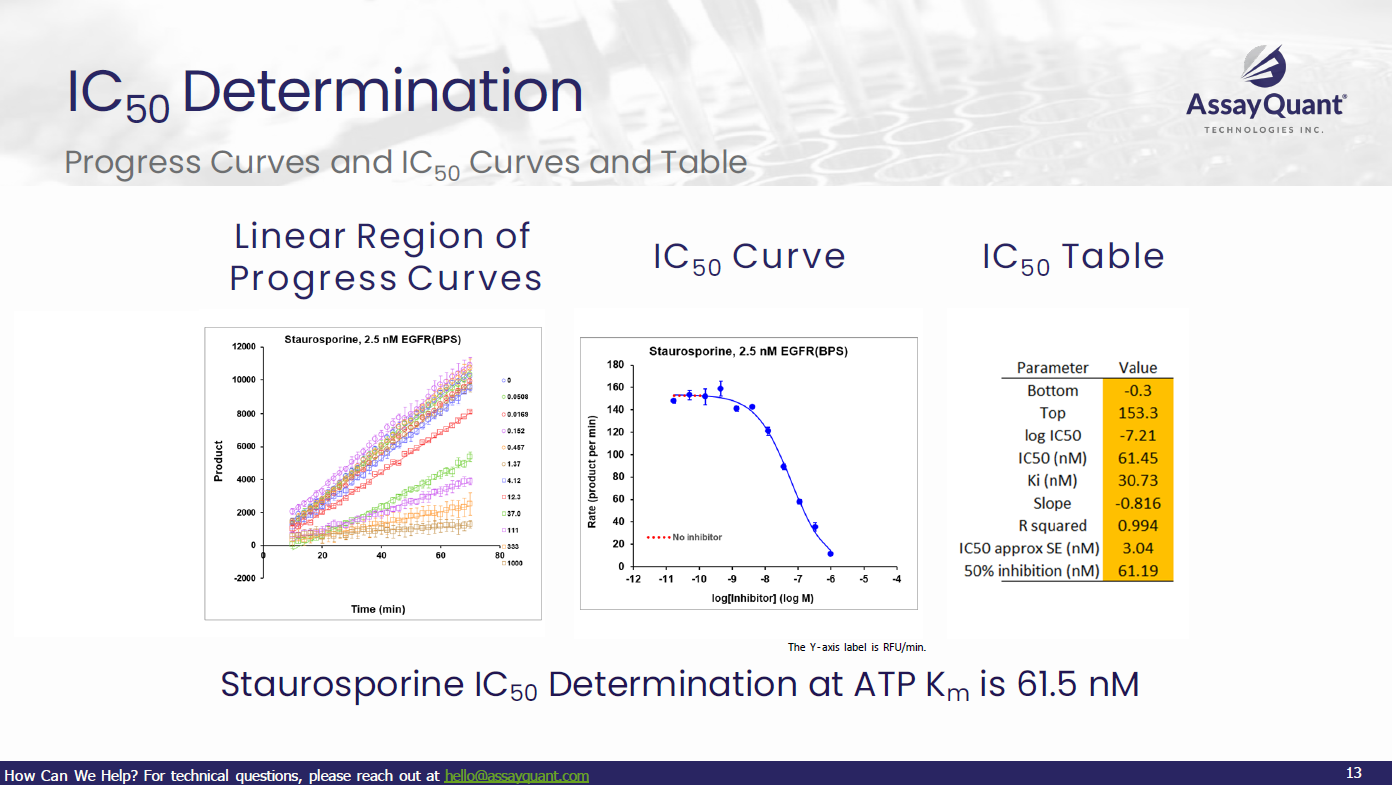
Each validation report provides experimental conditions and data showing:
Protocol
See how the PhosphoSens-Kinetic Assay can be used to find the IC50 of a kinase inhibitor.
Download Protocol →Webinar
Discover how continuous assay formats power deep understanding of kinase function. See how PhosphoSens® assays guide inhibitor profiling, selectivity assessment, and mechanistic characterization.
Watch the Webinar →Service
Need broader selectivity data? KinSight profiling runs your compounds across our full kinase panel under identical PhosphoSens conditions.
Learn about KinSight →Want to hear the latest about our technology? Be among the first to learn about our latest products and services.