Screening more than one compound against the same target? Get up to 50% off your IC50 or TDI Characterization project when you send multiple compounds.
New-customer offer — existing customers, contact our team about volume pricing.
Time-Dependent Kinase Inhibition (TDI) Services: kinact/KI, Residence Time & koff
Assessments of the rate of inactivation (kinact), residence time (τ), half-life (t1/2), inactivation efficiency (kinact/KI), and other kinetic parameters are relevant characteristics that are otherwise missed through classical potency determinations with endpoint assays.
Compounds that inhibit their target more over time — slow off-rate binders, covalent and irreversible inhibitors — can be mischaracterized by a fixed-timepoint IC50. KinSight™ TDI services use our PhosphoSens® continuous assay format to capture the full reaction progress curve and report the kinetic parameters that actually predict potency.
An endpoint reading can't see a curve that's still moving
Endpoint assays have traditionally been used to determine inhibitor potency, but that format has real disadvantages for studies involving time-dependent inhibition. An endpoint analysis assumes a fixed reaction rate from the start of the assay to the moment of signal measurement — which misses important aspects of inhibition modality entirely.
As interest in slow off-rate and irreversible inhibitors has grown, so has the need for a continuous assay format to supplement — or replace — endpoint approaches.
KinSight TDI services are powered by our proprietary PhosphoSens® technology, a direct, continuous assay format that lets you view real-time enzymatic activity over the full course of the reaction. That yields true reaction rates from dozens of data points, generating a complete progress curve in every well — whatever the nature of the inhibition: non-time-dependent, reversible, or irreversible.
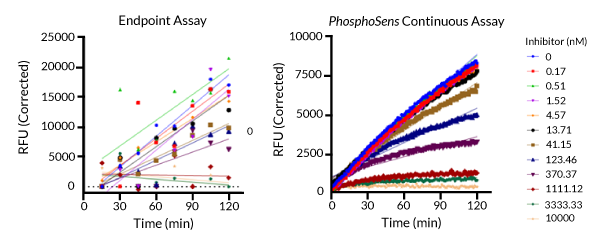
Activity of EGFR tested with Osimertinib (concentration of inhibitor indicated above) using either a commercially available endpoint assay (left) or a PhosphoSens® continuous assay (right).
PhosphoSens direct-detect chemistry: a Sox-fluorophore sensor peptide reports phosphorylation in real time, so every well yields a full kinetic progress curve instead of one timepoint.
Kinetic parameters, defined
The terms you'll see in every KinSight TDI report — scan this before you dig into the workflow below.
Ki: Allows for the independent kinetic characterization of the reversible binding of your compound to its target and comparisons across enzymes and substrates. Determining Ki requires the measured IC50 in the experiment, an understanding of the inhibitor's mode of inhibition, and Km.
- kinact: maximal rate of inactivation
- KI: kinetic binding constant, concentration at half maximal rate
Related Services
Kinase Selectivity Profiling
The same continuous-assay approach applied to 560+ serine/threonine and tyrosine kinases — a companion service when off-target kinase liability is part of your program. See kinome profiling →
Phosphatase Selectivity Profiling
The same continuous-assay approach applied to 45 serine/threonine and tyrosine phosphatases — a companion service when off-target phosphatase liability is part of your program. See phosphatase profiling →
Custom Assay Development
Need a target outside our standard catalog? Our team designs and validates a PhosphoSens substrate for it, typically within 8–12 weeks. See custom assay development →
Compound Testing Services
Flexible potency and profiling services scoped to your specific compound and program needs, beyond standard panel formats. See testing services →
Understanding the KinSight™ TDI Characterization Workflow
Get the most important kinetic parameters you need to understand your compound’s MOA with our validated workflow developed by expert enzymologists. Each stage is designed to deliver specific kinetic insights.
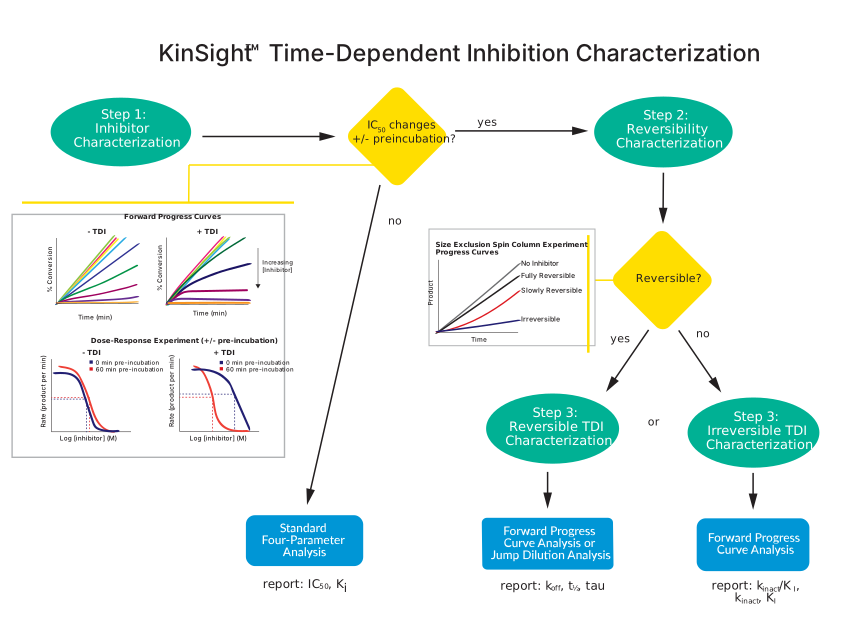
Inhibitor Characterization
12-dose inhibitor dose-response curve, run in duplicate at 1 mM ATP (or ATP Km), with and without 60 minutes of enzyme pre-incubation.
We characterize your inhibitor using a 12-dose dose-response curve, run in duplicate at 1 mM ATP (or ATP Km), with and without 60 minutes of enzyme pre-incubation. To recognize TDI, we perform both a qualitative assessment of the progress curve (signal vs. time) and a quantitative analysis of IC50 as a function of pre-incubation.
Compounds that demonstrate TDI produce non-linear progress curves — the slope decreases over time. Compounds without TDI stay linear throughout. We also calculate the fold-change in IC50 before and after pre-incubation to quantify any time-dependent shift.
If there's no observable TDI, we report IC50 and Ki (for ATP-competitive inhibitors) per our standard potency assessment, and the downstream TDI workflow is not performed. If IC50 shifts, we determine a "proxy IC50" — the working concentration derived from the 60-minute pre-incubation dose-response curve, used for the reversibility and TDI characterization steps that follow.
Reversibility Characterization
Pre-incubation at 10x the proxy IC50, followed by clearance of unbound inhibitor via desalting (size-exclusion) columns, run in duplicate at 1 mM ATP (or ATP Km).
We pre-incubate the enzyme with an excess of inhibitor at 10x the proxy IC50 determined in Step 1, then clear the unbound inhibitor via desalting (size-exclusion) columns, run in duplicate at 1 mM ATP (or ATP Km). The enzyme is assayed immediately after compound clearance, alongside appropriate controls, while we monitor recovery of activity over time.
A reversible inhibitor's enzyme activity recovers nearly to the uninhibited rate as the compound dissociates. An irreversible inhibitor shows little to no recovery. This tells us which downstream kinetic parameters — reversible (koff, residence time) or irreversible (kinact/KI) — apply to your compound.
TDI Characterization
Reversible inhibitors: three IC50 multiples in triplicate, reporting residence time, koff, t½. Irreversible inhibitors: 24-dose progress curves, reporting kinact/KI (or kinact and KI separately).
Reversible inhibitors: free/unbound compound clearance is performed at three inhibitor concentrations in parallel (5x, 10x, and 15x IC50 by default), each in triplicate at 1 mM ATP (or ATP Km), with a low and high inhibitor control plus global pre- and post-column DMSO controls. We report residence time (τ), koff, and t½.
Irreversible inhibitors: we run progress curves at 24 doses, in duplicate, and fit the data via best-fit global analysis to 1-step and 2-step models. If the data fit a 1-step model, we report kinact/KI; if the data fit a 2-step model, kinact and KI are reported as separate parameters.
These parameters are critical for interpreting structure-activity relationships, and translate more reliably from biochemical assays to cellular activity than a traditional IC50 comparison. Journals increasingly require this kind of kinetic characterization for TDI compounds and no longer accept steady-state IC50 reporting in isolation.

Beyond Reversible: Unlocking Covalent & Time-Dependent Kinase Inhibition (on-demand webinar)
On-demand webinar (45 min) on measuring kinact/KI and residence time for covalent and slow-binding kinase inhibitors.
Common questions about TDI characterization
What is time-dependent inhibition (TDI)?
TDI is when a compound's degree of target inhibition changes over time rather than staying fixed. A single-timepoint IC50 can miss this entirely, which is why compounds with TDI need kinetic — not just potency — characterization.
Why can't IC50 alone identify TDI?
IC50 captures potency at one fixed timepoint. TDI compounds — especially slow off-rate and irreversible/covalent inhibitors — can look very different in potency depending on when you measure them. Only a continuous, time-resolved readout reveals the shape of that change.
What's the real difference between an endpoint assay and a continuous assay?
It's not "activity vs. no activity" — many endpoint assays do measure enzymatic activity. The difference is resolution: an endpoint assay infers a rate from one or two fixed timepoints, while a continuous PhosphoSens® assay generates dozens of data points and a full progress curve in a single well, in real time.
How do you determine if a compound is reversible or irreversible?
We pre-incubate the enzyme with inhibitor at a multiple of its proxy IC50, remove unbound compound by size-exclusion spin columns, then monitor whether kinase activity recovers. Recovery toward the uninhibited rate indicates a reversible inhibitor; little to no recovery indicates an irreversible one.
What kinetic parameters will I get for my compound?
Reversible inhibitors: residence time (τ), koff, and t½
Irreversible inhibitors: inactivation efficiency (kinact/KI), and kinact / KI separately where the data resolves them
No TDI: standard IC50 and Ki
What is a "proxy IC50" and why do you use it?
It's an IC50 value derived from the pre-incubation dose-response curve in Stage 1. It's not meant to characterize the inhibitor's potency — there isn't a single "standard" IC50 for a TDI compound to begin with. Instead, the proxy IC50 serves as a guide for setting the working concentration in the reversibility and kinetic experiments that follow.
Do I need to know if my compound is reversible or irreversible before submitting it?
No — that's exactly what Stage 2 of the workflow determines. Submit what you know about your compound and target, and our workflow will identify the mechanism and route it to the right kinetic characterization.
Related reading
- Continuous vs. Endpoint Kinase Assays: What You Need to Know — why endpoint assays can miss time-dependent inhibition and slow-binding effects.
- How Covalent Inhibitor Profiling Supports Drug Discovery — measuring selectivity, potency, and residence time for go/no-go decisions.
Find out what your IC50 isn't telling you.
Send us your compound and target — we'll scope the fastest path to kinact/KI, residence time, or koff data for your program.
No minimum compound count to get a quote
Data delivered in a publication-ready format
Works alongside our kinome & phosphatase selectivity profiling
More on TDI & covalent inhibitor kinetics
Webinars, articles, and related services for teams working on slow-binding or covalent inhibitor programs.
Beyond Reversible: Covalent & Time-Dependent Kinase Inhibition
Erik Schaefer, Ph.D. walks through a three-step kinetic workflow: progress curves, reversibility, and kinact/KI determination (45 min).
WebinarContinuous Assays for Time-Dependent Inhibition
Earl May, Ph.D. walks through the TDI workflow and how to interpret the kinetic parameters it produces.
ArticleIdentification & Characterization of Time-Dependent Kinase Inhibitors
How reversibility testing and global progress-curve fitting produce kinact/KI, koff, and residence time.
ArticleEGFR Kinase Activity: Continuous Fluorescence Assay
The osimertinib/EGFR TDI example used above, in full — distinguishing covalent from reversible EGFR inhibitors.
ArticleEasy Identification & Analysis of Time-Dependent Kinase Inhibitors
Why continuous assay formats are replacing endpoint IC50 for TDI-prone chemotypes.
Related ProductBTK Kinase Activity Assays
See kinact/KI characterization applied to covalent BTK inhibitors like ibrutinib and acalabrutinib.
Related ServiceKinase Selectivity Profiling
Pair TDI characterization with selectivity profiling across 600+ on-panel kinase and phosphatase targets.
Related ServiceCompound Testing Services
Potency, mode-of-inhibition, and selectivity testing alongside your TDI characterization.
Related ServiceCustom Assay Development
Need a target or format outside our standard catalog? We build and validate custom PhosphoSens assays.
Stay Informed
Want to hear the latest about our technology? Be among the first to learn about our latest products and services.