Still have questions about our products?
Our scientists can help you choose the right assay format, substrate, and enzyme for your experiment.
Also known as: unc-51 like autophagy activating kinase 1 • UNC51 • Unc51.1 • ATG1 • ATG1A • ATG1 autophagy related 1 homolog • Unc-51-like kinase 1 • FLJ38455
.jpg?width=450&name=PhosphoSens%20Packaging%20C%20(3).jpg)
ULK1 (unc-51 like autophagy activating kinase 1) belongs to the ULK serine/threonine kinase family, which also includes ULK2, and serves as the primary mammalian ortholog of yeast Atg1. ULK1 functions as the apical kinase of the autophagy initiation complex, forming a heterotetrameric complex with ATG13, FIP200, and ATG101. Its activity is tightly regulated by two master metabolic sensors: mTORC1 phosphorylates ULK1 at Ser757 to suppress it under nutrient-rich conditions, while AMPK phosphorylates ULK1 at Ser317 and Ser777 to activate it during energy stress. Key substrates include Beclin-1, ATG14, and FUNDC1. ULK1 sits at the crossroads of nutrient sensing, mitophagy, and selective autophagy pathways, making it critically relevant to cancer (where autophagy supports tumor cell survival), neurodegeneration, metabolic disease, and infectious disease. Its unique position as a druggable kinase upstream of the entire autophagy cascade renders ULK1 a compelling oncology and neurodegeneration drug target.
ULK1 presents several assay challenges: it has a relatively low catalytic rate, requires careful ATP concentration management because physiological ATP levels differ markedly from Km values, and is susceptible to compound interference in endpoint luminescence formats like ADP-Glo. HTRF and radiometric assays introduce additional complexity through antibody cross-reactivity and radioactive waste handling. PhosphoSens continuous kinase assays overcome these hurdles by generating real-time fluorescent progress curves at physiological ATP concentrations, enabling direct capture of kinact/KI for covalent inhibitor characterization and accurate IC50 determination without endpoint artifacts. The continuous format also detects time-dependent inhibition and compound instability that static endpoint formats miss, making it especially powerful for profiling ULK1 inhibitors across diverse chemotypes in drug discovery campaigns.
Have questions about ULK1 assay design, selectivity panels, or covalent inhibitor characterization?
Ask Our Scientists →Continuous, real-time fluorescent assays optimized for quantitative ULK1 activity measurements, IC50 determination, and mechanistic studies.
PhosphoSens-Kinetic assays directly quantify enzyme activity by continuously monitoring substrate phosphorylation or dephosphorylation in real time, generating a full progress curve in every well.
Learn more about PhosphoSens-Kinetic →Need pricing or availability? Select a kit or substrate to request a quote below.
Kits
Ready-to-use assay kits containing substrate and all essential reagents.
Automatically save 10% when bundling 10ug recombinant enzyme with your 1,000 assay kit. View enzymes
Substrate
Bulk PhosphoSens® substrate for assay development and high-throughput workflows.
Automatically save 10% when bundling Reagent Packs with your substrate. View Reagent Packs
Select a kit, substrate, or enzyme above. Our team will confirm pricing, availability, and any applicable bundle discounts.
No PhosphoSens-Red format is currently available for ULK1.
Select a kit, substrate, or enzyme above. Our team will confirm pricing, availability, and any applicable bundle discounts.
Wild-type and mutant forms of ULK1 for assay development, kinase profiling, and mechanistic studies. Enzymes are supplied active and optimized for PhosphoSens® substrates.
Human • Baculovirus-Insect Cells
Price: $$378.00
AssayQuant offers PhosphoSens peptide substrates derived from validated ULK1 phosphorylation sites, including sequences from ATG13 and Beclin-1, conjugated to the Sox fluorophore. Phosphorylation is detected continuously in real time without antibodies or secondary reagents, providing clean kinetic data even at low enzyme concentrations typical of ULK1 assays.
Yes. Unlike ADP-Glo or coupled enzyme assays that require ATP titration optimization or compromise at sub-Km concentrations, PhosphoSens assays function across a wide ATP range including 1 mM physiological ATP. This is critical for ULK1 inhibitor profiling because compound potency rankings can shift substantially between low and physiological ATP, directly impacting translational relevance of IC50 values.
Because PhosphoSens measures fluorescence continuously, full progress curves reveal onset-of-inhibition kinetics in a single experiment, enabling direct fitting of kinact and KI parameters for covalent or slow-binding inhibitors. Endpoint assays collapse this rich temporal information into a single data point, often masking time-dependent behavior and leading to misclassification of inhibitor mechanism.
Explore data and documents to support your kinase and phosphatase experiments. Download sample data, protocols and other resources to see how our assays perform and to help you get started in your own lab. All validation data generated using PhosphoSens® assays under recommended conditions.
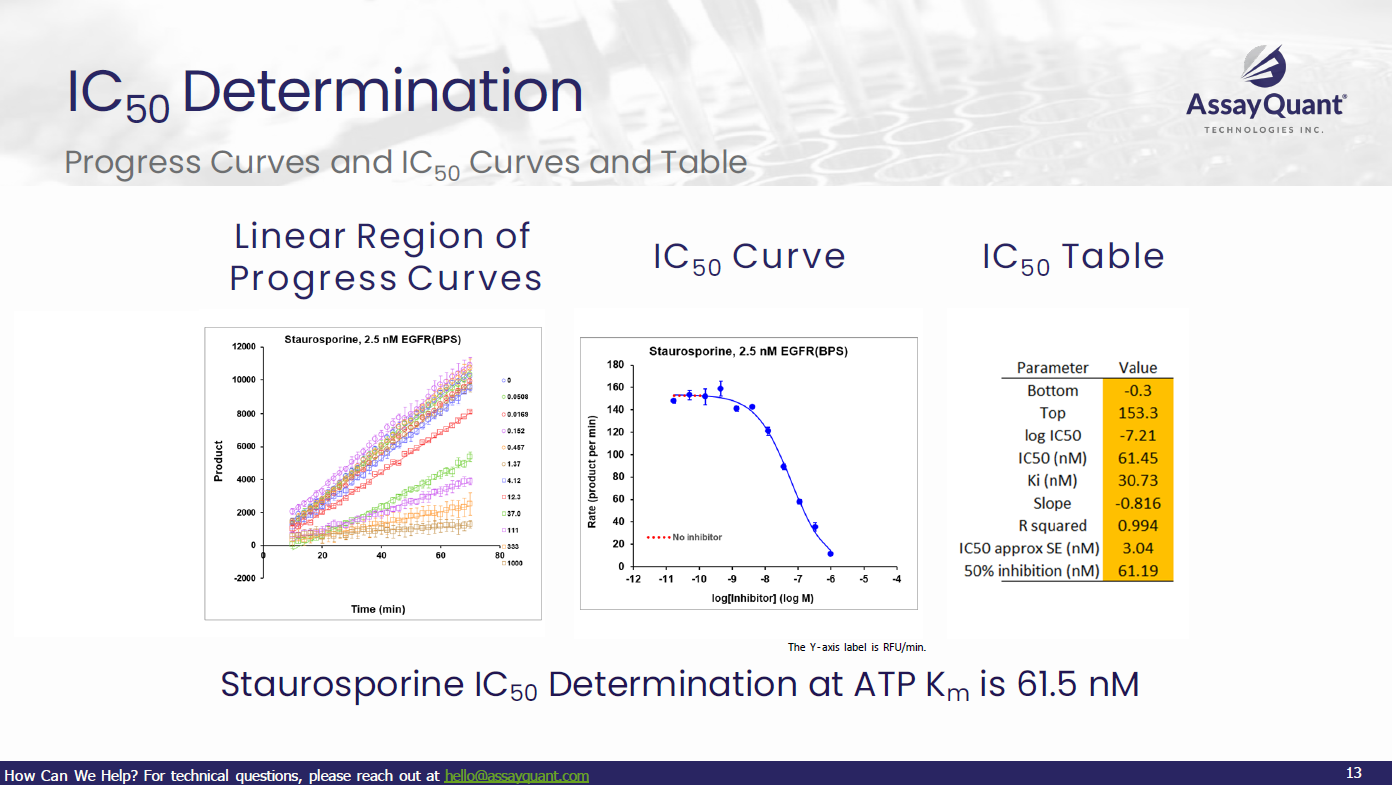
Each validation report provides experimental conditions and data showing:
Protocol
See how the PhosphoSens-Kinetic Assay can be used to find the IC50 of a kinase inhibitor.
Download Protocol →Webinar
Discover how continuous assay formats power deep understanding of kinase function. See how PhosphoSens® assays guide inhibitor profiling, selectivity assessment, and mechanistic characterization.
Watch the Webinar →Service
Need broader selectivity data? KinSight profiling runs your compounds across our full kinase panel under identical PhosphoSens conditions.
Learn about KinSight →Want to hear the latest about our technology? Be among the first to learn about our latest products and services.