Still have questions about our products?
Our scientists can help you choose the right assay format, substrate, and enzyme for your experiment.
Also known as: PTEN induced putative kinase 1 • BRPK • PARK6 • Parkinson disease (autosomal recessive) 6
.jpg?width=450&name=PhosphoSens%20Packaging%20C%20(3).jpg)
PINK1 (PTEN-Induced Kinase 1) is a serine/threonine kinase belonging to the NKF2 (Novel Kinase Family 2) branch of the human kinome, bearing structural resemblance to the Ca2+/calmodulin-dependent kinase (CAMK) superfamily. PINK1 localizes to mitochondria and serves as a master sensor of mitochondrial membrane potential. Under healthy conditions, PINK1 is rapidly imported and cleaved by the mitochondrial protease PARL, targeting it for proteasomal degradation. Upon mitochondrial depolarization, PINK1 accumulates on the outer mitochondrial membrane, where it autophosphorylates and phosphorylates key substrates including Parkin (RBR E3 ligase) at Ser65 and ubiquitin at Ser65, initiating mitophagy. This PINK1-Parkin axis is central to mitochondrial quality control. Loss-of-function mutations in PINK1 cause autosomal recessive early-onset Parkinson's disease (PARK6), making PINK1 a compelling therapeutic target. Activating PINK1 pharmacologically represents a disease-modifying strategy for Parkinson's disease and broader mitochondrial dysfunction disorders.
PINK1 presents significant assay challenges: it is constitutively auto-inhibited, requires mitochondrial depolarization for activation in cellular contexts, and is notoriously difficult to express in active recombinant form. Traditional endpoint assays such as ADP-Glo and HTRF fail to capture the slow, progressive phosphorylation kinetics of PINK1 substrates like ubiquitin-Ser65 peptides, missing early activation dynamics and leading to endpoint artifacts. Radiometric assays offer sensitivity but lack throughput and real-time resolution. PhosphoSens continuous fluorescent assay technology monitors substrate phosphorylation in real time at physiological ATP concentrations, generating full progress curves that accurately capture PINK1 kinetics, detect partial agonism of PINK1 activators, and enable precise kinact/KI determination for covalent activator or inhibitor programs — all without antibodies or radioactivity, enabling higher-throughput compound profiling.
Have questions about PINK1 assay design, selectivity panels, or covalent inhibitor characterization?
Ask Our Scientists →Continuous, real-time fluorescent assays optimized for quantitative PINK1 activity measurements, IC50 determination, and mechanistic studies.
PhosphoSens-Kinetic assays directly quantify enzyme activity by continuously monitoring substrate phosphorylation or dephosphorylation in real time, generating a full progress curve in every well.
Learn more about PhosphoSens-Kinetic →Need pricing or availability? Select a kit or substrate to request a quote below.
Kits
Ready-to-use assay kits containing substrate and all essential reagents.
Automatically save 10% when bundling 10ug recombinant enzyme with your 1,000 assay kit. View enzymes
Substrate
Bulk PhosphoSens® substrate for assay development and high-throughput workflows.
Automatically save 10% when bundling Reagent Packs with your substrate. View Reagent Packs
Select a kit, substrate, or enzyme above. Our team will confirm pricing, availability, and any applicable bundle discounts.
No PhosphoSens-Red format is currently available for PINK1.
Select a kit, substrate, or enzyme above. Our team will confirm pricing, availability, and any applicable bundle discounts.
No recombinant enzymes are currently available for PINK1.
PhosphoSens uses a chelation-enhanced fluorescent (CSox-based) peptide substrate that undergoes a measurable change in fluorescence intensity upon phosphorylation by PINK1, enabling continuous monitoring of reaction progress without stopping the reaction. This generates full kinetic progress curves in a single well, allowing precise calculation of initial velocities, Km, kcat, and IC50 values. No antibodies, coupled enzymes, or radioactivity are required.
Many competing assay platforms require low ATP concentrations to achieve sensitivity, artificially lowering the ATP-competitive baseline and skewing inhibitor potency measurements. PhosphoSens operates at physiological ATP levels (1 mM range), providing IC50 and Ki values that are more predictive of cellular and in vivo activity. This is especially critical for PINK1 activator programs, where compound mechanism and cooperativity can be obscured at non-physiological ATP concentrations.
Yes. Because PhosphoSens monitors the full reaction progress curve continuously, it can detect increases in reaction velocity caused by small-molecule PINK1 activators, a mode of action that endpoint assays frequently miss or misinterpret due to signal saturation or timing artifacts. This makes PhosphoSens particularly valuable for the growing PINK1 activation therapeutic strategy in Parkinson's disease drug discovery.
Explore data and documents to support your kinase and phosphatase experiments. Download sample data, protocols and other resources to see how our assays perform and to help you get started in your own lab. All validation data generated using PhosphoSens® assays under recommended conditions.
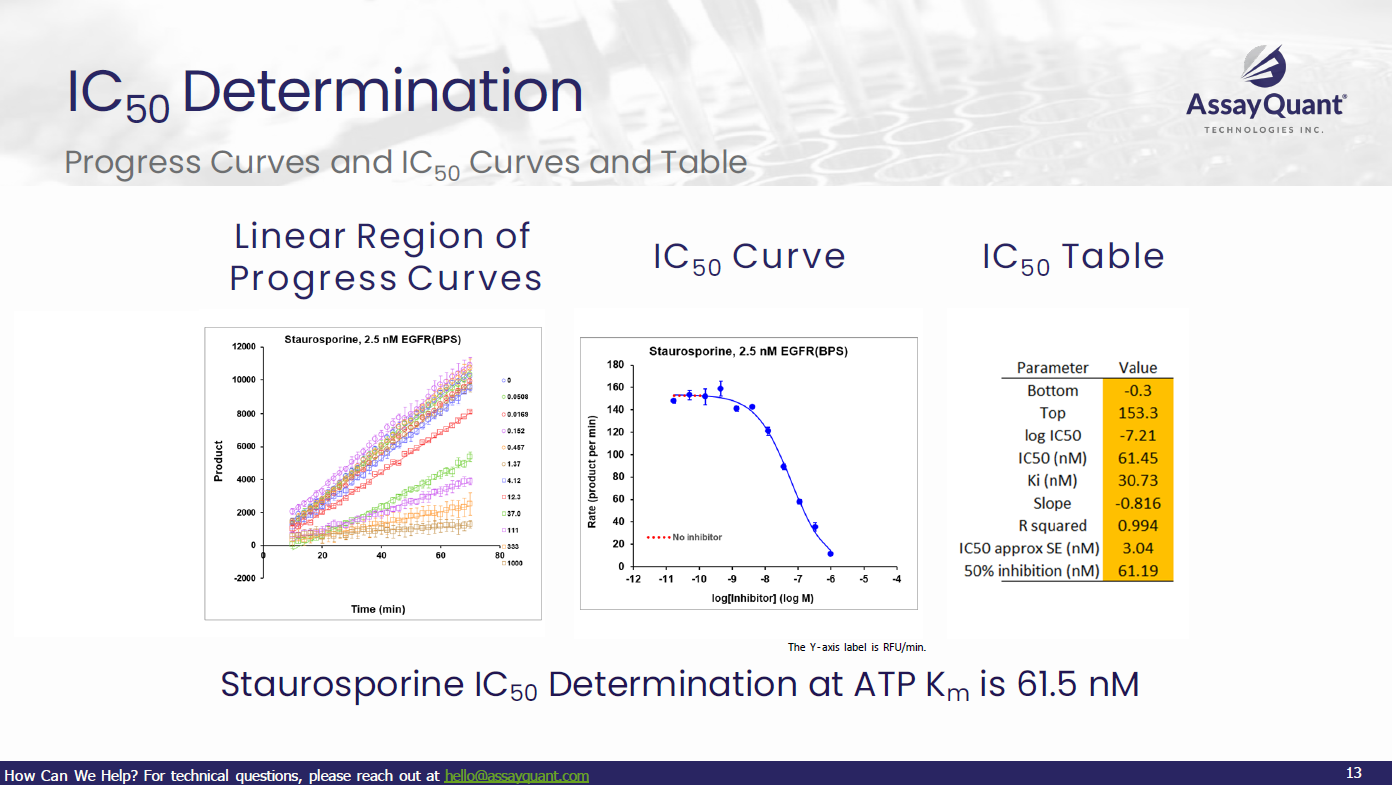
Each validation report provides experimental conditions and data showing:
Protocol
See how the PhosphoSens-Kinetic Assay can be used to find the IC50 of a kinase inhibitor.
Download Protocol →Webinar
Discover how continuous assay formats power deep understanding of kinase function. See how PhosphoSens® assays guide inhibitor profiling, selectivity assessment, and mechanistic characterization.
Watch the Webinar →Service
Need broader selectivity data? KinSight profiling runs your compounds across our full kinase panel under identical PhosphoSens conditions.
Learn about KinSight →Want to hear the latest about our technology? Be among the first to learn about our latest products and services.