Still have questions about our products?
Our scientists can help you choose the right assay format, substrate, and enzyme for your experiment.
Also known as: leucine rich repeat kinase 2 • RIPK7 • ROCO2 • FLJ45829 • DKFZp434H2111 • PARK8 • Parkinson disease 8 • Dardarin
.jpg?width=450&name=PhosphoSens%20Packaging%20C%20(3).jpg)
LRRK2 (Leucine-Rich Repeat Kinase 2) belongs to the LRRK family of large, multidomain Roco GTPases that uniquely combine both GTPase and serine/threonine kinase activities within a single polypeptide. LRRK2 is activated through autophosphorylation and Rab8A/Rab10-mediated feedback loops, and its activity is tightly regulated by 14-3-3 protein binding and PP1 phosphatase. Key substrates include Rab GTPases (Rab8A, Rab10, Rab35) at conserved threonine residues, as well as NSF and RILPL1/2, linking LRRK2 to endolysosomal trafficking, autophagy, and ciliogenesis. LRRK2 is centrally implicated in Parkinson's disease (PD); gain-of-function mutations such as G2019S (the most prevalent familial PD mutation) hyperactivate kinase activity by 2–3 fold. LRRK2 inhibition has emerged as a compelling therapeutic strategy for both familial and sporadic PD, and LRRK2 variants also associate with Crohn's disease and leprosy susceptibility, broadening its disease relevance beyond neurodegeneration.
LRRK2 presents significant assay challenges: it is a large (286 kDa), low-abundance kinase requiring careful handling to preserve activity, and its preferred substrates are Rab GTPases with moderate catalytic efficiency. Traditional endpoint assays such as ADP-Glo and HTRF require quenching steps that can miss transient activity changes, introduce variability, and fail to capture the full kinetic profile needed for covalent inhibitor characterization. Radiometric assays add safety and throughput burdens. PhosphoSens continuous fluorescent kinase assays overcome these limitations by generating real-time progress curves at physiological ATP concentrations, enabling accurate Km(ATP) determination, detection of covalent kinact/KI parameters for irreversible inhibitors, and early identification of assay artifacts such as compound fluorescence interference or substrate depletion — all critical for prosecuting LRRK2 drug discovery campaigns with high fidelity.
Have questions about LRRK2 assay design, selectivity panels, or covalent inhibitor characterization?
Ask Our Scientists →Continuous, real-time fluorescent assays optimized for quantitative LRRK2 activity measurements, IC50 determination, and mechanistic studies.
PhosphoSens-Kinetic assays directly quantify enzyme activity by continuously monitoring substrate phosphorylation or dephosphorylation in real time, generating a full progress curve in every well.
Learn more about PhosphoSens-Kinetic →Need pricing or availability? Select a kit or substrate to request a quote below.
Kits
Ready-to-use assay kits containing substrate and all essential reagents.
Automatically save 10% when bundling 10ug recombinant enzyme with your 1,000 assay kit. View enzymes
Substrate
Bulk PhosphoSens® substrate for assay development and high-throughput workflows.
Automatically save 10% when bundling Reagent Packs with your substrate. View Reagent Packs
Select a kit, substrate, or enzyme above. Our team will confirm pricing, availability, and any applicable bundle discounts.
No PhosphoSens-Red format is currently available for LRRK2.
Select a kit, substrate, or enzyme above. Our team will confirm pricing, availability, and any applicable bundle discounts.
Wild-type and mutant forms of LRRK2 for assay development, kinase profiling, and mechanistic studies. Enzymes are supplied active and optimized for PhosphoSens® substrates.
Human • Baculovirus-Insect Cells
Price: $$488.00
AssayQuant offers PhosphoSens CSox-based peptide substrates optimized for LRRK2, derived from validated Rab GTPase phosphorylation sites. These substrates enable continuous, real-time monitoring of LRRK2 activity without antibodies or secondary detection reagents. Substrate selection guidance is available from our scientific team to match your specific assay format and throughput requirements.
Yes. Because PhosphoSens generates continuous fluorescent progress curves, it is uniquely suited to capture the time-dependent inhibition profiles required to determine kinact and KI for covalent or irreversible LRRK2 inhibitors. This cannot be reliably accomplished with single-timepoint endpoint assays such as ADP-Glo or HTRF, which may underestimate or misrepresent covalent inhibitor potency.
PhosphoSens LRRK2 assays can be run at physiological ATP concentrations (typically 1 mM), closely mimicking cellular conditions and yielding IC50 values more predictive of in vivo potency. Many competing platforms use artificially low ATP to boost signal, which inflates apparent compound potency and reduces translational relevance u2014 a critical consideration for LRRK2 drug discovery programs targeting CNS indications.
Explore data and documents to support your kinase and phosphatase experiments. Download sample data, protocols and other resources to see how our assays perform and to help you get started in your own lab. All validation data generated using PhosphoSens® assays under recommended conditions.
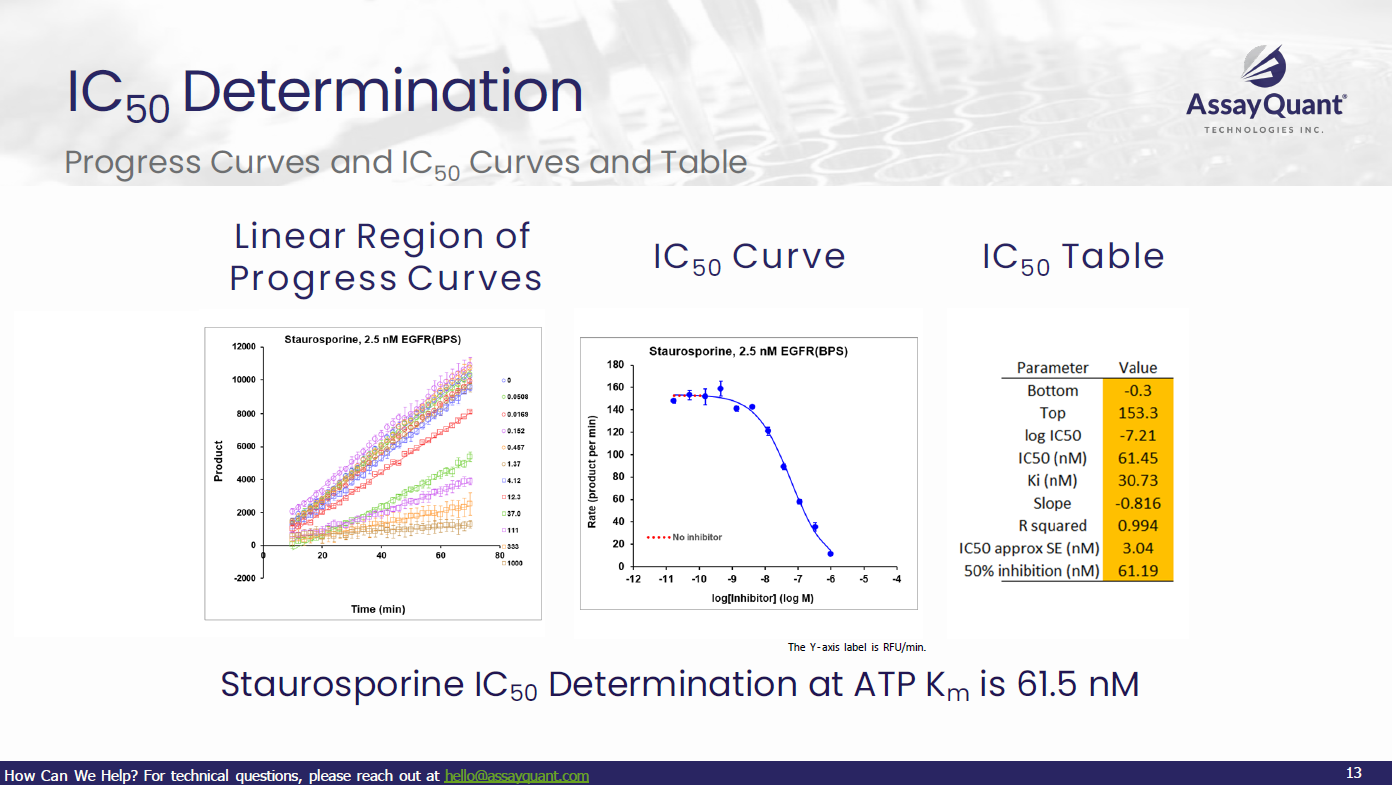
Each validation report provides experimental conditions and data showing:
Protocol
See how the PhosphoSens-Kinetic Assay can be used to find the IC50 of a kinase inhibitor.
Download Protocol →Webinar
Discover how continuous assay formats power deep understanding of kinase function. See how PhosphoSens® assays guide inhibitor profiling, selectivity assessment, and mechanistic characterization.
Watch the Webinar →Service
Need broader selectivity data? KinSight profiling runs your compounds across our full kinase panel under identical PhosphoSens conditions.
Learn about KinSight →Want to hear the latest about our technology? Be among the first to learn about our latest products and services.