Still have questions about our products?
Our scientists can help you choose the right assay format, substrate, and enzyme for your experiment.
Also known as: JAK1 • Janus kinase 1 • JAK1A • JAK1B • JTK3
.jpg?width=450&name=PhosphoSens%20Packaging%20C%20(3).jpg)
JAK1 (Janus Kinase 1) belongs to the JAK family of non-receptor tyrosine kinases, which includes JAK2, JAK3, and TYK2. JAK1 contains a catalytically active JH1 kinase domain and a pseudokinase JH2 domain that regulates activity. It constitutively associates with cytokine receptors such as the type I/II interferon receptors, IL-6 receptor, and gp130, and is activated upon cytokine binding through transphosphorylation. Key substrates include STAT1, STAT2, STAT3, and STAT6, which translocate to the nucleus to drive transcription of immune and inflammatory genes. JAK1 is central to the JAK-STAT signaling axis, governing immune cell differentiation, proliferation, and cytokine responses. Dysregulated JAK1 activity is implicated in rheumatoid arthritis, atopic dermatitis, ulcerative colitis, and multiple myeloma. Gain-of-function mutations drive myeloproliferative neoplasms and certain leukemias. Its essential role in cytokine-driven inflammation and hematologic malignancies makes JAK1 a highly validated therapeutic target with multiple approved inhibitors in clinical use.
JAK1 assays present several challenges: physiological ATP concentrations (1-5 mM intracellular) are rarely used in endpoint formats, leading to misleading IC50 values for ATP-competitive inhibitors such as upadacitinib and filgotinib. ADP-Glo and HTRF detect signal only at a single endpoint, masking non-linear kinetics, substrate depletion, and time-dependent inhibition — critical considerations for covalent or slow-binding JAK1 inhibitors. Radiometric assays offer kinetic data but are hazardous and low-throughput. PhosphoSens continuous fluorescent assays generate real-time progress curves at physiological ATP concentrations, enabling accurate Ki, kinact/KI determination for covalent inhibitors, and direct detection of inhibitor mechanism. This approach eliminates endpoint artifacts, reduces assay development time, and delivers mechanistically richer data for JAK1 drug discovery programs.
Have questions about JAK1 (JH1) assay design, selectivity panels, or covalent inhibitor characterization?
Ask Our Scientists →Continuous, real-time fluorescent assays optimized for quantitative JAK1 (JH1) activity measurements, IC50 determination, and mechanistic studies.
PhosphoSens-Kinetic assays directly quantify enzyme activity by continuously monitoring substrate phosphorylation or dephosphorylation in real time, generating a full progress curve in every well.
Learn more about PhosphoSens-Kinetic →Need pricing or availability? Select a kit or substrate to request a quote below.
Kits
Ready-to-use assay kits containing substrate and all essential reagents.
Automatically save 10% when bundling 10ug recombinant enzyme with your 1,000 assay kit. View enzymes
Substrate
Bulk PhosphoSens® substrate for assay development and high-throughput workflows.
Automatically save 10% when bundling Reagent Packs with your substrate. View Reagent Packs
Select a kit, substrate, or enzyme above. Our team will confirm pricing, availability, and any applicable bundle discounts.
Robust endpoint TRF assays optimized for high-throughput screening and quantitative JAK1 (JH1) activity measurement in plate-based workflows.
PhosphoSens-Red assays use europium-based time-resolved fluorescence detection to enable robust, plate-based quantification of enzyme activity, making them well suited for high-throughput screening workflows.
Learn more about PhosphoSens-Red →Need pricing or availability? Select a kit or substrate to request a quote below.
Kits
Ready-to-use TRF assay kits containing substrate and essential reagents.
Automatically save 10% when bundling 10ug recombinant enzyme with your 1,000 assay kit. View enzymes
Substrate
Bulk substrate for PhosphoSens-Red TRF assays and high-throughput workflows.
Automatically save 10% when bundling Reagent Packs with your substrate. View Reagent Packs
Select a kit, substrate, or enzyme above. Our team will confirm pricing, availability, and any applicable bundle discounts.
No recombinant enzymes are currently available for JAK1 (JH1).
Most approved JAK1 inhibitors are ATP-competitive, meaning their measured IC50 values shift dramatically depending on ATP concentration. Running assays at physiological ATP levels (1-5 mM) with PhosphoSens yields IC50 and Ki values that are far more predictive of cellular and in vivo potency. Endpoint assays commonly use sub-physiological ATP (10-100 u00b5M), which artificially inflates apparent inhibitor potency and can mislead SAR campaigns.
Yes. PhosphoSens continuous progress curves directly capture time-dependent loss of JAK1 activity that is characteristic of covalent inhibitors, allowing calculation of kinact and KI from a single experiment. Endpoint methods such as ADP-Glo cannot resolve the time dependence of inactivation, potentially misclassifying covalent inhibitors as reversible or underestimating their potency.
AssayQuant employs a proprietary Sox-based peptide substrate engineered for selectivity toward JAK1 phosphorylation consensus sequences, incorporating a chelation-enhanced fluorophore that generates a real-time fluorescent signal upon substrate phosphorylation. This eliminates the need for antibodies, secondary reagents, or radioactive labels, enabling robust, homogeneous assay performance in both research and high-throughput screening formats.
Explore data and documents to support your kinase and phosphatase experiments. Download sample data, protocols and other resources to see how our assays perform and to help you get started in your own lab. All validation data generated using PhosphoSens® assays under recommended conditions.
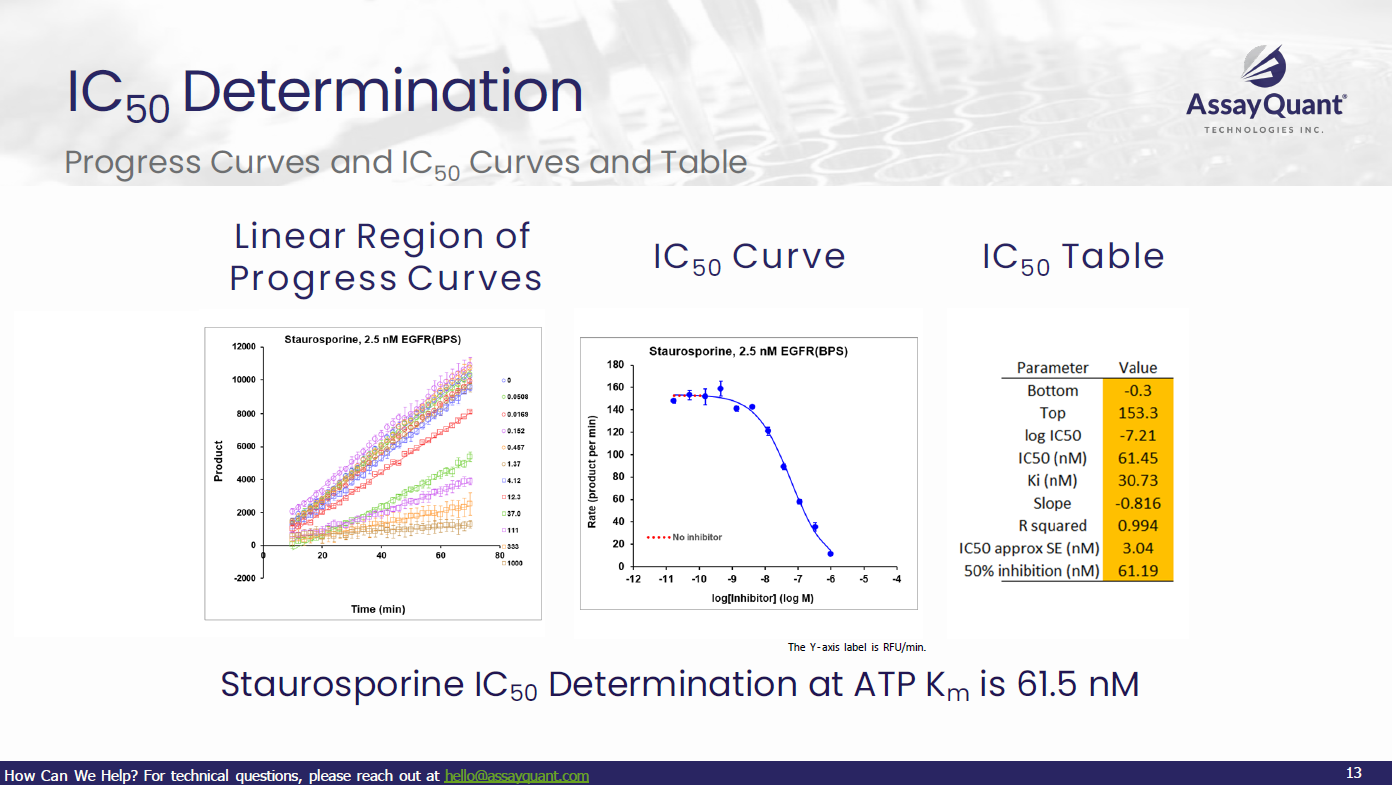
Each validation report provides experimental conditions and data showing:
Protocol
See how the PhosphoSens-Kinetic Assay can be used to find the IC50 of a kinase inhibitor.
Download Protocol →Webinar
Discover how continuous assay formats power deep understanding of kinase function. See how PhosphoSens® assays guide inhibitor profiling, selectivity assessment, and mechanistic characterization.
Watch the Webinar →Service
Need broader selectivity data? KinSight profiling runs your compounds across our full kinase panel under identical PhosphoSens conditions.
Learn about KinSight →Want to hear the latest about our technology? Be among the first to learn about our latest products and services.