Measure Kinase Activity Directly in Crude Cell Lysates, Now for 21 Kinases
Selective sensor peptides read endogenous kinase activity in unfractionated cell lysates: continuous, quantitative, and from just 1–5 µg of protein per well.
See the MAPK, AKT, CDK and ZAP70 data we presented at Discovery on Target 2026.

Satish Pimrale
Satish works with discovery teams worldwide on PhosphoSens® lysate assays, from the nine catalog lysate assays on the poster to new sensor peptides for your target.
Talk to us about lysate assays
Tell us your kinase, cell model and question. Satish will follow up, and loop in our scientists where it helps.
What the DOT 2026 Poster Shows
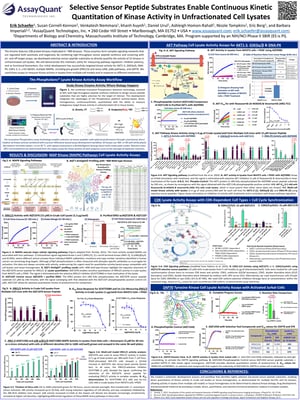
Using selective Sox-based sensor peptides, we measured endogenous kinase activity directly in crude lysates from multiple cell models. Signals respond to known pathway stimuli and disappear with selective inhibitors or heat inactivation.
- ERK1/2: 10-fold activation in PDGF-stimulated NIH3T3 lysate, eliminated by SCH772984 (lysate IC50 9.3 nM; Vx-11e 101 nM).
- AKT1-3: 8-fold activation with PDGF; lysate IC50 of 5.2 nM for rizavasertib + vevorisertib.
- JNK1-3: up to 22-fold induction under anisomycin stress in HeLa cells.
- ZAP70: lysate IC50s in activated Jurkat cells track recombinant ZAP70, not SYK.
- Low input, absolute numbers: 1–5 µg total protein per 384-well; phosphopeptide controls convert signal to moles of product per minute.
Would you like our CSO to walk you through how this applies to your target?
Download the DOT 2026 Poster
Phospho-specific antibodies report that a kinase is phosphorylated, which doesn't always mean it is active. This poster shows how we pair PhosphoSens® sensor chemistry with high-throughput peptide synthesis and screening to build substrates selective enough to read a single kinase in an unfractionated lysate.
Inside: the assay workflow plus MAPK, AKT pathway, CDK and ZAP70 lysate data across multiple cell models, with inhibitor IC50s.
"Selective Sensor Peptide Substrates Enable Continuous Kinetic Quantitation of Kinase Activity in Unfractionated Cell Lysates"
Erik Schaefer, Susan Cornell-Kennon, Venkatesh Nemmara, Khanh Huynh, Daniel Urul, Ashleigh Homon-Rahall, Nicole Tompkins, Eric Berg, and Barbara Imperiali. AssayQuant Technologies, Inc. and Massachusetts Institute of Technology. Supported by an NIH/NCI Phase II SBIR.
Cell Lysate Kinase Activity Assays by Target
Nine validated PhosphoSens®-Lysate assays covering ERK1/2, AKT1/2/3, GSK3α/β, DNA-PK, JNK1/2/3, p38α/β/γ/δ, CDK1/2/3/5, CDK2/Cyclin E1 and ZAP70. Each kinase-selective sensor substrate has a unique AQT code and a validation report with lysate data. See the full lysate assay catalog →
| Target | Full Name | Substrate | Validation Report |
|---|---|---|---|
| ERK1/2MAPK | Mitogen-activated protein kinase (MAPK3/1) | AQT1076 | View report → |
| JNK1/2/3MAPK | Mitogen-activated protein kinase 8/9/10 | AQT1196 | View report → |
| p38α/β/γ/δMAPK | Mitogen-activated protein kinase 11/12/13/14 | AQT1280 | View report → |
| AKT1/2/3AKT pathway | AKT serine/threonine kinase 1/2/3 | AQT0982 | View report → |
| GSK3α/βAKT pathway | Glycogen synthase kinase 3 alpha/beta | AQT1211 | View report → |
| DNA-PKDNA damage response | Protein kinase, DNA-activated, catalytic subunit | AQT0440 | View report → |
| CDK1/2/3/5Cell cycle | Cyclin-dependent kinase 1/2/3/5 | AQT1271 | View report → |
| CDK2/CycE1Cell cycle | Cyclin-dependent kinase 2 & Cyclin E1 | AQT1170 | View report → |
| ZAP70TCR signaling | Zeta chain of T-cell receptor associated protein kinase 70 | AQT1450 | View report → |
In final optimization: c-KIT [D816V], CDK4/6, and CDK5/p25 & CDK5/p35. Want to know when one is released, or need a kinase that isn't listed? Tell us your target →
Don't See Your Kinase? Tell Us.
A new lysate sensor peptide is built, not pulled off a shelf: each one takes rounds of high-throughput peptide synthesis and selectivity screening. So we prioritize development by demand, and your request is one of the clearest signals we have.
- We review requests by target family each quarter.
- If your target moves into development, you'll hear from us directly with an estimated timeline.
- Need it sooner? Custom Assay Development can scope a dedicated project.
Frequently Asked Questions
Can you measure kinase activity directly in cell lysates?
Yes. A selective sensor peptide is phosphorylated by the target kinase in an unfractionated lysate, and the resulting fluorescence change is read continuously, so the reaction rate reflects endogenous kinase activity.
How is a sensor peptide made selective in a complex sample?
We synthesize and screen peptide substrates against the target and potential off-targets, then confirm selectivity with KinSight™ profiling against more than 400 wild-type kinases and with selective inhibitors in lysate.
How much lysate do I need?
Typically 1–5 µg of total protein per well in a 384-well plate.
How is this different from phospho-specific antibodies or western blots?
Phospho-specific antibodies report phosphorylation of the kinase itself, which doesn't always correlate with activity. Sensor peptides report substrate turnover, which is the activity itself.
Are the results quantitative?
Yes. Phosphopeptide controls let us convert fluorescence to moles of product formed per minute.
Can I measure inhibitor potency in lysate?
Yes. The DOT 2026 poster reports lysate IC50 values for ERK1/2, AKT and ZAP70 inhibitors.
Revolutionizing Kinase Research and Drug Development with Continuous Activity Assays

Continuous, Real-Time Monitoring
Progress curves in every well. This approach yields the actual reaction rate, with high accuracy, precision, and confidence.
Direct Measurement of Enzyme Activity
Measures enzyme activity at the substrate level, avoiding the complications of indirect assays that require additional steps.
Physiologically Relevant Conditions
Biologically relevant peptide sequences in assays that are compatible with low to physiological [mM] concentrations of ATP.
Homogenous Add & Read Workflow
Achieve fast and reproducible results with a homogenous, single-step workflow without compromising data quality.
Featured Resources
Continuous vs. Endpoint Kinase Assays: What You Need to Know
Explore the key differences between continuous and endpoint kinase assays to determine the best approach for your research needs.
KinSight Kinome Profiling
Get high-confidence kinase selectivity and MOA data from our activity-based biochemical assays across 560+ kinases.
Measure Kinase Activity Where Biology Happens
Discover real-time lysate assays that reveal kinase activity and cellular responses across various models, offering insights beyond traditional...
AssayQuant at Discovery on Target
Drug discovery is full of uncertainty. Traditional tools often lack the precision and real-time feedback needed to confidently evaluate potential therapeutics—especially kinase and phosphatase inhibitors, where mechanism and kinetics matter most.
That’s where AssayQuant makes a difference.
We're proud to support scientists working to solve some of the most complex challenges in human health. Whether you're exploring new targets or optimizing leads, AssayQuant is here to be your trusted partner in progress.
Explore how our PhosphoSens® technology and KinSight™ Profiling Services bridge the gap between biochemical assays and biological complexity.
Stay Informed
Want to hear the latest about our technology? Be among the first to learn about our latest products and services.