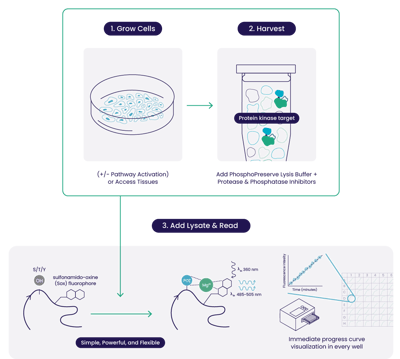
Measure Endogenous Kinase Activity Directly in Cell and Tissue Lysate
A PhosphoSens-Lysate assay measures real-time kinase substrate phosphorylation directly in crude cell or tissue lysate, giving a direct, quantitative readout of endogenous kinase activity rather than an inferred phospho-status snapshot. Unlike phospho-antibody methods, which only detect whether a residue is phosphorylated at one moment, PhosphoSens-Lysate tracks the actual catalytic reaction continuously, in native biological context.
An independent 2026 study (Darash-Yahana et al., iScience) illustrates why this distinction matters: five clinical-stage ERK1/2 inhibitors all triggered an increase in phospho-ERK by western blot — the classic negative-feedback signature — while PhosphoSens-Lysate showed true catalytic activity collapsing under the same inhibitors. Phosphorylation state and catalytic activity told opposite stories.
Validated for ERK1/2, AKT1/2/3, GSK3A/B, DNA-PK, JNK1/2/3, p38A/B/D/G, CDK1/2/3/5, CDK2/CycE1, and ZAP70 with kits available from 100-reaction evaluation size through bulk substrate.
Does ERK1/2 phosphorylation reflect true kinase activity? An independent study says no.
Researchers at the Hebrew University of Jerusalem tested five clinical-stage ERK1/2 inhibitors — BVD523, GDC0994, SCH772984, ASN007, and Temuterkib — across transformed and cancer-derived cell lines. Every inhibitor blocked ERK's catalytic output while lifting the negative feedback that normally suppresses ERK phosphorylation at the TEY motif. Western blot signal went up. Real kinase activity, measured directly with the PhosphoSens-Lysate ERK1/2 kinase activity assay, stayed firmly suppressed.
Darash-Yahana, M., Soudah, N., Baskin, A., Levy-Saar, I., Levitzki, A., & Engelberg, D. (2026). Erk inhibitors intercept Erk-mediated negative feedback while imposing cell-cycle arrest and activating p38. iScience 29, 116629.
"...the measure of Erk1/2 catalytic activity, in a direct and specific kinase assay, should be the sole bona fide readout for the status of Erk's catalytic capabilities."
— Darash-Yahana et al., iScience 2026
All five inhibitors triggered strong, sustained ERK1/2 phosphorylation at the TEY motif within hours — the classic negative-feedback release signature.
PhosphoSens-Lysate: Activity ↓
Kinase catalytic activity, measured directly on the same lysates, collapsed 80–95% and stayed suppressed — the opposite conclusion phospho-blot alone would suggest.
ERK1/2 Catalytic Activity (RFU/min)
No inhibitor+BVD523 (5 µM)
Recreated from Fig. 1B — Darash-Yahana et al., iScience 29, 116629 (2026)
THE CORE PROBLEM
Why phosphorylation status doesn't equal kinase activity
PHOSPHO-ANTIBODY METHODS
What Western blot / phospho-antibody assays measure
They can't distinguish an active kinase from one that's phosphorylated but catalytically dead — exactly the gap this new iScience study demonstrates across five ERK1/2 inhibitors.
Requires target-specific antibodies
Wash steps, fixed timepoints
No kinetic or mechanism information
PHOSPHOSENS LYSATE ASSAYS
What a cell lysate kinase activity assay measures
A continuous fluorescence readout tracks real substrate phosphorylation as it happens, in cell or tissue lysate — capturing true catalytic function, not just a modification state.
Wherever catalytic output — not phosphorylation state — is the question, PhosphoSens-Lysate gives a direct answer. Four places labs are using it right now.
Inhibitor MOA & Resistance Studies
Confirm a compound is actually shutting down catalytic output — not just triggering a feedback-driven rise in phospho-signal, as seen with all five ERK1/2 inhibitors in the Engelberg lab study. Essential for distinguishing true target engagement from resistance mechanisms that restore phosphorylation without restoring activity.
Target Engagement & PD Biomarker Studies
Track real-time pathway suppression or activation after dosing, in the same lysate used for downstream profiling. A continuous activity readout gives pharmacodynamic data that a fixed-timepoint western blot can't — including detecting rebound or incomplete engagement missed by phospho-status alone.
Cross-Cell-Line & Model Validation
Compare functional kinase activity across transformed lines, patient-derived lines, or genetic variants (e.g., resistance mutations) under identical assay conditions — the same approach used to test wild-type and mutant ERK1 constructs in the iScience study, without re-optimizing an antibody for every model.
Translational & Patient-Sample Profiling
Measure functional kinase activity directly in tissue or clinical lysate to assess disease etiology, progression, and individual treatment response — pairing quantitative activity data with genomic, transcriptomic, and proteomic platforms for a fuller functional picture.
Not sure which target or format fits your application? Talk to our team →
Shop by target
Cell Lysate Kinase Activity Assays by Target
Nine validated ERK1/2, AKT, GSK3, DNA-PK, JNK, p38, CDK, and ZAP70 lysate kinase activity assays. Each Kinase-Selective Lysate Substrate is identified by a unique AQT code — email us with your desired format to order.
These sensor substrates have cleared selectivity screening and are in final assay validation. They're not orderable yet — join the notify list on a target below and we'll email you the moment it's released.
CDK5/p25 & CDK5/p35
Cyclin-dependent kinase 5, with p25 or p35 activator
A new PhosphoSens-Lysate substrate isn't picked off a shelf — it's built. Getting to a kinase-selective sensor typically takes several rounds of high-throughput peptide library synthesis and screening, so we prioritize new targets by where demand is strongest.
Add your target below. It costs nothing and takes thirty seconds — and it's one of the clearest signals we have for what to prioritize next.
1We review requests by target family each quarter as one input into what we prioritize next.
2If your target moves into development, you'll hear from us directly with an estimated timeline.
3Need it sooner than that? Custom Assay Development can scope a dedicated project.
Stay in the loop
Get an Update on Your Target of Interest
New PhosphoSens-Lysate substrates take months of validation, so we like to know what's in demand before we start. Add your target below and we'll keep you posted on its status.
Looking for a target that's not listed?
Download our complete product list, which includes component tables for each lysate assay.
PhosphoSens Lysate Assays Catalog
For your convenience, you can also download a PDF version to review later or share with your colleagues.
Quantify endogenous kinase activity in cell and tissue lysates — no antibodies, no washes, just a continuous signal. Flexible configurations built around each PhosphoSens-Lysate substrate.
CSLS-AQTxxxx-KL-100
Cell Lysate Assay Kit — 100 Assays
$495
Built for streamlined technology evaluation. Enough substrate, reaction reagents, extraction reagents, and controls for 100 reactions at 15 µM substrate (384-well, 25 µL).
Lyophilized substrate only, for labs building it into their own workflow. Reactions per mg vary by target — see the target catalog above for target-specific yield (384-well, 15 µM, 25 µL). Bulk pricing available.
A cell lysate kinase activity assay measures real-time, endogenous kinase catalytic activity directly in a crude cell or tissue lysate, rather than in purified recombinant enzyme. PhosphoSens-Lysate assays use the same no-antibody, continuous fluorescence detection as AssayQuant's recombinant kinase assays, applied directly to native biological samples.
How is measuring kinase activity in lysate different from a phospho-specific western blot?
A western blot reports phosphorylation state at a single moment using an antibody — it does not measure catalytic turnover. A lysate kinase activity assay measures the actual enzymatic reaction continuously, which can diverge sharply from phospho-status; a target can show high phospho-signal while catalytic activity is actually suppressed, or vice versa.
Can I use my own cell or tissue lysate with these kits?
Yes. PhosphoSens-Lysate kits are designed to work with lysate you prepare from your own cell lines, primary cells, or tissue, using the included PhosphoPreserve extraction buffer and protease/phosphatase inhibitor cocktails to maintain activity during preparation.
Which kinase targets are currently available as lysate assays?
ERK1/2, AKT1/2/3, GSK3A/B, DNA-PK, JNK1/2/3, p38A/B/D/G, CDK1/2/3/5, and CDK2/CycE1 are currently validated. Targets not yet listed can be discussed via custom assay development.
How long does it take to get results from a lysate kinase assay?
PhosphoSens-Lysate assays run as a single continuous fluorescence read, typically producing kinetic activity data within the same plate-read session — there is no fixed incubation-then-endpoint workflow, and no antibody incubation or wash steps to add time.
Do I need special equipment to run the assay?
A standard fluorescence plate reader capable of kinetic (time-course) reads is required, the same instrumentation used for PhosphoSens-Kinetic recombinant enzyme assays. No specialized detection hardware beyond a standard multimode reader is needed.
Trusted by Researchers
"Most studies of protein kinases in disease focus on changes in gene expression, but not activity,
thereby missing critical information. AssayQuant's protein kinase activity assays with
kinase-selective sensor peptides are a game-changer. They serve as vital tools for
profiling kinase activity in research and clinical samples to assess disease etiology,
progression, and individual responses to drug treatment. The kinetic information from these
kinase-selective sensor peptides enables studies in tissue and cell culture lysates with high
confidence."
Robert McCullumsmith, MD, PhD, FACNPProfessor and Chair, Department of Neurosciences and Psychiatry, University of Toledo
Resources
PhosphoSens Lysate Technology
Direct, Real-Time Detection of Kinase Activity in Complex Samples
PhosphoSens Lysate Assays directly quantify functional kinase activity in cell and tissue lysates. Unlike phosphoprotein methods that only measure phosphorylation state as a proxy, PhosphoSens captures true enzymatic activity at the substrate level, delivering real-time progress curves in a biologically relevant context.
See how kinase activity changes across multiple cell lines, conditions, and stimuli — and why functional assays reveal dynamics that phospho readouts miss.
Most kinase assays infer activity from phospho-status. Learn why catalytic function and phosphorylation often diverge — and how PhosphoSens measures real activity.
Most kinase assays infer activity from phospho-status. Learn why catalytic function and phosphorylation often diverge — and how PhosphoSens measures real activity.