ON DEMAND WEBINAR | 45 MIN

Beyond reversible: unlocking covalent & time-dependent kinase inhibition

A single-timepoint IC50 can misrepresent a covalent or slow-binding inhibitor entirely. See the workflow that gets the kinetics right.

EGFR + Covalent Inhibitor · 24-Point Dose Series
Product Formation
Time (min)
[Inhibitor]
WHY THIS MATTERS

Potency that changes over time breaks the standard playbook

Covalent inhibitors and reversible compounds with slow off rates demonstrate time-dependent inhibition (TDI) and don't behave like classical non-TDI inhibitors. Their apparent potency shifts with incubation time — so the parameters that predict efficacy are Ki and residence time for reversible TDI compounds, and kinact/KI, kinact and KI, for irreversible compounds. Compounds with TDI should not be evaluated with a single IC50 value.

Topics covered in this session

01

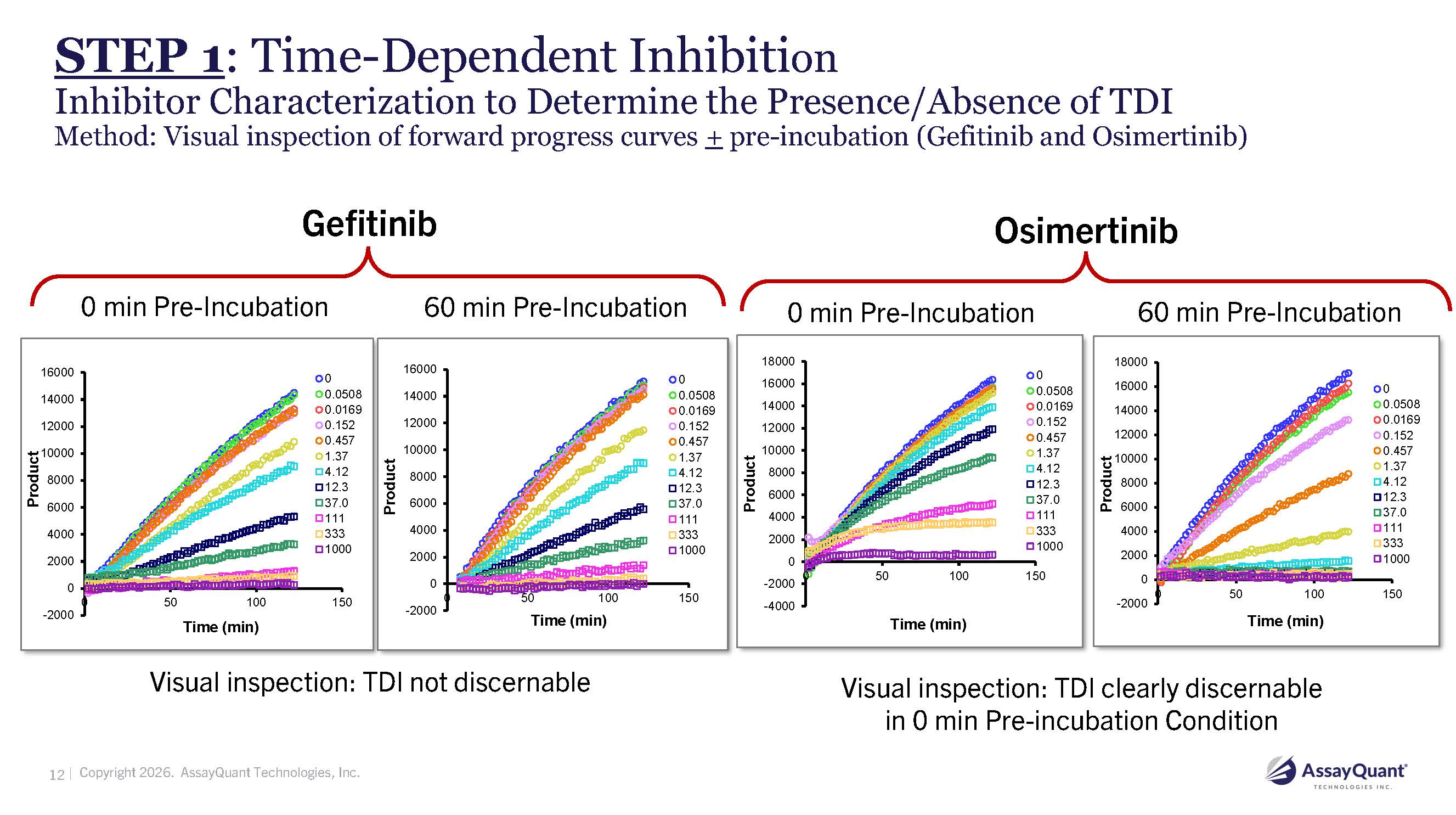
Why TDI breaks classical IC50 assumptions, and how to spot it directly in your own progress-curve data.

02

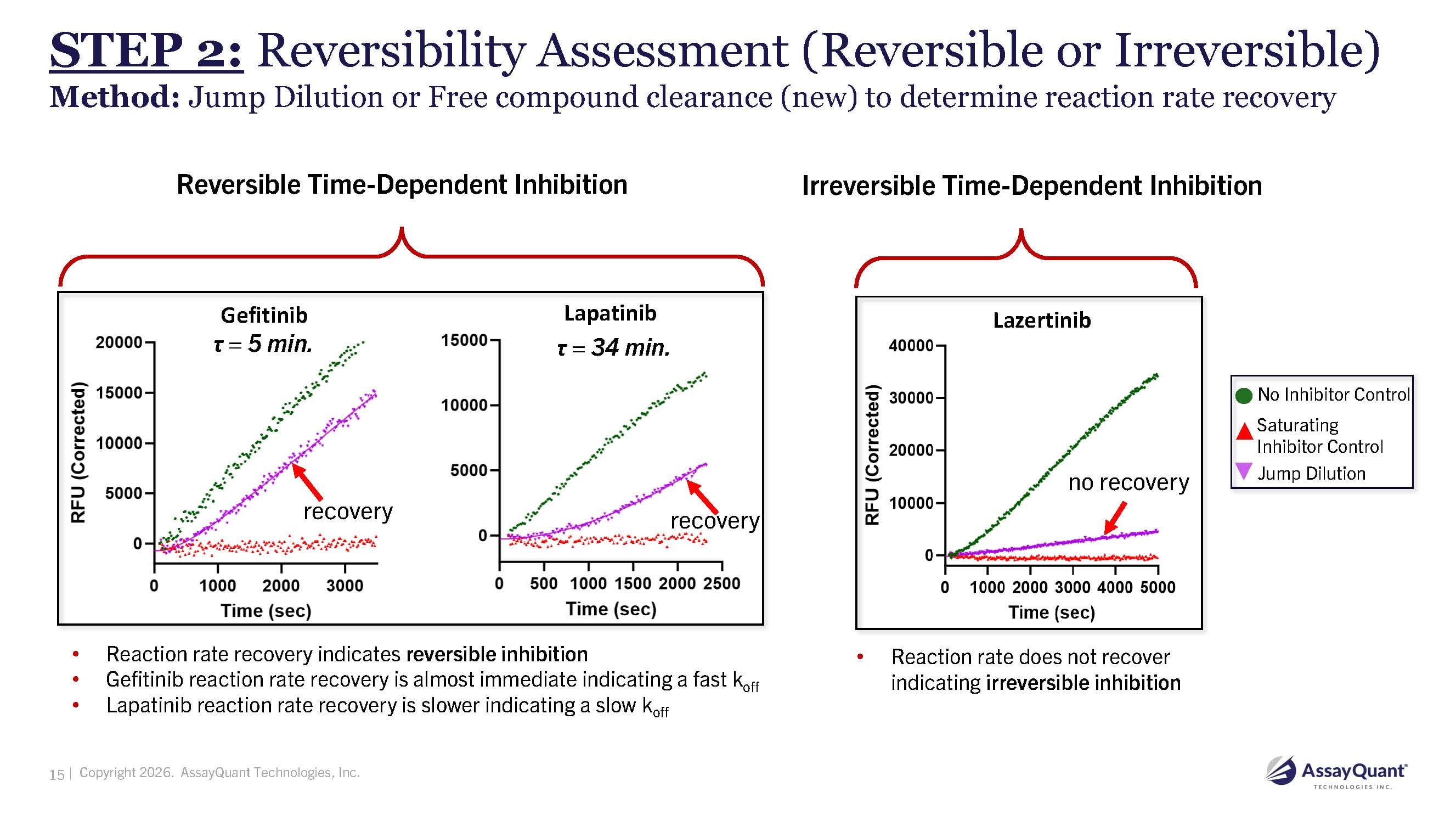
How free-compound-clearance and jump dilution distinguish reversible slow-binders from true covalent inhibitors, without rebinding artifacts.

03

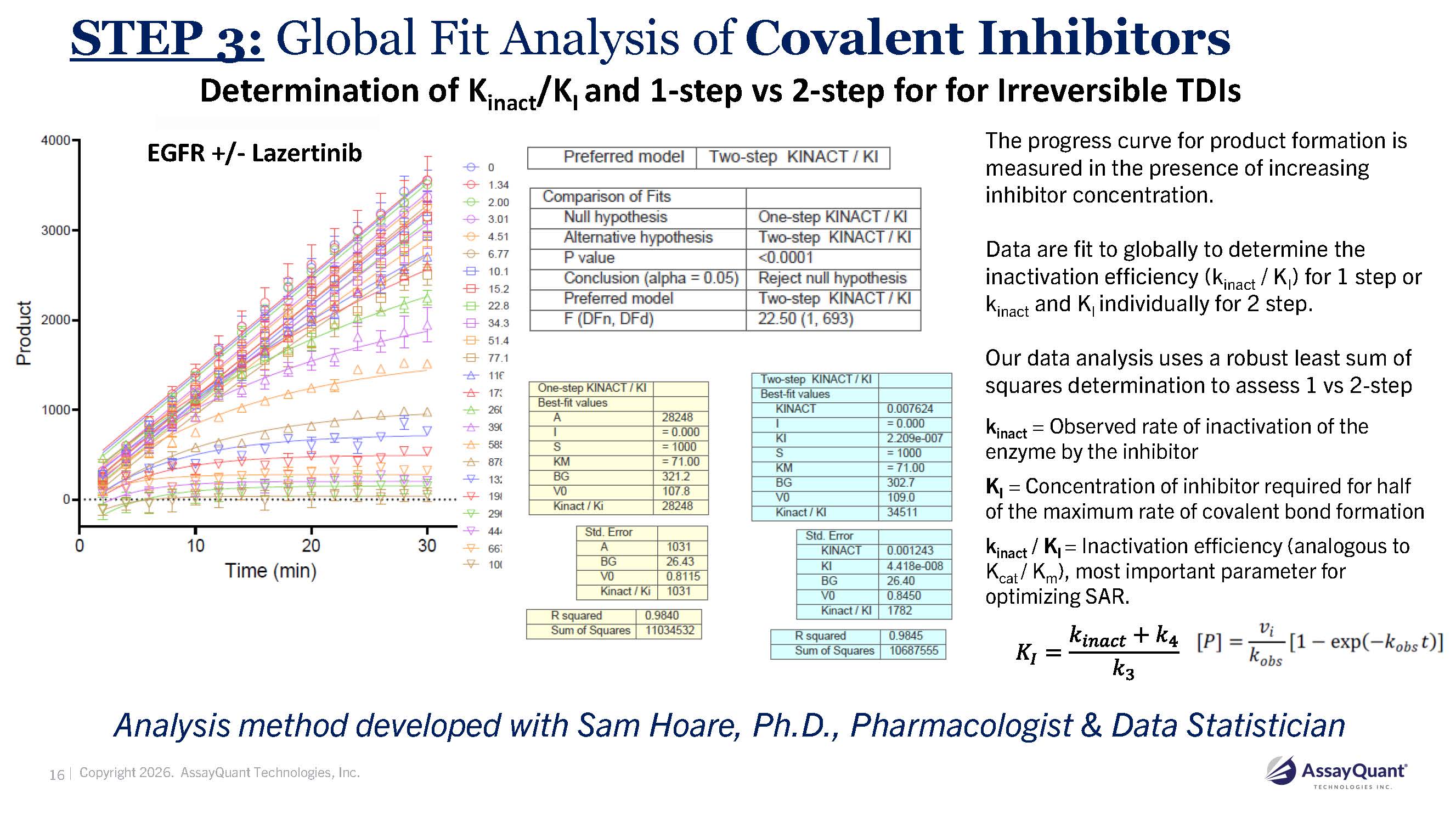
How to determine kinact/KI correctly via global fit analysis — including when a one-step versus two-step model applies.

04

Why compounds with near-identical IC50 values can carry very different inactivation efficiencies, and what that means for SAR ranking.

05

How kinact/KI correlates with cellular potency, shown against real Ba/F3 CellTiter-Glo data.

06

Kinome-wide selectivity profiling for covalent inhibitors, and how ATP concentration shifts apparent selectivity.

How AssayQuant enables this

The kinetic workflow in this session — progress-curve analysis, free-compound-clearance, global kinact/KI fitting — depends on continuous, real-time activity measurement. That's exactly what our PhosphoSens® activity assay kits are built for. 

Run continuous, real-time kinase activity assays in your own lab — the same assay format used throughout this webinar. 

THE KINSIGHT™ WORKFLOW

A proven three-step path to the right kinetic parameters

Demonstrated live on five well-known EGFR inhibitors — Gefitinib, Lapatinib, Osimertinib, Lazertinib, and Staurosporine — each with a distinct mechanism.

01

Inhibitor characterization

Determine whether TDI is present at all, using progress-curve linearity and IC50 shift with pre-incubation.


02

Reversibility characterization

Free-compound-clearance or jump dilution establishes whether inhibition is reversible or irreversible.


03

TDI characterization

Extract final kinetic parameters — off-rate and residence time, or kinact/KI via global progress-curve fitting.


Working on a covalent or slow-binding inhibitor program?

Get direct scientific support characterizing your compounds — plus access to our Excel-Fit templates for streamlined kinact/KI and residence-time analysis.

A PREVIEW FROM THE RECORDING

TDI detection.

Reversibility assessment.

Global kinact/KI fitting.

Erik_img
Erik Schaefer, PhD | Co-founder & CSO

Erik has spent his career developing kinetic assay technologies for kinase and phosphatase drug discovery, working directly with pharma and biotech partners to characterize covalent and time-dependent inhibitors across dozens of programs.

WATCH THE RECORDING

Get the full 45-minute session

Standard IC₅₀ assays can seriously mislead when a compound shows time-dependent inhibition — and that's common for covalent kinase inhibitors and slow-binding reversible ones alike. This session walks through a proven three-step kinetic workflow for getting it right, demonstrated on five real EGFR inhibitors spanning fast-reversible to fully covalent mechanisms, with a close look at how to correctly determine kinact/KI, distinguish reversible from irreversible binding without rebinding artifacts, and interpret kinome-wide selectivity data for covalent compounds.
KinSight™ CRO Services

AUG23-TDI-Market-Awareness

KinSight™ Time-Dependent Inhibition Services

READ MORE

KinSight™ Kinase Selectivity Profiling Services

READ MORE